

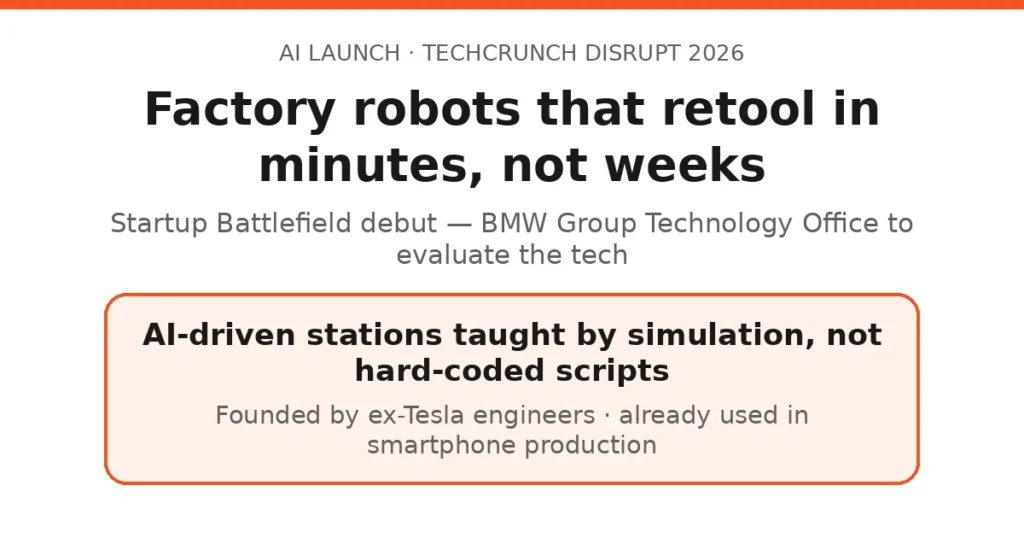
Direct answer: San Francisco startup Industrial Next has unveiled AI-driven robotic stations that it says can retool a factory production line in minutes rather than weeks — no traditional programming required. Presenting at TechCrunch Disrupt 2026's Startup Battlefield, the company also announced that the BMW Group Technology Office will evaluate its technology for manufacturing, and says its stations are already working in smartphone production.
What happened
Most factory automation is frozen in place: robots are programmed for one specific task and one specific product, and changing the line means reprogramming, physical retooling, or swapping equipment — a process that takes weeks or months. Industrial Next, founded in 2021 by ex-Tesla engineers Lukas Pankau and Allen Pan, says its AI-driven, self-contained robotic stations break that trade-off (TechCrunch).
The stations run on proprietary foundation models that connect vision, task context and motion. Instead of hard-coded scripts, new tasks are taught through simulation and demonstration: the robots train in high-fidelity virtual environments that closely mimic real-world physics, building what the founders describe as a general understanding of the process. Stations can then be reconfigured, combined and redeployed across product lines.
The founders' frustration is personal. Pankau was a lead electrical architect at Tesla before moving to Waymo; Pan led Tesla's autonomous factory efforts and later became a chief architect at autonomous driving company Neolix. Both kept hitting the same wall: cutting-edge design tools on one side, 1980s factory equipment on the other.
Two announcements gave the pitch weight. First, the company announced on stage a partnership with the BMW Group Technology Office to evaluate its AI-powered dexterous manipulation for manufacturing — a serious industrial name willing to put the tech through its paces. Second, Pankau described production deployments already running: robotic stations used in making one of the world's most popular smartphones (the customer is undisclosed), handling tasks manufacturers had tried and failed to automate for years — threading a delicate flex cable, snapping a tiny connector cap into place. He also described a "film peeling" station where AI-powered robots strip protective film off camera modules and buttons at or above human speed with claimed 100% accuracy, even on phone models and production lines the system has never seen.
The stated endgame is characteristically ambitious: building a full car end-to-end without any human touching it.
What it means for UK small businesses
This story is aimed at car factories, but the logic lands hardest on smaller manufacturers — including the thousands of UK firms in the 10-to-200-employee bracket.
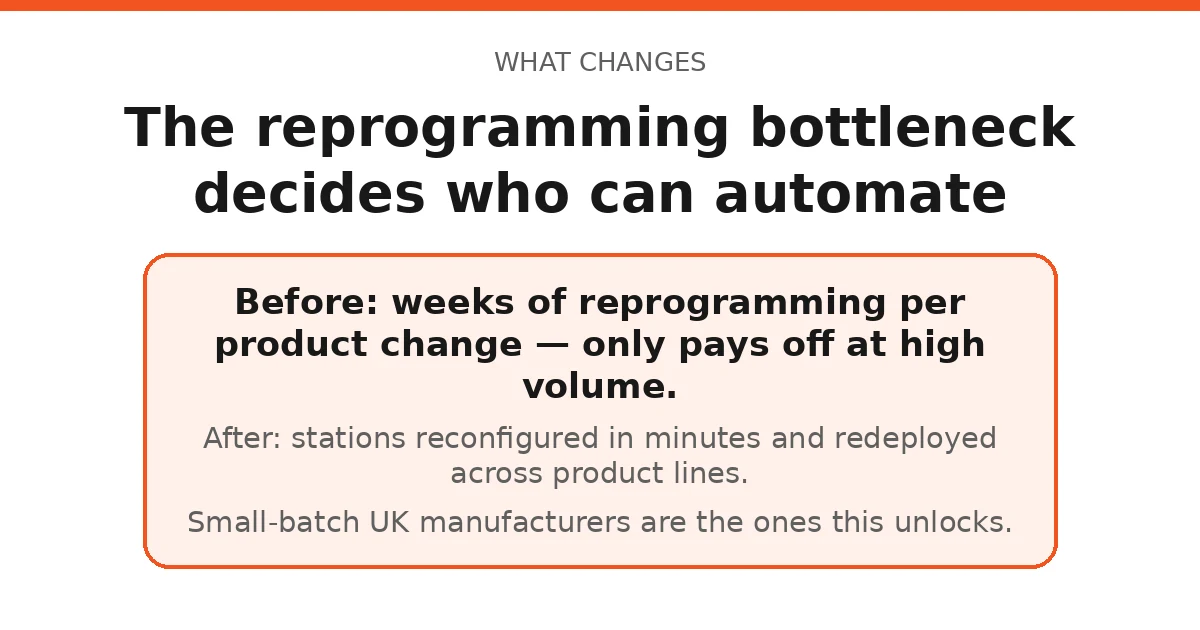
Traditional industrial robots have a brutal economic filter: they only pay off when you run the same product at high volume for a long time, because every changeover costs weeks of specialist reprogramming. That is precisely why small-batch, made-to-order and frequently-changing production — the bread and butter of UK manufacturing SMEs — has stayed manual. The maths never worked.
If retooling genuinely collapses from weeks to minutes, that filter disappears. A small manufacturer could automate a run of 500 units on Monday and switch to a different product on Tuesday, without calling in an integrator. For UK firms facing persistent skilled-labour shortages and reshoring pressure, that is a fundamentally new option sitting between "do it by hand" and "install a mass-production line".
Practical read for now: you cannot buy this yet, and the price is unknown. But the direction is unmistakable — AI is doing to robotics what it did to software: removing the specialist bottleneck. If you run any kind of production, start tracking flexible automation now, because the first systems that reach SME price points will reward the firms that already know which of their processes are automatable. And as ever, the latest AI adoption figures show the gap widening between firms that experiment early and those that wait — see also how fast AI is changing the tools small businesses use.
Honest limits / what to watch
- It is a pitch, not a benchmark. Startup Battlefield is a stage designed to impress investors. "100% accuracy", "at or above human speed", "minutes not weeks" — these are company-stated claims from controlled demonstrations, not independent test results.
- The BMW deal is an evaluation. A technology office evaluating dexterous manipulation is a long way from a purchase order or a production contract. It is a credibility signal, not revenue.
- Price and availability are unknown. The economics are the whole story for SMEs, and we have no numbers. Flexible robots with foundation-model brains will not be cheap at first.
- No-code robots still need integration. Teaching a task by demonstration sounds simple; fitting the station into your line, your safety systems, your quality control and your maintenance regime is not. The software may skip programming, but the factory around it still needs engineering.
- The jobs question is real. "A full car end-to-end without any human touching it" is the founders' stated ambition. For UK manufacturers, automation that handles the tasks nobody wants to do is welcome; automation framed as removing humans entirely deserves a harder conversation about what happens to the workforce.
The signal worth keeping: the hardest problem in manufacturing automation was never the robot arm — it was the reprogramming. If AI genuinely solves that, the economics of who can automate are about to change.
FAQs
What is Industrial Next?
Industrial Next is a San Francisco-based robotics startup founded in 2021 by Lukas Pankau and Allen Pan, both former Tesla engineers. It builds AI-driven, self-contained robotic stations powered by proprietary foundation models that connect vision, task context and motion — designed so a production line can be retooled in minutes rather than weeks, without traditional programming.
What did Industrial Next announce?
Presenting on the Startup Battlefield stage at TechCrunch Disrupt 2026, the company announced a partnership with the BMW Group Technology Office to evaluate its AI-powered dexterous manipulation technology for manufacturing. It also described production deployments, including robotic stations used in smartphone manufacturing for tasks like threading delicate flex cables and peeling protective film at or above human speed.
How do the robots learn new tasks?
Instead of hard-coded scripts, new tasks are taught through simulation and demonstration. The company says its robots train in high-fidelity simulated environments that closely mimic real-world physics, giving them an understanding of the process in general — so stations can be reconfigured, combined and redeployed across product lines.
What does this mean for UK manufacturers?
Flexible automation attacks the exact problem that keeps smaller manufacturers from automating: traditional robots need weeks of reprogramming for every product change, which only pays off at high volumes. If retooling genuinely drops to minutes, small-batch and made-to-order production become automatable — and UK firms struggling with labour shortages get a new option between "fully manual" and "mass-production robotics".
What are the honest caveats?
This is a Startup Battlefield pitch, so treat the claims accordingly: "100% accuracy" and at-or-above-human speed are company-stated figures from staged demonstrations, not independent benchmarks. Pricing and availability are undisclosed. The BMW arrangement is an evaluation, not a purchase order. And flexible robots still need integration expertise — the software may be no-code, but the factory around it is not.


