
If you can’t find the service you need, just write to us and we’ll figure something out [email protected]
If you can’t find the service you need, just write to us and we’ll figure something out [email protected]

Direct answer: Elorian, a Palo Alto AI startup that raised a $55 million seed round at a $300 million valuation before it had a product, has released its first model — Glimpse, a research-preview AI built around one idea: today’s AI can’t really see. Instead of glancing at an image once and reasoning about it in text, Glimpse keeps going back to the source mid-thought, cropping into regions, pulling frames from video, and running code to measure what it’s looking at. The company claims it already beats GPT-6 Astra on chart reasoning.
Elorian came out of stealth six months ago, backed by Striker Venture Partners, Menlo Ventures and Altimeter Capital, with participation from Nvidia and Google chief scientist Jeff Dean. On Friday it released Glimpse with API access; the chat interface is waitlist-only for now.
The thesis, from former Google DeepMind researcher and Elorian CEO Andrew Dai, is that frontier AI is still blind in the ways that matter. Most multimodal models look at an image once, convert it to tokens, and then reason about it in text — “like describing a photo from memory.” The evidence was personal: last year Dai photographed a finished board game and asked a frontier model who was winning. It couldn’t say. Board games each have their own visual language — “each have their own iconography, symbols,” he told TechCrunch. “To an adult, it’s quite easy to understand what’s going on with minimal text, but these models aren’t able to intuit what the symbols mean.” His benchmark for real vision: “Humans can look at Ikea diagrams, with no text, and assemble Ikea furniture, right? Why can’t AI models?”
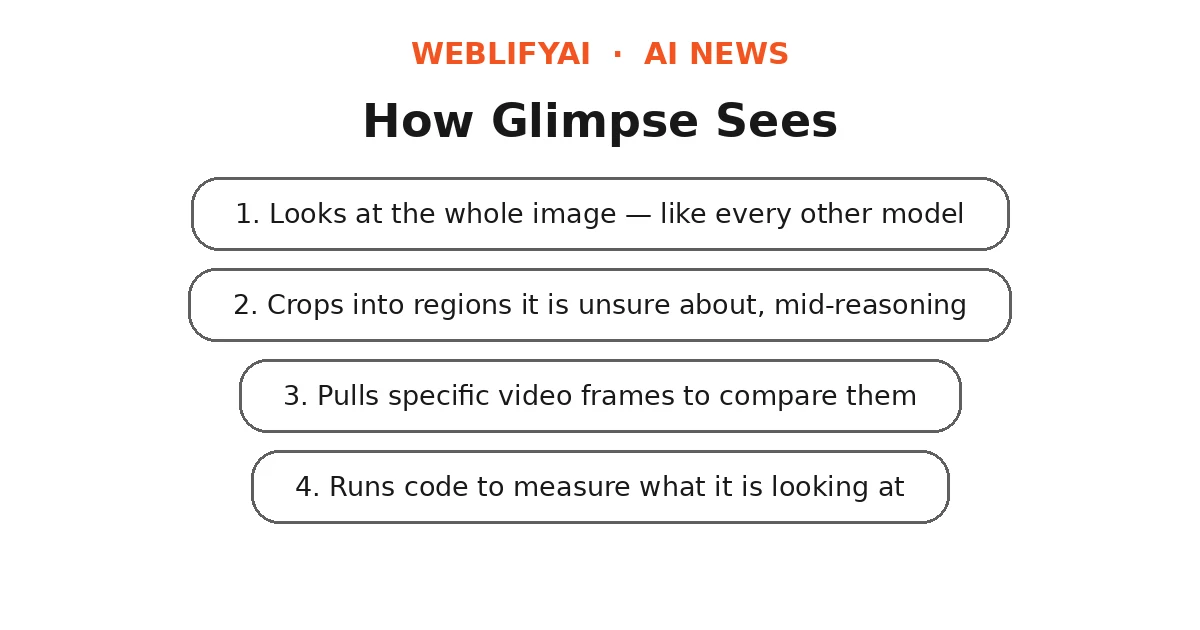
Glimpse’s answer is what Elorian calls a “visual scratch space”: mid-reasoning, the model can crop into a region, pull specific frames from a video, or run code to measure or compare what it’s looking at. The approach isn’t entirely new — OpenAI added crop-and-zoom during reasoning to its o-series models in 2025 — but Elorian says it built the whole model around the idea, and did it cheaply: a small team trained Glimpse on a few hundred GPUs, and the model is substantially smaller than the frontier systems it benchmarked against. It costs $0.60 per million tokens in and $3 per million tokens out — cheaper than mid-range models like Sonnet and Sol, more expensive than lightweight Haiku and Luna. On Elorian’s evaluations, Glimpse outperforms GPT-6 Astra on scientific chart reasoning and short-form video captioning, with competitive results elsewhere. (Source: TechCrunch)
This is not a tool you can sign up for today — it’s a research preview with a waitlisted chat. But it points at a real, near-term upgrade for the most error-prone thing small businesses ask AI to do: look at pictures.
Today’s AI vision is hit and miss in exactly the ways that cost businesses money. It misreads invoices and receipts from photos — the core of automating invoicing with AI. It hallucinates details in product photos. It misreads the axis on a supplier’s chart. A model that genuinely goes back and checks — zooming in on the figure it isn’t sure about — is the difference between “AI that looks” and “AI that sees.”
Elorian’s first targets are robotics firms, scientific labs, and media and creative companies. Longer term, Dai says the goal is moving “from seeing to doing”: building a model of a scene and using it to choose actions — including directly controlling robots. Next year, he says, Elorian wants “the world’s best visual reasoning model,” leading on every visual reasoning test.
If you’re a business sitting on image-heavy work — estate agents, insurers, trades quoting from photos, retailers managing listings — this is the class of AI to watch. When models can truly see, photo-based workflows stop needing a human double-check on every step. For creative work, it pairs naturally with the image generation tools covered in our Nano Banana guide: generation for creating images, Glimpse-style models for actually understanding them.
Three caveats before you get excited. First, Glimpse is a research preview — API access only, chat waitlisted, no pricing or performance history in real deployments. Second, the headline benchmark wins are Elorian’s own evaluations; independent testing hasn’t confirmed them, and startup benchmark claims have a long, dishonest tradition. Third, seeing is not understanding: a model that can crop into a chart still doesn’t know your business’s context, and a visual scratch space doesn’t fix the deeper problem of AI confidently misreading things it claims to have measured.
Watch whether the frontier labs follow. OpenAI already added crop-and-zoom to its reasoning models last year; if Elorian’s approach works as claimed, expect Anthropic, Google and Meta to build it in within months. The real story here isn’t one startup’s model — it’s that AI vision, the most visibly broken part of today’s AI, is finally getting serious engineering attention.
Glimpse is the first AI model from Palo Alto startup Elorian, released as a research preview on 16 October 2026. It’s built for visual reasoning: instead of glancing at an image once and reasoning about it in text, it keeps returning to the source — cropping, zooming, and running code to measure what it sees.
Most multimodal models convert an image to tokens once, then reason in text — like describing a photo from memory. Glimpse uses what Elorian calls a “visual scratch space” to revisit the image mid-reasoning, checking details the way a person pinches to zoom on a phone photo.
According to Elorian’s own evaluations, Glimpse outperforms GPT-6 Astra on scientific chart reasoning and short-form video captioning, with competitive results on other visual reasoning tasks. Independent benchmarks have not yet verified these claims.
API pricing is $0.60 per million input tokens and $3 per million output tokens — cheaper than mid-range models like Sonnet and Sol, but pricier than lightweight models like Haiku and Luna.
The initial targets are companies sitting on large volumes of video and images: robotics firms, scientific labs, media and creative companies. Longer term, Elorian wants to move from seeing to doing — including controlling robots.
Accurate AI vision could read invoices and receipts from photos, check product photos before listings go live, pull key figures from charts in supplier reports, or review CCTV and dashcam footage — tasks where today’s models still make embarrassing mistakes.
Ready to put AI to work in your business — safely? Get a Free AI Consultation.