

Five things changed this week that touch how customers find a small business online. Google’s September spam update is still finishing its rollout, Search Console now splits image-led searches out of your traffic data, Google Maps has put its reviews behind a sign-in wall, Google’s AI Mode can now keep watch on the web for your customers, and Meta has launched an AI agent built for small business owners. None of these needs a panicked response. Each one needs a small, specific action. This post covers all five in plain English, with what to do about each one before next week.
1. Google’s September spam update is still rolling out
What happened
Google released its September 2026 spam update on 24 September. It is the fourth spam update of the year, and the first one Google has given a two-week rollout window, which means it can still be moving through search results as late as 6 to 8 October. Google has not said what the update targets. Those details come from b2the7.com’s weekly trends roundup, drawing on reporting from Search Engine Journal and Search Engine Roundtable.
Two-week rollouts are unusual. Spam updates have historically landed in a day or two. A longer window means ranking volatility can come in waves, with quiet days in between, which makes it harder to tell whether a dip in your traffic is the update or something you did.
What it means for your business
Spam updates aim at sites that try to game rankings: thin auto-generated pages, scraped content, link schemes and similar tricks. If your website is built on genuine service pages and original writing, these updates are usually background noise. The awkward part this time is the timing. A site going through a Google review, or a brand-new post finding its feet in the index, can wobble for reasons that have nothing to do with quality. We are living through exactly that combination at WeblifyAI, with our own AdSense review running while the update rolls out.
Your move this week
Do nothing dramatic. If you check Search Console and see impressions dipping or jumping this week, write the date next to it and wait until the rollout is confirmed finished before drawing conclusions. Definitely do not delete pages, rewrite content or restructure your site in response to a mid-rollout wobble. That is the single most common way small businesses turn a temporary blip into a real, lasting problem.
2. Search Console now separates image-led searches
What happened
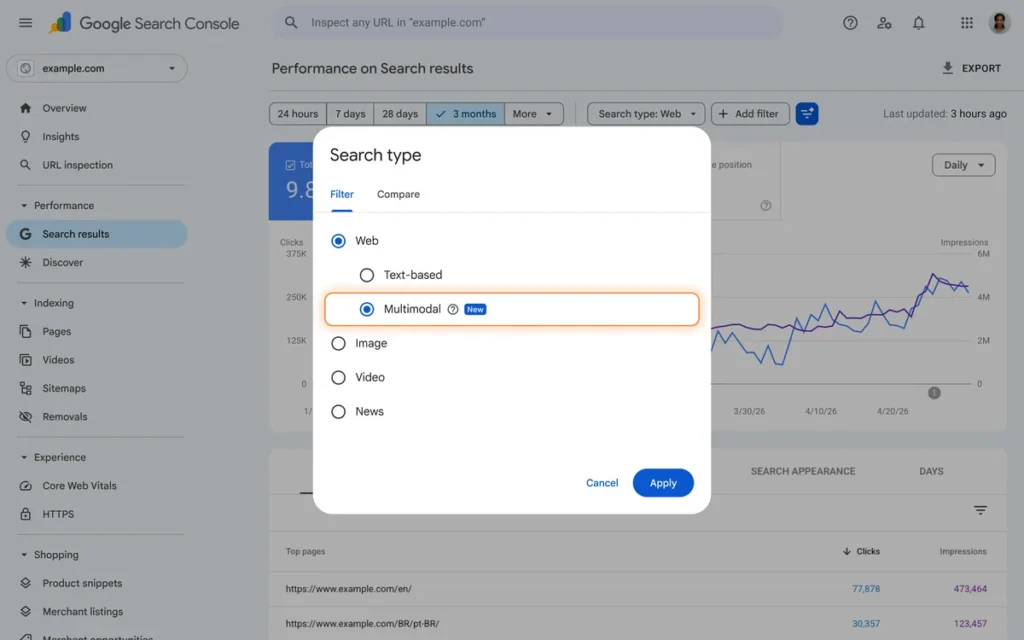
From 24 September, the Performance report in Search Console has a new “multimodal” filter. It splits your traffic into text searches and image-led searches, meaning searches that start from Google Lens, Circle to Search, a photo upload or the “Search this image” option in Chrome. The catch, reported by b2the7.com via Search Engine Roundtable: for multimodal traffic you only get pages, countries, devices, clicks and impressions. There is no query data. You can see that people found you through an image, but not what they typed, said or photographed to get there.
What it means for your business
More customers now start a search with a photo than with words. Somebody photographs a leaking boiler, a shopfront, a menu or a hairstyle, and Google matches the image to businesses. If your site carries no real photos, you are invisible to that entire channel. Stock photography does not help here, because Google is matching distinctive visual detail, not generic concepts. A plumber whose site shows actual photos of actual boiler installs can be matched to a photo of a similar boiler. A plumber whose site shows a smiling stock model holding a wrench cannot.
Your move this week
Open Search Console, switch the Performance report to the multimodal filter, and look at which of your pages already get image-led traffic. Then look at those pages with honest eyes. Do they carry genuine photos of your work, your premises and your products? If the answer is no, put real photography on your list before the end of the year. One honest photo of a finished job beats a gallery of stock images, and from now on you can measure the difference.
3. Google Maps now wants a sign-in to read reviews
What happened
Google has started requiring a Google sign-in to see every review on a Business Profile, to sort reviews, or to leave one. Without a signed-in account, visitors get a limited view. Google has not explained the change. The reporting, via b2the7.com citing Search Engine Roundtable, suggests it is most likely an anti-scraper move, aimed at the tools that harvest review data in bulk.
What it means for your business
Your reviews are still there, and signed-in customers can still read and leave them as before. But the casual browser, the person who glances at your star rating without logging in, will now see less of what your customers say about you. There is a quiet upside: your reviews become harder for competitors’ scraping tools to lift in bulk. The practical effect is probably smaller than it sounds, because most people browsing on their phones are already signed into a Google account. Still, it is one more reminder that your reputation should not live in only one place.
Your move this week
Do not rely on Google as the only home for your reviews. Put a handful of your best reviews on your own website, with the customer’s first name and the service they bought. That way a visitor sees social proof without signing in anywhere. And keep asking happy customers to leave Google reviews. The sign-in wall makes each new review slightly more valuable, not less, because fewer casual browsers will scroll far enough to find them.
4. AI Mode can now watch the web for your customers
What happened
On 28 September, Google VP Robby Stein announced AI Mode monitoring, now rolling out worldwide after starting as a feature for Pro and Ultra subscribers. The idea is straightforward: you tell AI Mode what you care about, and it watches websites, forums, social media and the Shopping Graph, then sends you an alert in the Google app when something relevant appears. Google’s own examples, reported by b2the7.com via Search Engine Roundtable, include new restaurants opening nearby, children’s events, product restocks and price drops.
What it means for your business
Your customers are about to get a research assistant that never sleeps. Someone can ask to be told the moment a cheaper quote appears, a competitor launches an offer or a new supplier opens in town. Businesses that publish fresh, dated updates, covering new services, seasonal offers, price changes and opening hours, give that assistant something current to find. Businesses whose websites have not changed since 2023 give it nothing at all, and the alert goes to whichever competitor did publish.
This is the same shift we keep writing about: being recommended by AI systems starts with being findable and current. Our guide to AI agents for small business covers how these assistants choose which businesses to surface.
Your move this week
Add one dated update to your site. A short news post, a seasonal offer, new photos with captions, anything with this month on it. Then make it a monthly habit. AI Mode rewards the businesses that look alive, and the cost is an hour a month.
5. Meta launched Muse for Small Business
What happened
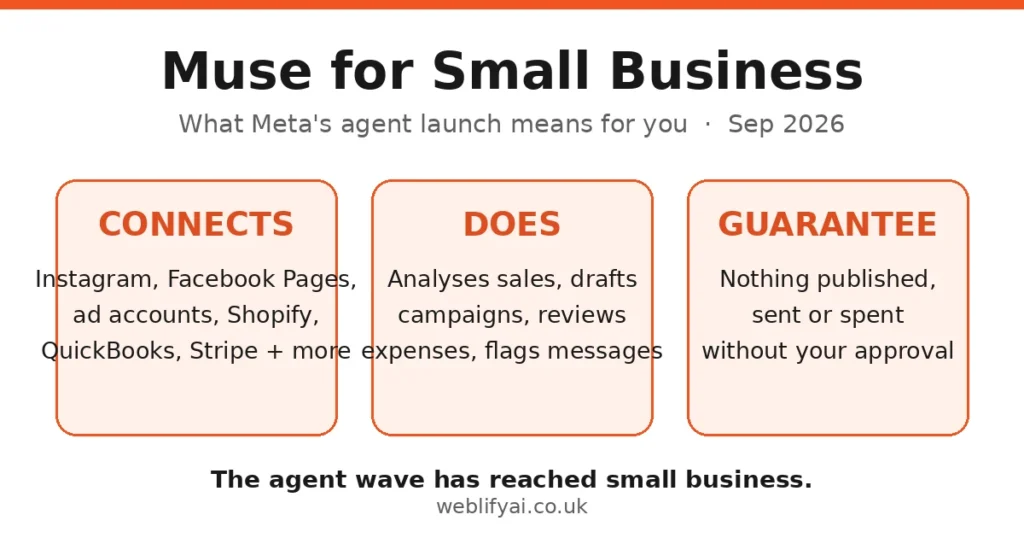
On 29 September, Meta launched Muse for Small Business, an AI agent aimed at owners rather than enterprises. It is available in the US and Canada for now, with no UK date announced. It connects to Facebook Pages, Instagram professional accounts, Meta ad accounts, Shopify, QuickBooks, Stripe, Klaviyo, Canva, Slack and Notion, and handles routine work across them. Meta’s line, reported by b2the7.com from the Meta Newsroom announcement, is that nothing gets published, sent or spent without the owner’s approval, and that the agent is free for most uses.
What it means for your business
Even though you cannot use it from the UK yet, the direction of travel is obvious. The admin work that eats a small business owner’s evenings, the posting, the replying, the reconciling, the scheduling, is being packaged into agents you supervise rather than software you operate. The owners who learn to check an agent’s work instead of doing the work themselves will buy back hours every week. If you want a sense of what Meta’s assistant can already do, our Muse AI guide walks through its current abilities, and our comparison of Meta AI versus Muse AI explains where it sits next to Meta’s consumer assistant.
Your move this week
You cannot sign up from the UK today, but you can prepare. Write down the five most repetitive admin tasks in your business, the ones you would hand to a reliable assistant tomorrow. When tools like this reach the UK, that list becomes your setup checklist, and you will be months ahead of owners starting from a blank page.
This week’s changes at a glance
| Change | Status this week | Reported by | Your action |
|---|---|---|---|
| Google September spam update | Rolling out until around 8 Oct | b2the7.com via Search Engine Journal and Search Engine Roundtable | Do not react to ranking wobbles; wait for the rollout to finish |
| Search Console multimodal filter | Live from 24 Sep | b2the7.com via Search Engine Roundtable | Check which pages get image-led traffic; add genuine photos |
| Google Maps review sign-in | Rolling out now | b2the7.com via Search Engine Roundtable | Display your best reviews on your own website too |
| AI Mode monitoring | Worldwide rollout | b2the7.com via Search Engine Roundtable (announced by Robby Stein) | Publish one dated update; repeat monthly |
| Meta Muse for Small Business | Launched 29 Sep, US and Canada | b2the7.com via Meta Newsroom | List your five most repetitive admin tasks |
The through line
Step back and the five stories point in the same direction. Google and Meta are both rewarding businesses that look real, current and verifiable: accurate facts on your pages, fresh dated updates, genuine photographs, and reviews that live somewhere you control. None of that needs a bigger budget. It needs an hour a month and the habit of keeping your online presence honest. If this week has shown anything, it is that the businesses treating their website as a living thing will keep getting found, while the ones treating it as a brochure will quietly fade from view.
If you would like a second pair of eyes on how your business looks to Google right now, book a free consultation. We will check your search presence, your reviews and your content, and tell you the three fixes that would matter most for your business.
Frequently asked questions
Is Google’s September 2026 spam update finished?
As of the first week of October it was still rolling out. Google released it on 24 September with a two-week window, the first time a spam update has been given that long, so it could still be moving through results until around 8 October. Google has not said what the update targets. If your rankings wobble this week, note the date and wait until the rollout is confirmed over before changing anything on your site.
What does the Search Console multimodal filter show?
It separates text searches from image-led searches in your Performance report. Image-led means traffic that started from Google Lens, Circle to Search, a photo upload or Chrome’s “Search this image”. For that traffic you can see pages, countries, devices, clicks and impressions, but Google does not show the queries behind it.
Why do I need to sign in to read Google Maps reviews now?
Google now requires a Google sign-in to see the full review list on a Business Profile, to sort reviews or to leave one. Google has not explained the change; reporting suggests it is aimed at stopping bulk scraping of review data. Most people on phones are already signed in, so the practical effect is small, but it is one more reason to show your best reviews on your own website where everyone can see them.
What is AI Mode monitoring and who gets it?
AI Mode monitoring was announced on 28 September by Google VP Robby Stein. You tell Google’s AI Mode what you want to watch, and it monitors websites, forums, social media and the Shopping Graph, then sends alerts to your Google app. It began as a Pro and Ultra subscriber feature and is now rolling out worldwide.
Is Meta Muse for Small Business available in the UK?
Not yet. It launched on 29 September for the US and Canada, with no UK date announced. It connects Facebook Pages, Instagram professional accounts, Meta ad accounts, Shopify, QuickBooks, Stripe, Klaviyo, Canva, Slack and Notion. Meta says nothing is published, sent or spent without the owner’s approval, and that it is free for most uses.
What is the one thing a small business should do this week?
Publish one fresh, dated update on your website, and make sure your best customer reviews appear somewhere you control. Accurate facts, current content, real photos and owned reviews are the through line of all five of this week’s changes, and they cost an hour, not a budget.
Still not sure where your business stands? Talk to us and we will audit your Google presence, free, and hand you a short list of fixes in plain English. No jargon, no obligation.


