

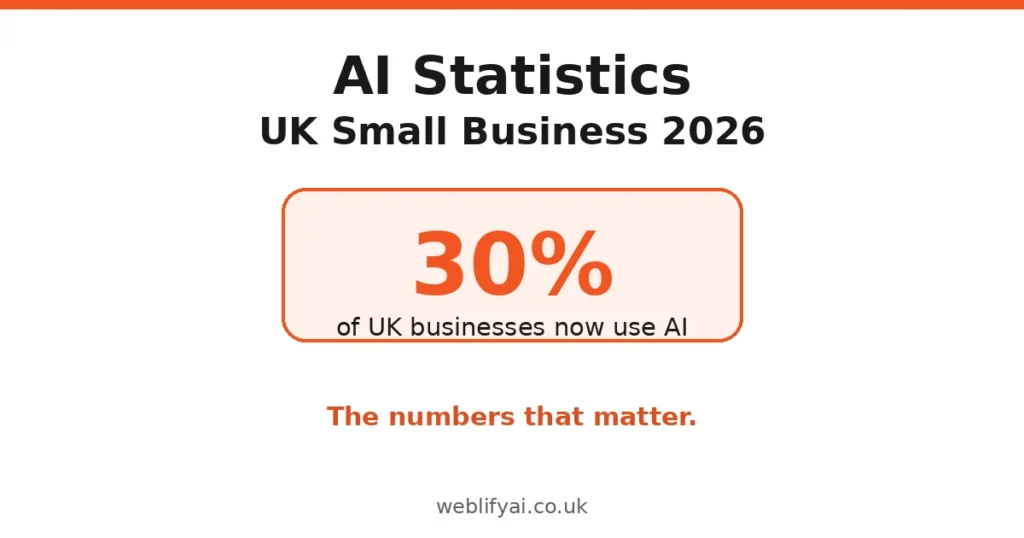
Direct answer: Around 30% of UK businesses now use at least one AI technology (ONS, September 2026), up from 9% three years ago — though business surveys put it as high as 54%. Large firms adopt more often, but small firms that do adopt use AI more intensively. The critical finding: only 6% of SMEs use AI deeply enough to transform operations, and it’s that depth — not mere adoption — that drives revenue gains. Below: the numbers, what they mean, and where your business fits.
Most AI statistics articles are US numbers in a trench coat. These are UK figures, from official and reputable sources, with the survey differences explained honestly — because the numbers disagree with each other, and you deserve to know why.
Headline Adoption: How Many UK Businesses Use AI?
| Source | Figure | When | Who was asked |
|---|---|---|---|
| ONS (official) | 30% use ≥1 AI technology | Sept 2026 | All UK businesses |
| ONS | 29% | Sept 2026 | Firms with <10 staff |
| ONS | 51% | Sept 2026 | Firms with 250+ staff |
| British Chambers of Commerce | 54% actively using | Mar 2026 | BCC members (~94% SMEs) |
| NatWest | 44% use AI | Sept 2026 | 1,400 UK SMEs & mid-market |
| Novuna | 30% currently use | 2026 | UK small businesses |
| FSB | 37% vs 1% | 2026 | Professional services vs construction |
Why the range? Different questions, different samples. The ONS asks a strict “currently use at least one AI technology” of a representative business sample — that’s the conservative, official number. Trade surveys of engaged members run higher. Treat 30% as the floor and 54% as the engaged-business ceiling. Either way, the direction is unambiguous.
The Growth Curve: From 9% to 30% in Three Years
The ONS series is the cleanest trend line we have:
- September 2023: 9%
- December 2025: 25%
- September 2026: 30%
The BCC member series tells the same story at higher altitude: 23% (2023) → 25% (2024) → 35% (2025) → 54% (March 2026). And intent is still rising — the ONS found 15% of businesses planning to adopt within three months in late 2025, its highest reading ever, while the share of SMEs with no AI plans at all fell from 43% to 33% in a year.
Translation: we’re past the “should we?” phase. The question now is “how well?”
The Size Paradox: Big Firms Adopt, Small Firms Commit
Every dataset agrees large firms adopt more: 51% of 250+ staff businesses versus 29% of micro firms (ONS). NatWest found firms over 100 staff nearly twice as likely to use AI as smaller ones (67% vs 36%).
But the Department for Science, Innovation and Technology found the twist nobody reports: inside adopting firms, 38% of staff use AI in micro businesses, versus 26% in small, 18% in medium and 20% in large firms. In a five-person business, AI isn’t a department pilot — it’s everyone’s assistant. Small firms adopt less often, but commit harder when they do.
What Businesses Actually Use AI For
ONS data for businesses with 10+ staff (September 2026):
- Text generation with large language models: 21% (up 16 points since 2023)
- Visual content creation: 19% (up 15 points since 2023)
Among small businesses that have adopted AI, the most-used categories run: writing and content generation (~71%), customer service and chatbots (38%), scheduling and admin automation (29%), and image generation (27%). The pattern is clear — businesses start with words and pictures, the lowest-risk, highest-volume tasks. Our AI agents for small business guide covers what comes next, when AI starts handling customer conversations.
The Depth Gap: Where the Money Actually Is
This is the most important statistic in the article. NatWest’s study of 1,400 UK SMEs sorted firms by adoption maturity:
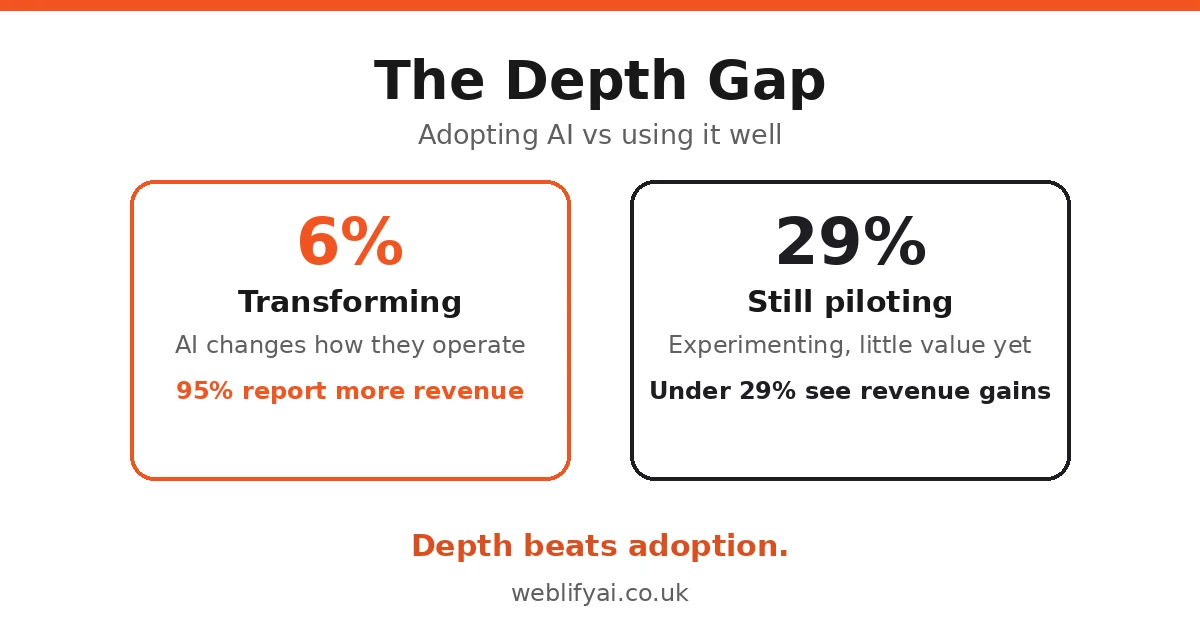
- Only 6% have reached the “transforming” stage, where AI fundamentally changes operations
- 29% of AI users are still just piloting — experimenting without capturing real value
- Early-stage firms report saving 1–10% of working time; transforming firms report 61–70%
- 95% of transforming firms report increased revenue, versus under 29% at the exploring stage
And the ONS backs up the shallowness: even among adopters, the average number of AI tools in use has crept only from 1.4 to 1.6, and just 10% describe their use as extensive.
The takeaway isn’t “adopt AI” — it’s “adopt it properly.” One tool, used by everyone, beats five tools nobody opened after the trial.
The Money: SME AI Spending Is Accelerating
Capital on Tap analysed UK SME credit card data from 2023 to 2026:
- Share of SMEs spending with AI providers: 1.1% → 12.8% (more than one in eight by mid-2026)
- AI’s share of total SME card spend: up nearly thirtyfold
- Growth accelerated sharply in the last year — not a steady trickle, a curve bending upward
AI is still a small slice of total business spending. But budget allocation is shifting fast, which means the competitive gap between adopters and holdouts is widening.
What’s Holding the Rest Back
- Cost and expertise top the ONS barrier list — unsurprising, and why free tiers matter so much for small firms.
- Energy concerns: 22% of non-adopting SMEs cite the energy/resource demands of AI (Novuna) — a very 2026 objection, and a real one for energy-conscious businesses.
- Sector inertia: the FSB found 37% adoption in professional and technical firms versus 1% in construction. Nine in ten hospitality, retail, transport and construction businesses neither use AI nor plan to (DSIT). If you’re in one of those sectors, you’re early — which is an advantage if you move now.
What This Means for Your Business
- You’re not late — but the window is narrowing. A third to a half of UK businesses use AI; the laggard half is shrinking every quarter.
- Go deep, not wide. The revenue gains sit with the 6% who integrated AI into operations, not the 29% still piloting. Pick one workflow and commit.
- Your size is an advantage. Small firms use AI more intensively per person than large ones. No procurement committee, no six-month pilot — just start.
- Start with words and pictures. Content generation is where 7 in 10 adopters began. It’s low-risk and the payoff is immediate.
FAQs
What percentage of UK small businesses use AI?
It depends on the survey: the ONS found 30% of UK businesses used at least one AI technology in September 2026 (29% for firms under 10 staff), while the British Chambers of Commerce found 54% among its members in March 2026. The honest answer is somewhere between a third and a half — and rising fast.
How fast is AI adoption growing among UK businesses?
Very fast. The ONS measure rose from 9% in September 2023 to 30% in September 2026. The BCC series went from 23% in 2023 to 54% in early 2026. The share of SMEs with no AI plans at all fell from 43% to 33% in a single year.
What do small businesses use AI for most?
Text generation with large language models (21% of businesses with 10+ staff) and visual content creation (19%), per the ONS. Among AI adopters, writing assistance leads at around 71%, followed by customer service chatbots (38%) and scheduling/admin automation (29%).
Do small or large businesses adopt AI more?
Large businesses adopt more often — 51% of firms with 250+ staff versus 29% of micro firms, per the ONS. But here’s the twist the DSIT found: inside firms that do adopt, 38% of staff use AI in micro businesses versus 20% in large ones. Small firms adopt less; they use it harder.
Does using AI actually increase revenue?
Depth matters more than adoption. NatWest’s 2026 study of 1,400 UK SMEs found 95% of firms at the ‘transforming’ stage reported increased revenue, versus under 29% at the early exploring stage. Shallow, experimental use barely moves the needle.
How much are UK SMEs spending on AI?
Capital on Tap’s analysis of SME card spending found the share of businesses buying from AI providers rose from 1.1% in early 2023 to 12.8% by mid-2026, with AI’s share of total card spend up nearly thirtyfold. Still small in absolute terms, but accelerating.
What’s stopping small businesses from adopting AI?
Cost and lack of in-house expertise top the ONS list. A Novuna survey found 22% of non-adopters cite energy and resource concerns. Sector matters enormously: 37% adoption in professional services versus 1% in construction, per the FSB.


