Direct answer: A shift pattern generator designs the repeating cycle your team works — 4-on-4-off, Panama, DuPont — from your cover rules. Feed a general AI tool (or a scheduling platform’s auto-scheduler) your opening hours, posts per shift and crew size, and it drafts the rotation in minutes. But the pattern is only the skeleton: UK law caps average hours and mandates rest periods, and holidays and sickness will always break the neat cycle. Here’s how to do it properly.
Shift pattern vs rota: the difference that matters
Small businesses mix these two up constantly, and it causes real confusion:
- Shift pattern = the repeating cycle. “We run 4-on-4-off: two early shifts, two late shifts, four days off, repeat.” You design it once.
- Rota = this week’s names on shifts. “Priya is on early Saturday, cover needed for Tom’s late.” You build it every week.
The pattern is architecture; the rota is furniture. An AI generator handles the architecture. For the weekly furniture, see AI staff scheduling — that’s the rota layer.
The classic patterns, decoded
| Pattern | Cycle | Avg weekly hours | Best for |
|---|---|---|---|
| 4-on-4-off | 8 days: 4 on, 4 off | 42h on 12h shifts; 28h on 8h shifts | Round-the-clock cover with built-in rest blocks |
| Panama (2-2-3) | 14 days: 2 on, 2 off, 3 on, 2 off, 2 on, 3 off | 42h on 12h shifts | 24/7 security, care, warehousing |
| DuPont | 28 days incl. a 7-day break | 42h on 12h shifts | Industrial 24/7 — watch the long stretches |
| 5-on-2-off rotating | 7 days, weekends rotate fairly | 40h on 8h shifts | Cafes, retail, hospitality with fixed hours |
The maths behind the famous 42: on 12-hour shifts, Panama gives 7 work days per 14-day cycle — 84 hours per fortnight, which averages 42 a week. That sits under the UK’s 48-hour average limit, but it leaves little slack for overtime. Always run the numbers for your own version.
How an AI generator builds one
You don’t need specialist software for the first draft. Open any capable AI chat tool and give it the five things it needs:
- Cover: “We need 2 people 7am–3pm and 2 people 3pm–11pm, 7 days a week.”
- Crew: “We have 8 staff, all full-time, all trained on both shifts.”
- Hours rule: “Average under 48 hours a week over 17 weeks.”
- Rest rule: “At least 11 hours between shifts.”
- Fairness rule: “Weekends shared equally; rotate early and late.”
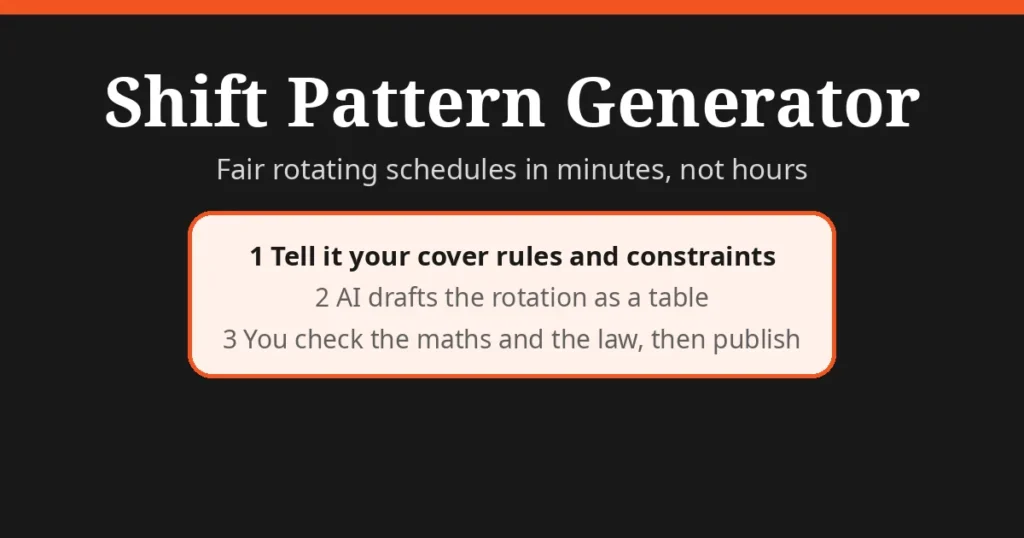
The AI will propose a rotation — usually 4-on-4-off for this shape of problem — as a table you can print. Scheduling platforms with auto-scheduling (Deputy, Rotageek) do the same from your demand data instead of a prompt. Either way, the output is a draft, not a decision.
Worked example: a cafe’s 4-on-4-off
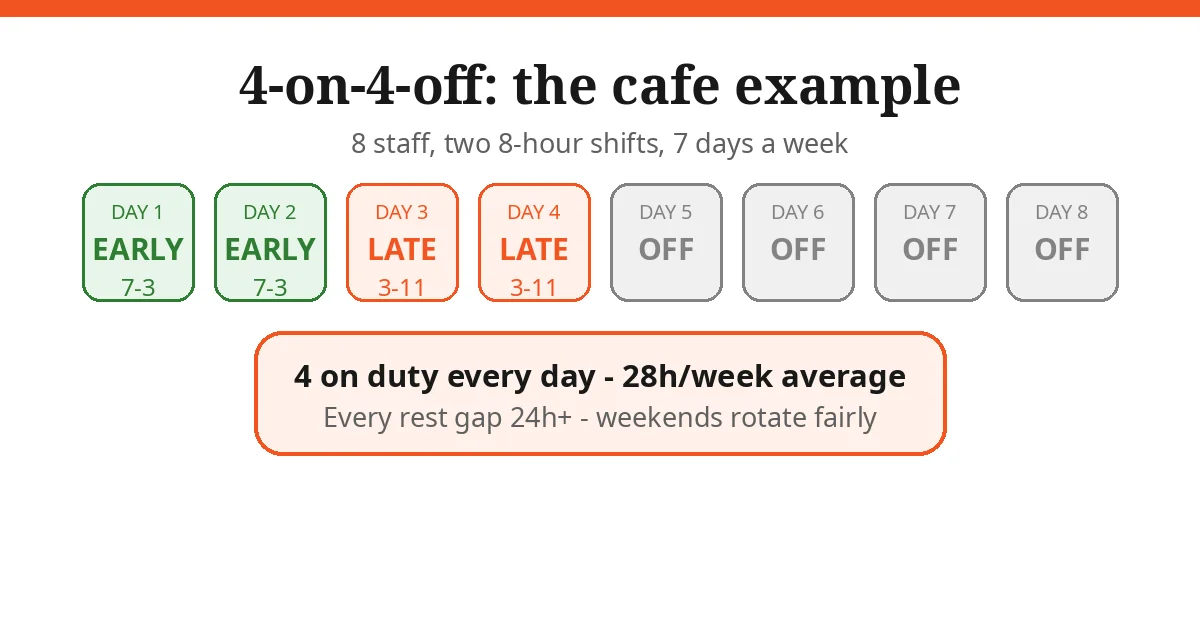
Take the cafe above: 8 staff, two 8-hour shifts, seven days a week. The generator’s answer:
- Each person works 4 consecutive days — 2 early shifts (7–3), then 2 late shifts (3–11) — then 4 days off.
- With 8 staff on this cycle, exactly 4 are on duty every day: 2 early, 2 late. Cover solved.
- Average hours: 4 × 8 = 32 hours per 8-day cycle = 28 hours a week. Well inside the legal limit.
- Rest check: early shift ends 3pm, next day’s late starts 3pm — 24 hours apart. Every transition clears the 11-hour minimum comfortably.
- Fairness: weekends fall on work days and rest days in turn, so nobody is stuck on Saturdays forever.
One page, ten minutes, and the endless “who’s on Saturday?” argument disappears.
The UK legal lines you can’t cross
Whatever the AI suggests, the Working Time Regulations set hard boundaries:
- 48-hour average week, averaged over 17 weeks. Workers can voluntarily opt out in writing, but you can’t pressure them, and they can withdraw.
- 11 consecutive hours of rest between working days.
- 24 uninterrupted hours off per week (or 48 per fortnight).
- Night workers: 8 hours average per 24-hour period — and unlike the 48-hour rule, night workers cannot opt out of this one.
- 20-minute break on any shift over 6 hours; 28 days of paid annual leave.
Check any AI-generated pattern against each of these before it goes near your team. The AI doesn’t know who signed an opt-out and who didn’t.
What the HSE says about healthy rotations
The Health and Safety Executive publishes good-practice guidelines for shift design, and they’re worth more than most scheduling software marketing. The headline points (source):
- Rotate forward — morning → afternoon → night — rather than backwards. It fits how the body clock actually drifts.
- Limit consecutive night shifts to 2–3, and give two nights of full sleep when switching between days and nights.
- Cap shifts at 12 hours including overtime; 8 hours for night shifts or demanding, monotonous or safety-critical work.
- Build regular free weekends into the schedule.
Note the honest tension: staff often love 12-hour 4-on-4-off patterns for the blocks of days off, while the health guidance is cautious about long shifts. That’s a trade-off to discuss with your team, not a detail to bury.
Honest limits
- Patterns assume a full crew. Holidays, sick days and resignations shatter the cycle on contact. The pattern is the ideal; the rota is the reality.
- AI doesn’t know your contracts. Opt-outs, young-worker rules (under-18s: max 8h/day, 40h/week), and collective agreements are invisible to it.
- Fair on paper isn’t fair in practice. A rotation that looks equal can still clash with school runs, second jobs and bus timetables. Ask the team before you lock it in.
- Patterns don’t fix understaffing. If the maths says you need five crews and you have four, no generator can close the gap — it will just distribute the pain evenly.
- Free templates and chatbots can’t enforce anything. They produce a document. Enforcement — rest breaks, hour tracking, payroll — needs systems, which is where AI payroll tools earn their place.
FAQs
What is a shift pattern generator?
A tool — or an AI prompt — that designs the repeating cycle your team works: who works which days, in what rotation, repeating every 1 to 4 weeks. You give it your cover rules (how many people per shift, shift times, days you trade) and it produces the rotation. It does not decide who works this Saturday; that is the weekly rota.
What are the most common shift patterns?
4-on-4-off (four shifts on, four off — a favourite for round-the-clock cover), Panama or 2-2-3 (averaging 42 hours a week on 12-hour shifts, popular in security and care), DuPont (a 28-day cycle also averaging 42 hours, used in industry), and plain 5-on-2-off for businesses with fixed opening hours. The right one depends on how many hours of cover you need and how your staff feel about nights.
How do I generate a shift pattern with AI?
Give a general AI tool your cover rules in plain words: opening hours, posts per shift, shift times, crew size, and constraints like “nobody works more than 48 hours a week averaged over 17 weeks” and “11 hours rest between shifts”. It will draft the rotation as a table. Scheduling platforms like Deputy or Rotageek can also auto-generate patterns from your demand data. Always check the maths and the law yourself before publishing.
Are AI-generated shift patterns legal in the UK?
Only if they respect the Working Time Regulations: a 48-hour average working week over 17 weeks (unless staff voluntarily opt out in writing), 11 consecutive hours of rest between working days, at least 24 uninterrupted hours off per week, and an 8-hour average per 24 hours for night workers. The pattern is your responsibility — the AI does not know your contracts.
How many staff do I need for 24/7 cover?
A common rule of thumb is four equal crews when using 12-hour shifts averaging 42 hours a week (4 × 42 = 168 hours, which is exactly one post covered round the clock). On 8-hour shifts averaging 40 hours, you need closer to five crews, or planned overtime. These are starting figures — sickness, holidays and training all need a buffer on top.
What is the difference between a shift pattern and a rota?
The pattern is the repeating skeleton: “Crew A works 4-on-4-off, two earlies then two lates.” The rota is this week’s flesh: which named person covers which shift on which day, including swaps, holidays and sickness. You design the pattern once; you build the rota every week. AI scheduling tools take over at the rota stage.
Can a shift pattern generator handle holidays and sickness?
No. A pattern assumes your full crew is available every cycle. Annual leave, sick days, training and resignations all break the neat rotation, which is why patterns need a rota tool or a manager on top of them. If absence cover eats your week, look at AI staff scheduling for the rota layer rather than tweaking the pattern.
Most small teams still run their weekly cover on a WhatsApp group — if that sounds familiar, WhatsApp automation for small business shows how to take the chaos out of it without losing the convenience.