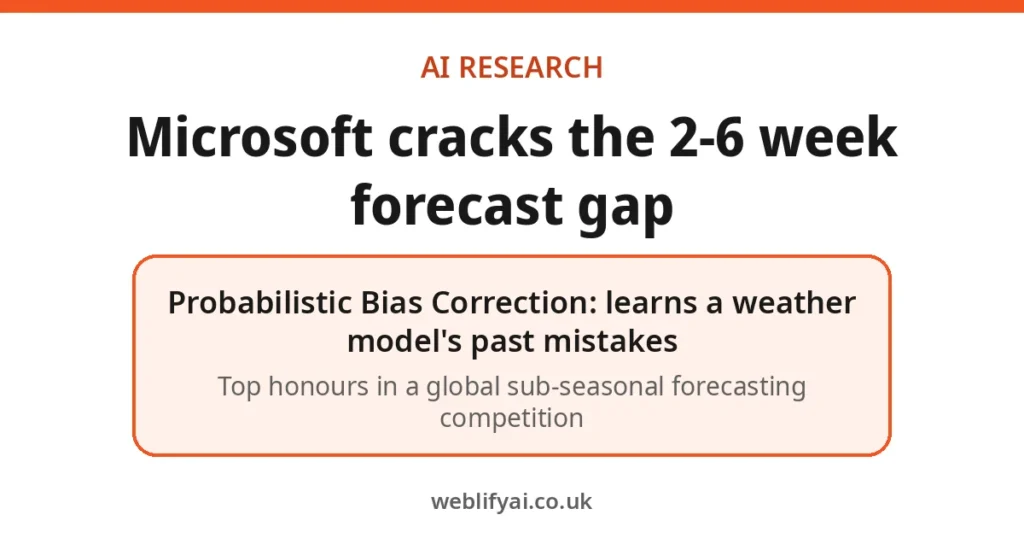
Direct answer: Microsoft Research has unveiled Probabilistic Bias Correction (PBC), a new machine-learning framework that tackles one of weather forecasting’s hardest problems — the unreliable 2-to-6-week “sub-seasonal” window. Instead of building yet another forecasting model, PBC learns from an existing model’s past mistakes and corrects them. It won a global competition for extended-range forecasting and is already being tested with real farmers in Kenya.
What happened
Today’s forecasts are dependable out to about two weeks; longer seasonal outlooks are improving too. But the 2-to-6-week gap is where both physics-based and AI models fall apart, as small errors compound through complex global weather systems. That window is exactly what matters for farming, wildfire management, water and energy allocation, and preparing for extreme weather.
PBC’s approach, in the words of senior principal researcher Lester Mackey: it “takes your favorite model as input and learns in what ways it tends to make errors. It then corrects those errors, yielding a better output forecast for the sub-seasonal range.”
Early results are genuinely impressive:
- Top honours in a global extended-range forecasting competition.
- Real-world use: improved monsoon forecasts for farmers in Kenya.
- A standout call: on 29 January 2026, MicroDuet — powered by PBC — anticipated the North American Blizzard of 22–24 February 2026, the biggest winter storm on record in parts of the US.
What it means for UK small businesses
Weather is a supply-chain variable. A 2-to-6-week reliable forecast horizon changes planning for:
- Logistics and trades: builders, landscapers and event businesses can schedule with more confidence than a 10-day forecast allows.
- Retail and hospitality: stock and staffing for seasonal swings become plannable a month out, not a fortnight.
- Insurance and risk: better sub-seasonal forecasts will eventually feed into risk pricing — businesses that act on them early get ahead.
This is the “boring AI” story worth paying attention to: machine learning not generating content, but quietly making a physical-world decision input more reliable. We have written before about practical AI adoption in our AI bookkeeping guide for UK small businesses — this is exactly the class of AI that pays for itself fastest.
Honest limits / what to watch
- “More reliable” is not “reliable.” The sub-seasonal window remains the hardest in forecasting. PBC improves a poor baseline; treat outputs as probabilistic guidance, not certainty.
- Still research-grade. A competition win and pilot deployments are promising, but PBC is not yet a commercial product you can buy or plug into your operations software.
- Regional skill varies. The Kenya monsoon work is encouraging, but sub-seasonal skill differs hugely by region and season. UK-specific performance is not yet established — watch for peer-reviewed follow-ups (the underlying paper is in Nature).
FAQs
What is Microsoft’s Probabilistic Bias Correction (PBC)?
PBC is a machine-learning framework from Microsoft Research that takes any weather model as input, learns the systematic errors it tends to make, and corrects them — sharpening forecasts in the 2-to-6-week window.
How well does PBC work?
It took top honours in a global competition on extended-range (sub-seasonal) forecasting, and early real-world deployments include improved monsoon forecasts for farmers in Kenya.
What is the ‘sub-seasonal gap’ in weather forecasting?
Weather models are dependable out to about two weeks, and seasonal climate forecasts are improving — but the 2-to-6-week window in between is where both physics-based and AI models struggle as errors compound.
Did PBC predict a real storm?
Yes — on 29 January 2026, MicroDuet, a system powered by PBC, anticipated the North American Blizzard of 22–24 February 2026, described as the biggest winter storm on record in parts of the US.
Source: Microsoft Research — “New AI framework bridges a critical gap in mid-range weather forecasts” (16 Oct 2026)