

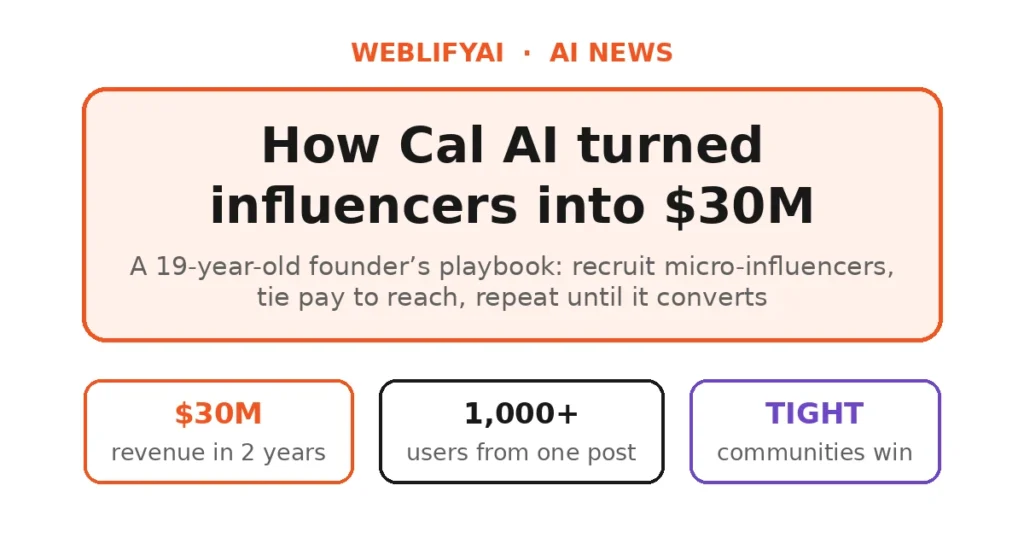
Direct answer: Cal AI, an AI calorie-tracking app founded in 2024, generated over $30 million in revenue in two years and was acquired by MyFitnessPal — largely on the back of a relentless influencer marketing machine. Founder Zach Yadegari told TechCrunch Disrupt this week that he recruited influencers “as fast as we could,” negotiated pay against guaranteed reach, and found that every post converted in a “clear formula.”
What happened
Speaking onstage at TechCrunch Disrupt on Thursday, the 19-year-old Yadegari walked through the playbook that took Cal AI from launch to viral fame to acquisition.
The first sign the strategy could work came early: a single influencer post brought roughly 1,000 new users over two days. From there, the company went all in. “We started recruiting influencers as fast as we could — paying as many people as possible to start posting for us,” Yadegari said. What they found was that the relationship between posts and signups was remarkably predictable: each post reached a certain number of viewers, and a reliable share converted.
The negotiation tactic was blunt and effective. Many of the influencers were young creators who simply wanted cash. So Cal AI offered them a deal: here’s your payout, but only if you deliver a set amount of reach — and keep posting until you get there. Payment tied to performance, not just exposure.
Just as important was who they picked. Rather than chasing follower counts, Cal AI hunted for influencers with “very tight communities” — smaller audiences whose trust and attention were real, and whose reach could actually be measured. Micro over mega.
The numbers speak: $30 million-plus in revenue in two years, then an acquisition by MyFitnessPal (for an undisclosed sum) in March. Yadegari has since launched a new AI agent startup, Persona, which has reportedly already raised $10 million.
What it means for UK small businesses
Forget the $30 million. The interesting part for a small business is the mechanics — and most of it scales down surprisingly well:
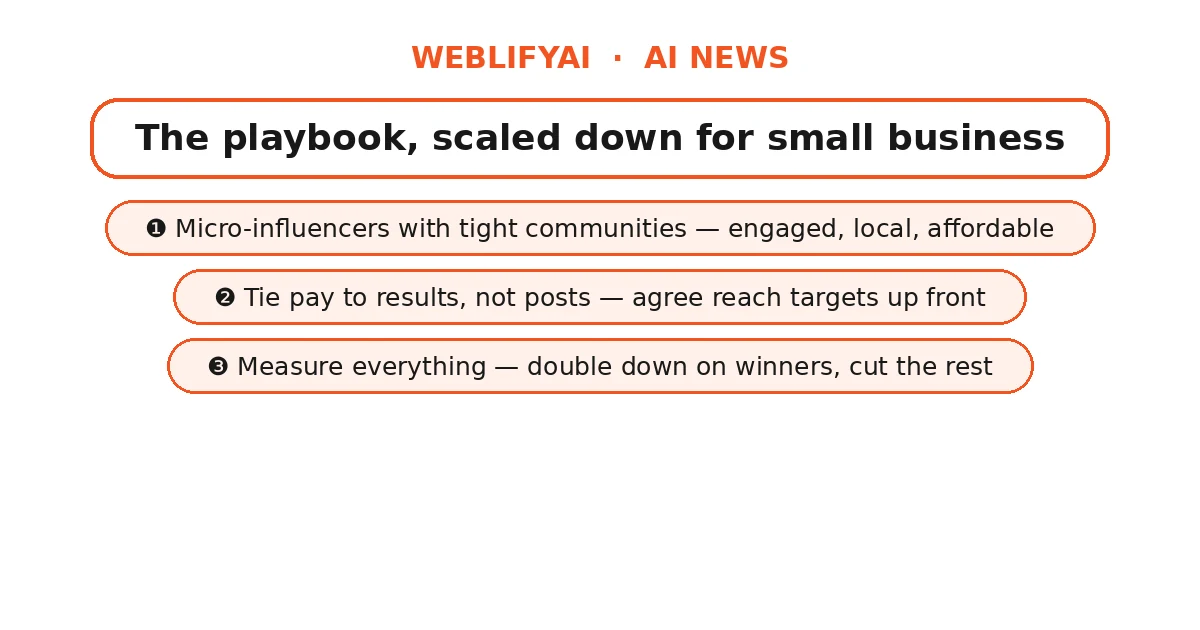
Micro-influencers beat big names. This is the most directly usable lesson. A local fitness coach, a food blogger with 8,000 engaged followers, a tradesperson YouTuber — people with tight communities convert. They’re also affordable and approachable. A small business doesn’t need an army; five good micro-influencers in your niche is a campaign.
Pay for outcomes, not posts. Cal AI’s smartest move was tying payment to guaranteed reach and ongoing posting. You can do the same: agree with a creator that payment (or free product/service) depends on them delivering agreed content and minimum engagement. Get it in writing — even informally, by message.
Predictability is the real prize. Yadegari’s team found a formula: X posts → Y viewers → Z signups. Once you have that, marketing spend becomes a dial you can turn. For a small business, this means tracking matters more than the first post. Measure what each creator actually delivers, double down on the ones that convert, cut the ones that don’t.
Match the product to the channel. Be honest about one thing: an AI calorie app is visual, simple and shareable — perfect influencer material. If your product is complex or unphotogenic (accounting services, B2B software), influencers will convert worse for you. In that case, the equivalent “clear formula” might be smarter AI-driven marketing aimed at search or referrals instead.
Honest limits / what to watch
Don’t romanticise this. Cal AI’s strategy worked because several things were true at once: a mass-market product, a viral-friendly category (fitness), an app that converts in one tap, and the capital to pay “as many people as possible.” Most small businesses have one or two of those, not all four.
Influencer marketing also has a compliance side the headlines skip. In the UK, paid posts must be clearly labelled as ads (ASA rules), and creators who hide sponsorships put your brand at risk too. Any influencer deal you run needs proper disclosure — no exceptions.
There’s also the question of what happens when you stop paying. Cal AI’s growth was rented, not owned: it depended on continuous influencer spend. The moment posting stops, the pipeline stops. Smart businesses pair influencer campaigns with something durable — an email list, a referral programme, local SEO — so they’re building an asset, not just renting attention.
Still, the core lesson stands. You don’t need a Super Bowl ad or a venture-funded war chest to market a product in 2026. You need the right small voices, a deal structure that ties pay to results, and the discipline to measure everything. That’s a playbook any UK small business can run — at whatever scale its budget allows. For the data behind that shift, see AI statistics for UK small business in 2026.
Source: TechCrunch (15 Oct 2026).
FAQs
What is Cal AI?
Cal AI is an AI-powered calorie tracking app founded in 2024 by then-teenager Zach Yadegari. It generated over $30 million in revenue within two years and was acquired by MyFitnessPal for an undisclosed amount in March 2026.
How did influencers drive Cal AI’s growth?
Yadegari recruited as many influencers as possible, negotiated rates with payouts tied to a guaranteed level of reach, and had them keep posting until they hit the agreed usage targets. An early sign of success came when a single influencer post brought roughly 1,000 new users in two days.
What kind of influencers did Cal AI use?
Rather than big celebrity accounts, the company focused on influencers with what Yadegari called “very tight communities” — smaller, engaged audiences whose reach could be quantified and converted reliably.
Can a small business copy Cal AI’s influencer strategy?
The core idea scales down well: work with micro-influencers who have tight, engaged local or niche audiences, agree payment tied to measurable results, and treat it as a repeatable formula rather than a one-off post. What won’t scale down is the volume — start with a handful of creators, not an army.
Is paying influencers better than running ads?
For Cal AI, influencer posts converted in a “clear formula” — each post reliably delivered viewers who signed up — making spend predictable. But it works best for visual, easy-to-explain products. Boring or complex services may get better returns from search ads or referrals.
What happened to Cal AI’s founder after the acquisition?
Zach Yadegari, now 19, has launched a new venture called Persona — an AI agent startup aiming to build a personal AI assistant across messaging, email and phone calls, which has reportedly already raised $10 million.


