

Direct answer: Small businesses get the most from AI marketing in five workflows: drafting social media posts, writing email newsletters, creating Google Business Profile updates, replying to reviews, and writing ad copy. Start with free tools (ChatGPT, Claude, Canva AI), use specific prompts that include your business details and tone, and always have a human review before publishing. Total cost: £0 to start, £15–£40/month if you upgrade. Here’s exactly how to do each one.
Search interest in AI marketing just spiked to its highest UK level this week — and most guides are written for marketing teams, not for the plumber, salon owner or café manager doing it themselves at 9pm. This one is for you.
Before You Start: The Two Rules
Rule 1: AI drafts, you decide. AI is brilliant at the blank page and terrible at the truth. It will confidently invent a “5-star review from Sarah in Manchester” that never existed. Every factual claim — prices, statistics, testimonials, qualifications — gets verified by a human before it goes anywhere public. In the UK, the Advertising Standards Authority applies the same honesty rules to AI-assisted ads as any other.
Rule 2: Feed it your business. Generic prompts get generic marketing. Every prompt below includes your business name, location, offer and tone. The ten seconds that takes is the difference between content that sounds like you and content that sounds like everyone.
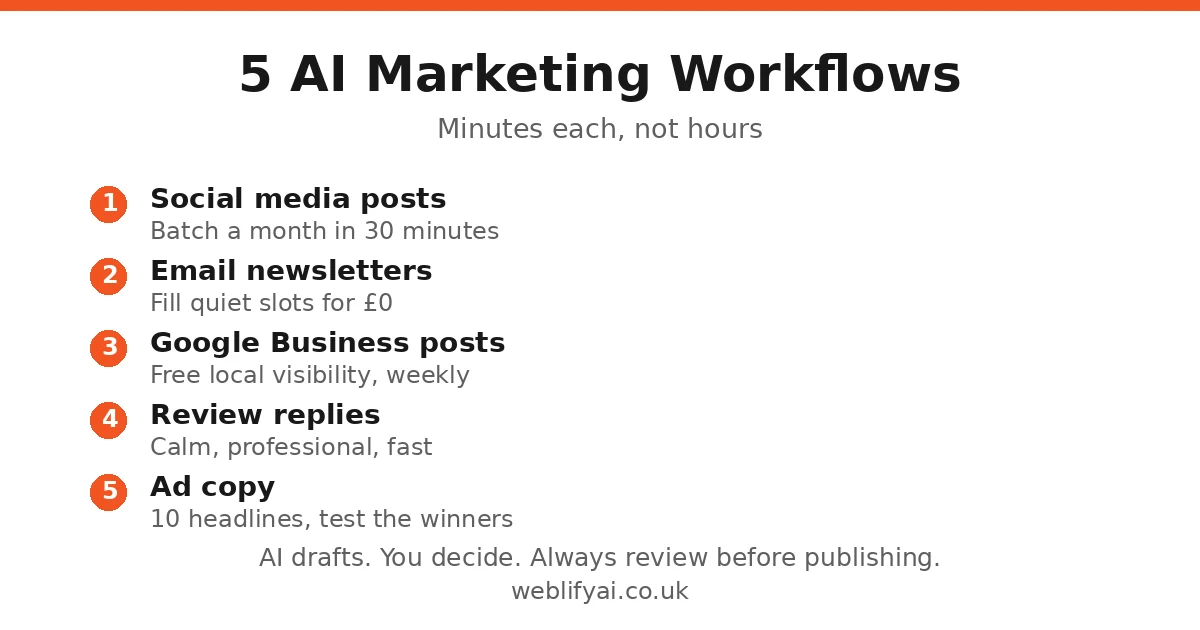
Workflow 1: Social Media Posts in Minutes
The average small business owner spends 3–5 hours a week on social content. AI cuts that to under an hour.
Copy-paste prompt:
Write 5 Facebook post ideas for [business name], a [trade] in [town]. We’re promoting [offer, e.g. winter boiler checks at £79]. Warm, local tone, no hype. Each post under 60 words, each with a different angle (one funny, one helpful tip, one customer story angle, one seasonal, one direct offer). No emojis in the helpful one.
Then: pick the best two, fix any local details it got wrong, swap in a real photo of your actual work (AI images on a trades business page look wrong to customers), and post.
How to use AI for small business marketing on social comes down to batching: generate a month of ideas in one 30-minute session instead of staring at a blank screen every Tuesday.
Workflow 2: Email Newsletters People Open
Email still beats social for actually driving bookings — and AI removes the “what do I write?” block.
Copy-paste prompt:
Write a short email newsletter for [business name]’s customers. Subject line plus 150 words. Topic: [e.g. 3 signs your boiler needs attention before winter]. Friendly expert tone. End with a clear call to action: call [number] to book a £79 winter check. Include a P.S. line with a limited-time angle.
Send it to your existing customer list (Mailchimp and Brevo both have free tiers up to a few hundred contacts, and both now include AI writing help built in). One salon client-style result owners report: a single “we have gaps next week” email routinely fills quiet slots. That’s a £0 marketing channel.
Workflow 3: Google Business Profile Posts
This is the most underused one. Your Google Business Profile is free advertising to people searching “[your trade] near me” — and most competitors never post to it.
Copy-paste prompt:
Write a Google Business Profile post for [business name] in [town]: we’re [offer/news]. Under 100 words, include our phone number [number] and a call to action. Professional but approachable tone.
Post it weekly. It takes five minutes, it shows activity to Google, and it puts your offer in front of local searchers. For more on getting found by the new AI search tools, see our guide on check if ChatGPT recommends your business.
Workflow 4: Replying to Reviews (Without the Dread)
Reviews drive local rankings and bookings, and replying to all of them matters — but staring at a one-star review wondering what to say is miserable. AI drafts the calm, professional version.
Copy-paste prompt:
Draft a professional reply to this Google review for [business name]: “[paste review]”. Thank them, address their point specifically, invite them to contact us at [number/email] to resolve it. Under 60 words. Never defensive, never admitting legal liability.
For positive reviews, a shorter prompt does it. The key: personalise each one slightly before posting. Identical AI replies to every review look automated and defeat the purpose.
Workflow 5: Ad Copy That Doesn’t Sound Like an Ad
Running a small Google or Facebook ad? AI is genuinely good at generating headline variations to test.
Copy-paste prompt:
Write 10 Google ad headlines (max 30 characters each) for [business name], [trade] in [town]. Focus on [offer/USP, e.g. same-day service, 4.9-star rated]. Mix direct offers, questions, and trust signals.
Pick the best five, run them, keep the winners. Prompt engineering for marketing is mostly this: specific inputs, multiple outputs, human selection.
Free vs Paid: What You Actually Need
| Need | Free option | Paid upgrade (£/month) |
|---|---|---|
| Writing/drafts | ChatGPT, Claude (free tiers) | ChatGPT Plus / Claude Pro (~£16–£20) |
| Visuals | Canva AI (free tier) | Canva Pro (~£10) |
| Mailchimp / Brevo (free tiers) | From ~£15 | |
| Scheduling posts | Meta Business Suite (free) | Buffer (~£12) |
Honest advice: start free. Most UK small businesses never outgrow the free tiers. Upgrade only when you’re hitting a specific limit weekly.
The Honest Limits
- It can’t know your customers. AI doesn’t know Mrs Patel always asks for the same stylist. Your knowledge of real people is the advantage — use AI for volume, yourself for the personal touch.
- It hallucinates. Statistics, reviews, awards, prices — verify everything. One invented claim in an ad can mean an ASA complaint.
- It can’t do strategy. AI executes; you decide what “good marketing” means for your business. The businesses winning with AI marketing are the ones with a clear offer and a human checking the output.
- Google rewards helpful content regardless of how it’s produced — but mass-published, unedited AI filler will underperform. Edit everything.
Pair this with AI handling your inbound enquiries and the loop closes: our AI agents for small business guide covers AI that answers customer messages while your marketing brings them in.
FAQs
How can a small business use AI for marketing?
The five highest-value uses: drafting social media posts, writing email newsletters, creating Google Business Profile posts, replying to customer reviews, and drafting ad copy. Each takes minutes with AI versus hours by hand — but a human should always review before publishing.
What are the best AI marketing tools for small business?
Start free: ChatGPT or Claude for drafting, Canva’s AI for visuals, and your email platform’s built-in AI. Paid options like Jasper or Copy.ai suit teams producing high volumes. Most UK small businesses never need more than the free tier plus one paid tool.
How do I write social media posts with AI?
Give the AI your business details, the offer, the platform, and your tone — e.g. ‘Write a friendly Instagram caption for a Leeds plumber offering a winter boiler check at £79, warm tone, one emoji max.’ Then edit: fix local details, check the offer is right, and post.
Is AI-generated marketing content legal in the UK?
Yes, but the Advertising Standards Authority holds you to the same honesty rules as any ad — claims must be truthful and substantiated. AI can hallucinate statistics and testimonials, so verify every factual claim before publishing.
Will Google penalise AI-written marketing content?
Google doesn’t penalise AI content specifically — it penalises unhelpful content however it’s made. AI drafts that you edit, fact-check and improve perform fine. Mass-published unedited AI spam does not.
How much does AI marketing cost a small business?
Free to start: the free tiers of ChatGPT, Claude and Canva cover most small-business needs. If you upgrade, budget £15–£40/month for one AI writing tool. Compare that to £500+/month for a freelancer or agency retainer.
What should I never let AI do in my marketing?
Never let it invent customer testimonials, statistics, prices or qualifications — AI hallucinates these confidently. Never publish without a human reading it first. And never let it handle complaints or sensitive customer issues unsupervised.


