

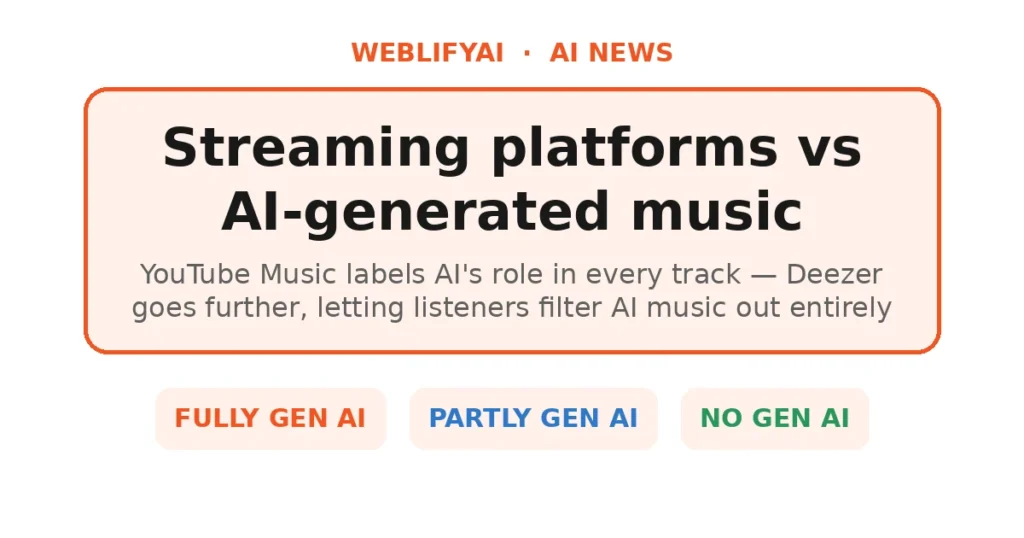
Direct answer: YouTube Music is rolling out labels that show exactly how much AI went into a song — fully generated, partly assisted, or not at all. At the same time, Deezer is going further, preparing a filter that lets listeners remove AI-generated music entirely as it battles a flood of around 90,000 AI-made tracks a day.
What happened
YouTube announced on Wednesday that YouTube Music will start labelling tracks created with generative AI. The label appears on the player page, and tapping it explains the specific role AI played in the track’s creation. The labels will extend to the main YouTube app too, not just the music service.
Uploaders declare AI use under one of three categories: Fully Gen AI for tracks entirely created by AI, Partly Gen AI for songs where artists blended AI-generated elements with their own live recording, and No Gen AI for tracks where AI played no role. Routine pitch correction tools like Auto-Tune still fall under “No Gen AI”.
YouTube says it built the system with music partners and its own detection tools. It’s a disclosure approach rather than a ban — AI involvement alone won’t get a track demonetised, and YouTube continues experimenting with AI music creation itself, including a tool that lets selected creators generate tracks in AI versions of participating artists’ voices.
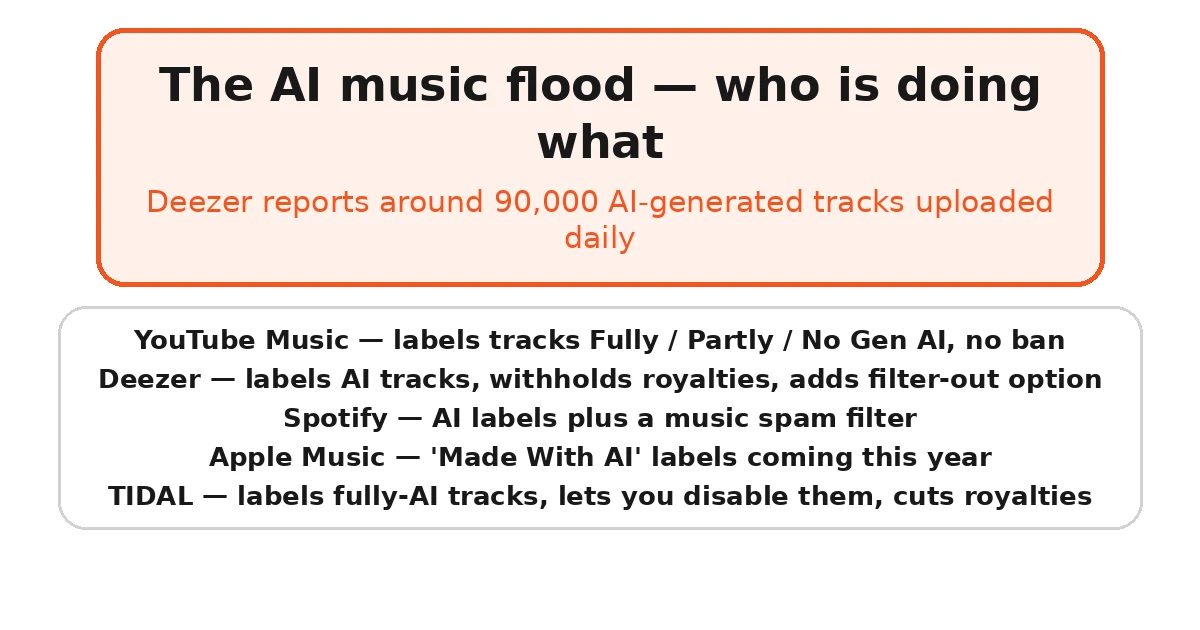
The rest of the industry is converging on transparency, each in its own way. Spotify already applies AI labels and runs a music spam filter. Apple Music plans “Made With AI” labels under its AI Transparency Tags later this year. TIDAL labels fully AI-generated recordings, lets listeners disable them, and excludes them from royalty attribution. Deezer has the strictest stance: detected AI tracks are labelled, kept out of algorithmic recommendations and editorial playlists, and stripped of royalties from fraudulent streams — with a full listener filter on the way.
The scale of the problem is enormous. Deezer reported receiving close to 90,000 fully AI-generated tracks every single day. Much of it is low-effort content designed to farm streams and siphon royalty money.
What it means for UK small businesses
If your business touches music, this matters more than it looks.
For cafés, shops, salons and restaurants: the background music services you pay for are stuffed with AI-generated filler. Labels won’t change what plays tomorrow, but the trend toward transparency and stricter royalty rules puts pressure on providers to keep playlists honest — so the licence fees you pay are more likely to reach real artists.
For marketers and video creators: if you commission or license music for ads and social content, clearer labels make it easier to know what you’re actually buying. Genuinely human-recorded tracks — which listeners increasingly value — become easier to identify and showcase.
For musicians and small labels: this is quietly good news. Human artists have been competing against an endless flood of machine-made tracks for playlist slots and royalties. Labels and filters don’t solve that, but they restore a basic fairness: listeners can choose the real thing, and royalties get harder to game.
For anyone building AI products: watch the pattern. YouTube’s approach — disclose, don’t delete — is likely how AI transparency rules will land across other industries, including in the EU AI Act’s labelling requirements. Getting your own AI-use disclosures right now puts you ahead of regulation.
Honest limits / what to watch
Let’s be realistic: a label system is only as good as its detection. YouTube’s tools have to catch AI audio in an arms race where generators improve every month, and the system partly relies on uploaders honestly declaring their AI use. Some AI tracks will slip through unlabelled.
There’s also a fuzzy middle ground. Where exactly does heavy AI-assisted production cross from “Partly Gen AI” into “Fully”? Borderline cases will be argued over for years.
And the deeper problem — sheer volume — isn’t solved by labels. Ninety thousand AI tracks a day is an industrial-scale content flood, and disclosure doesn’t slow the upload pipeline. Deezer’s filter option may turn out to be the more honest answer: if listeners can simply opt out, the economics of AI spam start to break.
Still, this is the right direction. Music was the first industry where AI output hit consumers at scale, and streaming platforms are now writing the transparency playbook everyone else will copy. Read more about how AI is reshaping small business strategy and how to use AI in your marketing the smart way.
FAQs
How does YouTube Music’s AI label work?
A label appears on the track’s player page. Clicking it shows whether the track is Fully Gen AI, Partly Gen AI, or No Gen AI, depending on how much of it was created with generative AI.
What does Fully Gen AI, Partly Gen AI and No Gen AI mean?
Fully Gen AI means the whole track was generated by AI. Partly Gen AI means AI-made elements were mixed with real live recording. No Gen AI means AI wasn’t part of creation — and routine pitch correction like Auto-Tune doesn’t count as AI use.
Can I filter out AI-generated music on streaming platforms?
Deezer is building an option to filter AI-generated music out completely. TIDAL already lets listeners disable fully AI-generated recordings. Spotify and Apple Music currently label AI tracks instead of offering a full filter.
Does YouTube Music remove AI-generated songs?
No. YouTube is taking a disclosure approach — AI involvement is labelled but doesn’t make a track ineligible for monetisation. Deezer takes a stricter line, excluding detected AI tracks from algorithmic playlists and withholding royalties on fraudulent streams.
Why does this matter for UK indie musicians and businesses?
Transparency protects human artists competing for the same playlists, royalties and listener trust. For businesses, it means the background music and ad soundtracks you license are more likely to be accurately described and fairly paid for.
Will the labels actually catch every AI track?
Not yet. The system combines YouTube’s own detection tools with self-declaration from uploaders, and AI detection is an arms race. Labels are a big step forward, but some AI tracks will still slip through.
Sources: TechCrunch (14 Oct 2026); TechCrunch on Deezer’s AI filter (14 Oct 2026).


