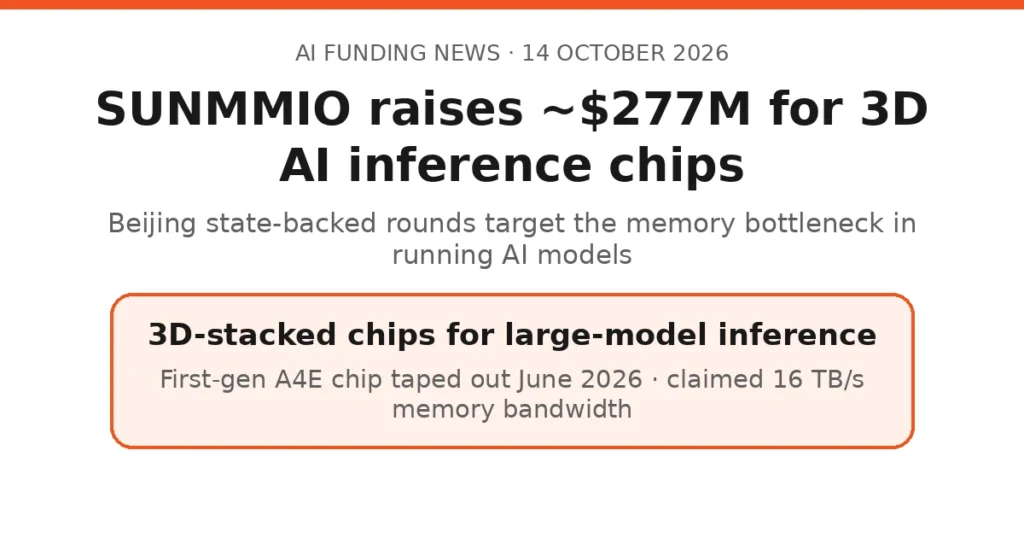
Direct answer: Beijing-based AI chip startup SUNMMIO has raised nearly RMB 2 billion — about $277 million — over the past year to mass-produce 3D-stacked chips purpose-built for AI inference. Its first chip design taped out in June, and the company claims a memory bandwidth of 16 terabytes per second, targeting the data-transfer bottlenecks that make running AI models expensive.
What happened
SUNMMIO (also transliterated as Suanmiao) has completed its Pre-A2 and Series A financing, taking its total raised over the past year to nearly RMB 2 billion, or roughly $277 million (TechNode). The latest rounds were led by Beijing state-backed investment platforms, including Yizhuang State Investment — a clear signal of how strategically China views domestic AI chip capacity.
The money will go toward expanding the R&D team, advancing the technology, and accelerating mass production of its proprietary 3D TokenPU processors. The company's first-generation A4E chip completed tape-out in June. The design stacks eight memory wafers above a logic wafer — 3D hybrid bonding — and the company states a memory bandwidth of 16 terabytes per second, aimed squarely at the "memory wall" that limits AI inference performance (Dealroom).
This is not a team starting from zero on 3D chipmaking. Its core members reportedly spent nearly seven years in 3D IC work before founding the company, building a wafer-on-wafer hybrid bonding supply chain in mainland China, with mass-production experience across tens of thousands of 3D IC wafers and cumulative revenue topping $165 million from that earlier work. Earlier backers across its rounds include CDB Capital, Zhongguancun Science City, Source Code Capital, Jade Value Capital and Legend Capital, with some reinvesting.
SUNMMIO sits in a busy lane. It follows a pattern of Chinese AI chipmakers raising big to build domestic alternatives for large-scale model deployment — the industry's centre of gravity is shifting from training models to running them, and inference is where the ongoing money is spent.
What it means for UK small businesses
You will never buy a SUNMMIO chip. That is not the point. The point is what you pay for every month: the AI chatbot on your website, the AI features in your software, the agents answering your customers. All of those are priced, in part, on inference costs — the compute burned every time the model produces an answer.
Right now, that cost base is dominated by a small number of hardware suppliers, and inference prices are one of the quiet forces pushing AI subscription prices up. Every serious new entrant in inference hardware — especially one attacking the memory-bandwidth bottleneck with a genuinely different architecture — adds competitive pressure that should, over time, bend the cost curve down.
For a UK small business, the practical read is this: AI capabilities keep getting cheaper per unit of usefulness, and the infrastructure money flowing in (see the wider AI data centre funding surge) is a leading indicator. If you have held off automating something because the AI tool felt too expensive or too slow, re-check the maths every six months — the economics are moving in your favour. The latest AI statistics for UK small businesses show adoption climbing as costs fall.
Honest limits / what to watch
A funding announcement is a milestone, not a product launch. Caveats:
- No mass production yet. Tape-out in June means the design exists on paper and in first silicon; volume manufacturing is still to come, and chip timelines slip constantly.
- The headline specs are company-stated. 16TB/s memory bandwidth sounds impressive, but it has not been independently benchmarked. Treat it as a claim, not a result.
- Geopolitics will decide the market. With Beijing state capital leading the rounds and export controls tightening around advanced chips, where these processors can actually be sold — and whether Western cloud providers can touch them — is an open question. A UK business may never see a SUNMMIO-powered service.
- The benefit is indirect and slow. Cheaper inference hardware reaches small businesses through cheaper AI services, filtered through cloud providers and software vendors. Think years, not months.
- "Trillion-level market" is marketing. The company describes its target as a trillion-level inference market. Every chip startup says this. The real question is whether it can ship at volume, at a competitive cost, with software developers actually want to use.
Still, the direction of travel is worth noting: serious money keeps flowing into making AI cheaper to run, not just smarter. For small businesses, that is the trend that matters most.
FAQs
How much has SUNMMIO raised?
SUNMMIO has raised nearly RMB 2 billion — roughly $277 million — in total over the past year, across a Pre-A2 round and a Series A. The rounds were led by Beijing state-backed investment platforms, including Yizhuang State Investment. Other backers across its raises reportedly include CDB Capital, Zhongguancun Science City, Source Code Capital, Jade Value Capital and Legend Capital.
What does SUNMMIO actually make?
SUNMMIO develops 3D-stacked chips designed specifically for large-model inference — the step where a trained AI model generates answers, images or text. Its first-generation A4E chip taped out in June 2026 and stacks eight memory wafers above a logic wafer, with a stated memory bandwidth of 16 terabytes per second, aimed at the data-transfer bottlenecks that slow AI inference down.
Why does AI inference need its own chips?
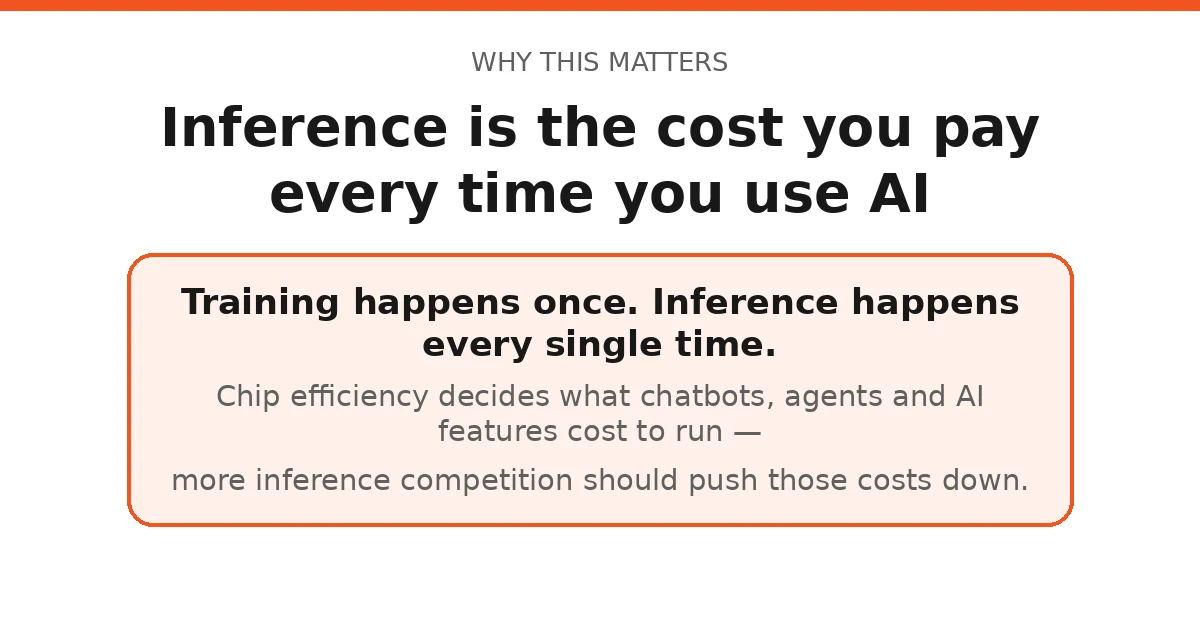
Training a model happens once; inference happens every single time someone uses an AI system. That makes inference a constant, growing cost for anyone running AI services — and chip efficiency directly shapes what those services cost to run. Purpose-built inference chips aim to deliver more answers per watt and per pound than general-purpose hardware.
What does this mean for UK small businesses?
You will not be buying these chips — but you buy what runs on them. Every chatbot, AI agent and AI-powered feature a small business pays for is priced, in part, on inference costs. More competition in inference hardware should, over time, push those costs down, making AI tools cheaper and faster for the businesses that use them.
What are the honest caveats?
The chips are not in mass production yet — the first design only taped out in June, so volume manufacturing is still ahead. The 16TB/s bandwidth figure is company-stated, not independently verified. The funding is heavily state-backed Chinese capital, and geopolitics plus export controls may decide where these chips can actually be sold and deployed. Any benefit to UK businesses arrives indirectly, through cheaper AI services, and on a timeline of years, not months.