

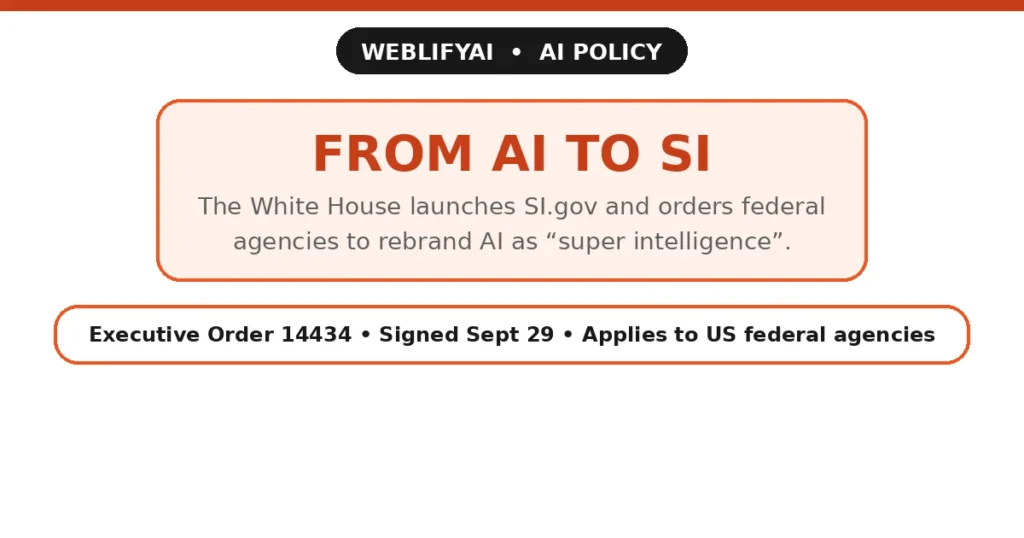
Direct answer: The Trump administration has launched SI.gov — a rebranded US government website — as part of a campaign to replace the term “artificial intelligence” with “super intelligence” (SI). A formal executive order signed on September 29 directs all federal agencies to use the new terminology in official communications. It is, on the surface, a branding exercise — but for UK businesses it signals how the US now frames AI policy: as a race with China that American firms must win.
What happened
The White House Office of Science and Technology Policy announced the new URL on X, with director Michael Kratsios writing: “The Super Intelligence era is here.” The site — previously AI.gov, launched under the Biden administration — now carries the “SI.gov” branding and outlines President Trump’s AI policies and initiatives, as reported by BusinessToday and Firstpost.
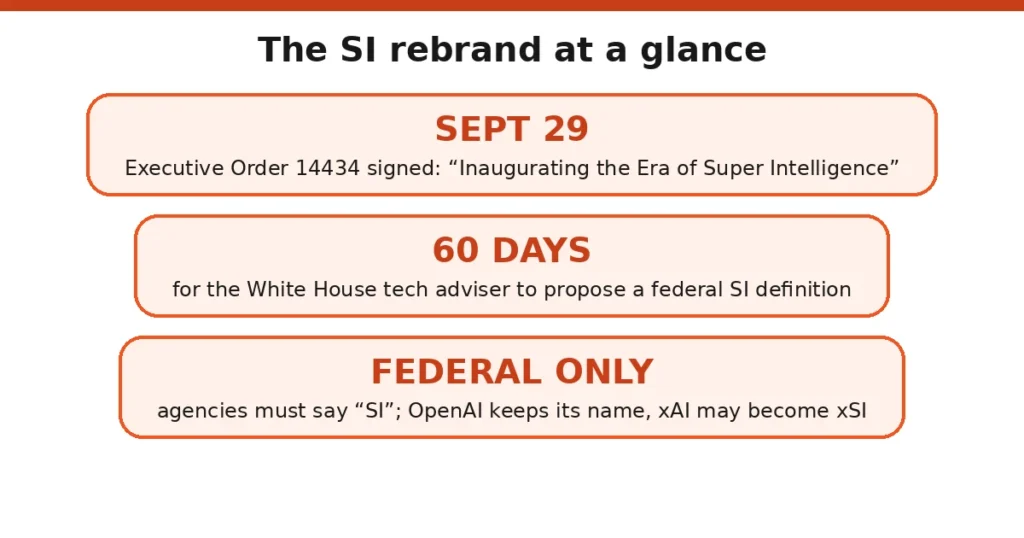
The rebrand has teeth behind it. Executive Order 14434, “Inaugurating the Era of Super Intelligence,” signed September 29, instructs federal departments and agencies to use “Super Intelligence” and “SI” instead of “Artificial Intelligence” and “AI” in official correspondence, public communications, websites, reports, and policy documents. The order gives the White House technology adviser 60 days — roughly to late November — to propose legislative language establishing a federal definition of SI.
Trump has been vocal about the push. In a Truth Social post last week, he said people who opposed the rebranding were “the enemy” of his administration — and he has argued the word “artificial” makes the technology sound fake.
Industry reaction is split. Elon Musk said he may rename xAI to xSI, and SpaceX’s AI venture has already been renamed SpaceXSI. OpenAI CEO Sam Altman acknowledged the push on a Politico podcast but said OpenAI would keep its name. The rebrand is uneven in practice: coverage from TokenPost notes SI.gov’s web address and much of its metadata still reference AI, and links like “AI Education” and “Presidential AI Challenge” keep the old terminology.
This sits alongside a separate but related move: Trump’s creation of a “Super Intelligence Force” to lead the US AI push, with an appointed AI tsar. The force is about talent and strategy; the SI.gov rebrand is about narrative.
What it means for UK small businesses
Let’s keep this in proportion. Nobody in Manchester or Leeds has to start saying “super intelligence” — the executive order applies to US federal agencies, not your business. But there are three things worth a UK business owner’s attention.
1. Watch the language in US-facing contracts and procurement. If you sell into the US — especially anything touching government work — expect “SI” to start appearing in tenders, compliance documents, and partner communications. It’s cosmetic, but contracts are contracts: match the terminology your counterpart uses.
2. Watch the policy divergence. This is the real story. The EU’s AI Act frames artificial intelligence around risk, rights, and regulation. The Trump White House frames “super intelligence” around competition, economic growth, and beating China. UK businesses sit between these two worlds: EU-aligned regulation at home, American tech stacks and partners abroad. When the two poles of your operating environment describe the same technology in opposite terms, your AI risk and compliance thinking has to be robust enough for both.
3. Don’t chase the narrative — chase the capability. Rebrands don’t change what AI tools do for your business. The meaningful question stays the same: what can this technology do for your margins? Our AI statistics for UK small businesses piece lays out where adoption is actually paying off.
Honest limits / what to watch
A few honest caveats. First, the rebrand is incomplete and partly theatrical — a government website that still uses “ai.gov” as its address while its branding says “SI.gov” tells you this is a messaging campaign in progress, not a finished transition. Second, renaming something doesn’t change it: the executive order uses the existing federal legal definition of AI and just swaps the label. Third, the deeper question — whether the US’s competition-first framing leads to looser safety rules — is still open, and it matters.
Watch for: the late-November deadline for a proposed federal SI definition, how many agencies actually comply with the terminology directive, and — most important for UK businesses — whether the US’s competitive framing starts translating into concrete regulatory divergence from the EU AI Act, for example around foundation model obligations or red-teaming requirements.
FAQs
What is SI.gov?
SI.gov is the US government’s relaunched website covering its artificial intelligence policies, rebranded under President Trump’s push to rename AI as “Super Intelligence” or SI. It replaces the AI.gov site created during the Biden administration.
Does this affect UK businesses?
Directly, no — it applies to US federal agencies, not private companies or UK law. Indirectly, yes: if you sell to US government clients or work with American partners, expect “SI” in procurement documents and contracts. And watch how US policy language diverges from EU/UK frameworks like the EU AI Act.
Why is Trump renaming AI to Super Intelligence?
Trump has argued the term “artificial intelligence” makes the technology sound fake, and that “super intelligence” better captures what it can achieve while improving public perception — AI has faced criticism over job losses and safety risks. The rebrand is part of a broader push tied to US competition with China.
Is there an executive order behind the rebrand?
Yes. Executive Order 14434, titled “Inaugurating the Era of Super Intelligence,” was signed on September 29. It directs federal departments and agencies to use “Super Intelligence” and “SI” instead of “Artificial Intelligence” and “AI” in official correspondence, websites, reports, and policy documents.
What did Elon Musk and Sam Altman say about it?
Musk said he may rename xAI to xSI and has renamed SpaceX’s AI venture to SpaceXSI. OpenAI CEO Sam Altman acknowledged the push but said on a Politico podcast that OpenAI would keep its name.
What is Trump’s ‘AI Force’ and does it relate to this?
Separately, Trump announced a “Super Intelligence Force” (earlier framed as an “AI Force”) with an appointed AI tsar to lead the US AI push. It’s a distinct policy move — about talent and strategy — running alongside the terminology rebrand.


