

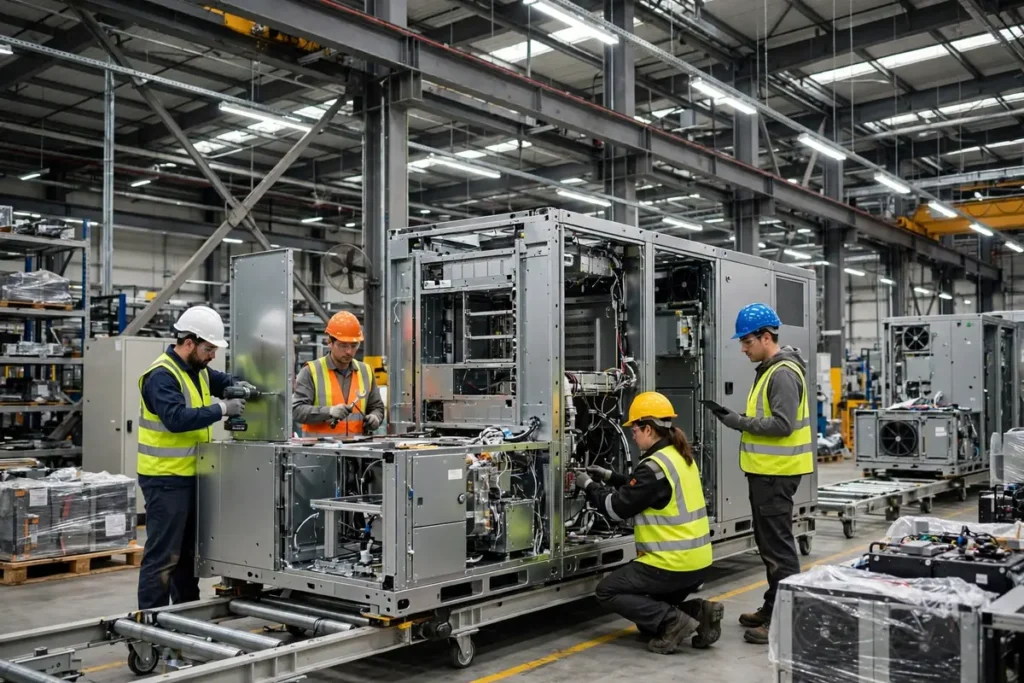
Direct answer: Runware, an AI infrastructure company, has told TechCrunch it wants to build a factory that assembles modular data centres on a production line, as if they were cars, scaling to 30 megawatts of capacity a day by 2028 and bringing each pod online within 48 hours of arriving at a site. The factory claim is more concrete than most data centre announcements, the company says it already has two factories and $1 billion of committed interest in its pods, but the headline production rate is a 2028 target, not today’s output, and the history of factory reinvention counsels caution.
What happened
Runware is making news for the second time in a few months. Earlier in 2026 it unveiled the Sonic Inference Pod, a modular data centre built in a factory and shipped to customers ready to install. Now, in an interview reported by TechCrunch on 30 October 2026, co-founder and chief executive Flaviu Radulescu has set out a bigger plan: a factory that produces those pods on an assembly line, at car-industry pace, for customers who want AI computing capacity without waiting years for a traditional data centre to be designed, permitted and built.
The numbers Radulescu gave are deliberately arresting. The company plans to scale production at its Romania-based factory to 30 megawatts of data centre capacity per day by 2028, or nearly 1 gigawatt per month. For context, TechCrunch notes that the entire United States was expected to add about 10 gigawatts of data centre power this year, according to Goldman Sachs. At Runware’s target pace, it would produce roughly a year’s worth of American additions in a single year, from one factory system. That comparison is useful precisely because it shows how ambitious the target is, and therefore how much execution it will require.
The timeline is more modest than the 2028 rate suggests, and the modesty is reassuring. Radulescu said Runware will increase production gradually starting next year. It already has two factories: one it has used for a few years to build pods, and a second it started building earlier this year, which is expected to be finished within months and to go online early next year. In other words, this is not a rendering of a factory that might one day exist. It is an expansion of manufacturing that is already happening, with a new facility due to start work in the near term. That distinction, between a design and a factory, is the heart of Runware’s pitch.
How a factory-built data centre works
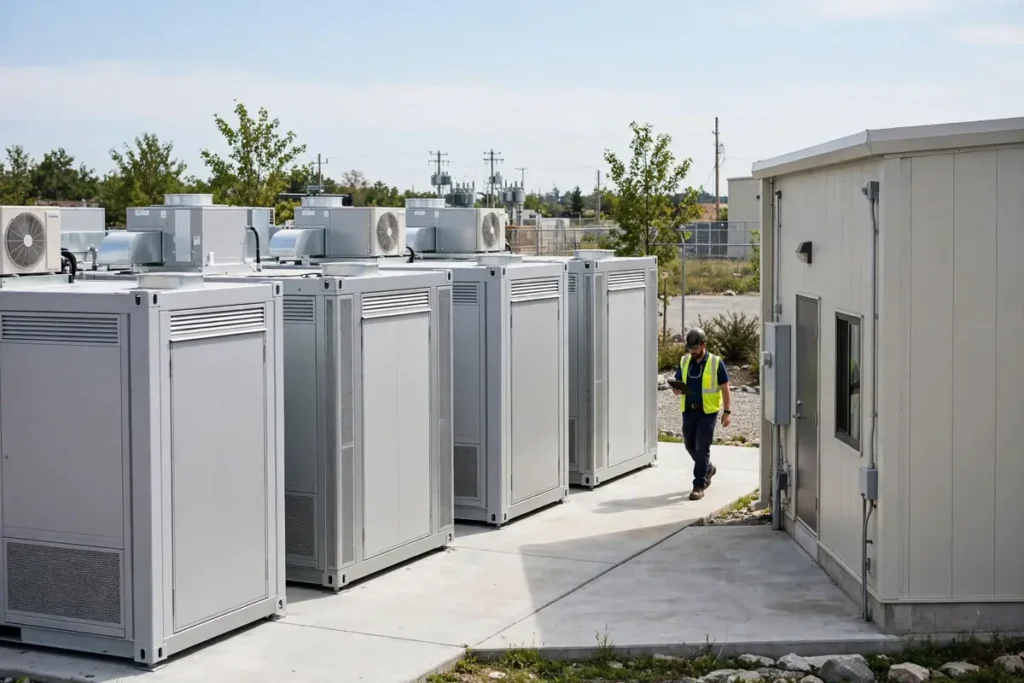
A traditional data centre is a construction project. A building is designed for a site, permits are sought, power is negotiated, cooling is engineered, and servers are installed over months or years. A modular data centre reverses that logic. The computing, cooling, power distribution and networking are built into a standardised unit in a factory, tested there, and then shipped to a site where the remaining work is installation and connection. Runware’s Sonic pods follow that model, and the new factory is intended to industrialise it.
Customers have two choices under Runware’s model. They can provide their own site, and Runware assembles the pods there, or Runware can find a site for them. Once a pod arrives, Radulescu says, the aim is to bring it online within 48 hours. That figure needs careful reading, because it is easy to misreport: the 48 hours covers installation and set-up time, not manufacturing time. A pod once took three weeks to build, and the company says that will fall to one day as production ramps up. So the full journey from order to working capacity is still measured in longer than two days, but the on-site portion, historically the slowest and most unpredictable part of a data centre build, is compressed to a weekend.
The commercial model is similarly flexible, and flexibility is part of the appeal for buyers who do not want to become data centre operators. Customers can rent compute from Runware directly, or supply their own graphics processing units, the specialised chips that run AI workloads, and pay a monthly fee for the pods and their operation. Power and internet connectivity are charged separately. Runware provides spare parts if components fail, which matters because a modular site may be far from a traditional support team. The pods have a standard design but can be configured to customer requirements and to the latest GPU chips, which is important in a market where chip generations turn over quickly.
That last point contains a neat piece of timing logic. Chips can take a long time to arrive after they are ordered, and Radulescu argues that this works in Runware’s favour: pod delivery times are shorter than current GPU lead times, giving the company time to adapt the infrastructure to the hardware being ordered. Its in-house hardware team can design, build and test components itself for new GPU generations, rather than waiting on a third party to redesign a bespoke facility. Whether that advantage holds at scale depends on supply chains, which is a theme this story returns to, but the logic itself is sound: standardise the slow part, customise the fast part.
Why the industry wants this now
Runware’s announcement lands in the middle of an industry-wide race to deploy AI capacity faster. Every major AI lab, cloud provider and chip company is trying to add computing power, and the traditional data centre pipeline is a bottleneck. Land must be found, power must be secured, planning permission must be won, cooling must be engineered, and skilled labour must be hired, all while demand grows faster than any of those processes can comfortably handle. Anything that shortens the pipeline, even by months, is commercially valuable.
That is why Runware is not alone in pursuing prefabrication, even if it claims to be furthest along. Crusoe and Schneider Electric also sell prefabricated pods, according to TechCrunch. Nvidia announced its Vera Rubin AI factories and its DSX POD earlier in 2026, both intended to make it faster and easier for companies to build their own AI data centres. The difference Runware claims is that it has actually built a factory rather than just designed the infrastructure that would let others build one. If that claim holds, it is a meaningful lead, because manufacturing capacity cannot be conjured from a slide deck: it requires a building, a workforce, a supply chain and working production lines.
The scale of demand also explains the money. Runware says it has received $1 billion in committed interest for its Sonic pods since it began offering them to outside customers a month ago, representing over 20 megawatts that it is now working to deliver. Committed interest is not revenue, and it is not a signed order book in the accounting sense, so it should not be quoted as sales. But as a signal of demand, it is striking: customers are evidently willing to commit to modular capacity at a pace that a traditional build could not match. For a company that has raised more than $60 million to date, including a $50 million Series A last December, and that plans a Series B while finishing the factory with the Series A money, that demand signal is also the fundraising story.
The energy and planning argument
Data centres have become controversial in the United States and abroad because of how much energy they consume and how that affects electricity grids, water supplies and local communities. Large hyperscale sites can require gigawatts of power, years of grid upgrades, and enormous water use for cooling. Runware’s pitch is, in part, an answer to that controversy: smaller sites, sited where power already exists, with cooling that does not need a water connection.
Radulescu told TechCrunch that the pods only need power and an internet connection. They use a closed-loop liquid cooling system with air-cooled radiators to release heat, so they do not really need a water connection. That matters in places where water is scarce or where a new data centre’s water use would become a planning objection. The company says its pods run completely silent up to temperatures of 86 degrees Fahrenheit, and that it uses energy from renewable sources whenever possible, aiming for renewables as its main energy source. Both claims should be treated as company statements about its design goals rather than independently verified performance figures, but the design direction is clear: minimise the site’s demands so that more sites become viable.
The site pipeline gives that direction some scale. Runware says it is working with power providers on a pipeline covering 397 megawatts, with potential to expand to 1.2 gigawatts, and that it deploys on sites much smaller than those used by hyperscalers such as Amazon, Microsoft and Google. The sites, Radulescu said, typically already have power, so they should not further strain the grid or disrupt the community. If that holds in practice, modular data centres could sidestep the two objections that most often delay large sites: grid connection queues and community opposition. For the UK, where grid connection delays and planning constraints are familiar complaints, that argument will sound familiar, and it is worth watching whether modular operators can actually secure sites faster here than hyperscalers can.
What it means for UK small businesses
No small business is going to buy a Runware pod this year, and this article will not pretend otherwise. Runware sells to data centre operators, AI companies and large users of computing capacity, not to a ten-person firm in Leeds or a café in Bristol. The relevance for a UK small business is indirect, but it is real, and it arrives through three channels: cost, availability and location.
The first channel is cost. AI services are priced, in large part, on the cost of computing capacity. If modular manufacturing genuinely lowers the cost and time of adding capacity, the providers that small firms buy from, whether that is a chatbot tool, an image generator, a voice agent or a business automation platform, face lower input costs over time. Those savings do not automatically reach small customers, and providers may keep them as margin, but a larger, faster-growing supply of capacity makes price rises less likely and price competition more likely. For a firm whose AI bill grows with usage, that is a meaningful tailwind.
The second channel is availability. The current AI capacity shortage shows up for small firms as waiting lists, throttled features, regional unavailability and sudden price changes. A world in which capacity can be added in months rather than years is a world in which those frictions ease. It also makes specialised capacity more plausible: a provider serving a niche, such as a UK legal or healthcare application, could secure dedicated modular capacity without building a data centre, which could improve performance and data handling for its customers.
The third channel is location and data. Smaller modular sites, sited where power already exists, could in principle bring AI capacity closer to where it is used, including in regions that hyperscalers overlook. For UK firms concerned about data sovereignty, latency or resilience, more numerous and more distributed sites are a good thing, provided the operators meet UK data protection and security expectations. None of that is guaranteed by Runware’s announcement, which concerns a Romanian factory and a global expansion plan, but the model, if it works, points in that direction.
There is also a practical lesson for any UK firm planning its own technology investments. The fastest-moving part of the AI stack is not the model or the app, but the infrastructure underneath it, and infrastructure shifts take years to reach small customers. The right posture is to buy AI services on flexible terms, avoid long lock-ins where possible, and revisit pricing when capacity expands. A three-year contract signed at shortage prices is a worse deal than a one-year contract renewed into a market with more supply.
Honest limits / what to watch
This is, at heart, a plan with a factory attached, and the honest limits are the ones TechCrunch itself flagged. Right now, these are all plans, and execution is the test. The factory will need a lot of people, inventory, supply chain logistics and money. There are cautionary tales about reinventing manufacturing, notably the electric vehicle start-up Arrival, once valued at over $13 billion, which struggled to mass-produce vehicles cost-effectively compared with traditional plants. Cars and data centre pods are different products, and Runware’s cost structure may indeed be different, as Radulescu argues, but the Arrival story is a reminder that a clever factory design and a working factory are different achievements.
Radulescu’s answer to that caution is specific and worth recording. “Our cost structure is very different,” he said. “We do have headcount and materials cost. But our factory staff is cost-effective relative to the value of deploying compute for AI.” He added that designing its own systems and buying widely available, affordable parts helps keep costs low, and that the company has brought in a highly experienced plant manager from the automotive industry to work alongside its chief of hardware. That is a credible team shape for this problem: automotive manufacturing experience plus hardware engineering. It is not, however, proof that the cost model works at 30 megawatts a day, and no one should quote the 2028 target as though it were a current run rate.
Supply chain dependencies are the second limit. Although Runware designs and builds its own cooling and other pod systems with standard components, some parts, such as pumps and fans, come from Germany, and it still depends on Nvidia for networking. A factory that depends on a single chip company’s networking gear and on cross-border component flows is exposed to the same shortages and geopolitical frictions as every other hardware maker. The company’s claim that its pod delivery times are shorter than GPU lead times mitigates that risk, but it does not remove it.
The third limit is the demand figure. One billion dollars of committed interest is not one billion dollars of revenue, and 20 megawatts being delivered is a long way from 30 megawatts a day. The gap between those numbers is the execution challenge in miniature: converting interest into delivered, working, paid-for capacity, site by site, pod by pod. The next milestones to watch are therefore concrete and boring, which is exactly how they should be: the second factory coming online early next year, the first pods delivered from it, the Series B fundraising, and any announcement of a UK or European site pipeline beyond Romania.
Finally, the environmental claims deserve the same treatment as any company’s sustainability statements: welcome the direction, verify the numbers. Closed-loop cooling without a water connection, silent operation up to 86 degrees, and renewables as the main energy source are all attractive, but they are company statements about design intent, not audited results across a fleet of operating sites. The UK’s planning and environmental regime will test those claims site by site if modular operators arrive here, and that scrutiny is a feature, not an obstacle.
What to watch next, then, is a short list. Watch for the second factory going online early next year and for production figures that follow. Watch for the Series B and what it values the company at. Watch for named customers and delivered megawatts rather than committed interest. Watch for a US expansion announcement, since Radulescu said the company will expand to the US and other regions after the factory launch. And watch for the first UK or European modular site proposals, because that is the moment this story stops being about a Romanian factory and starts being about capacity a British business could actually buy.
The broader point is one that applies to every infrastructure announcement in the AI boom. Capacity is the constraint, and whoever removes it fastest wins a real advantage. Runware’s bet is that manufacturing discipline, borrowed from the car industry, can remove it faster than construction discipline can. If that bet pays off, AI capacity becomes cheaper, closer and quicker to deploy, and small firms benefit through the services they buy. If it does not, Runware will join a long list of companies that discovered that building things at scale is harder than designing them. Either outcome will be visible in the most honest metric available: pods delivered, megawatts online, and customers paying for them.
Key facts
| Fact | Detail |
|---|---|
| Company | Runware, AI infrastructure company, co-founder and CEO Flaviu Radulescu |
| Product | Sonic Inference Pod, a modular data centre built in a factory and shipped ready to install |
| New plan | Factory assembling pods on a production line, like cars |
| Factory base | Romania; one factory in use for years, second due online early next year |
| Production target | 30 megawatts per day by 2028, nearly 1 gigawatt per month |
| US comparison | US expected to add about 10 gigawatts of data centre power in 2026 (Goldman Sachs, via TechCrunch) |
| Build time | Pod build once three weeks, soon one day; online within 48 hours of arrival (installation and set-up) |
| Business model | Rent compute from Runware, or supply own GPUs plus monthly fee; power and internet charged separately |
| Funding | More than $60 million raised to date; $50 million Series A last December; Series B planned |
| Committed interest | $1 billion since offering pods to outside customers a month ago, over 20 megawatts being delivered |
| Energy design | Closed-loop liquid cooling with air-cooled radiators, no water connection needed; site pipeline 397 megawatts, potential 1.2 gigawatts |
| Cautionary tale | Arrival, EV start-up once valued over $13 billion, struggled to mass-produce cost-effectively |
| Next milestones | Second factory online early next year, then expansion to the US and worldwide |
FAQs
What is Runware building?
Runware builds modular data centres called Sonic Inference Pods in a factory, then ships them ready to install. Its new plan is a factory that assembles those pods on a production line, as if they were cars, rather than building them one by one.
What does “online in 48 hours” actually mean?
Runware says 48 hours covers installation and set-up once a pod reaches a site, not the time to manufacture it. A pod once took three weeks to build, and the company says that will fall to one day as production ramps up.
How big is Runware’s production target?
The company plans to scale its Romania-based factory to 30 megawatts of data centre capacity per day by 2028, or nearly 1 gigawatt per month. That is a target for 2028, not current output, and it would roughly match a year’s worth of US data centre power additions at today’s pace.
How is this different from what Nvidia, Crusoe or Schneider Electric offer?
Crusoe and Schneider Electric also sell prefabricated pods, and Nvidia has announced AI factory designs. Runware’s claimed difference is that it has actually built a factory, with a second one due online early next year, rather than only designing infrastructure others would build.
What does this mean for a UK small business?
Directly, very little this year: Runware sells to data centre operators and large AI users, not to small firms. Indirectly, faster and cheaper AI capacity could lower the cost of the AI services small firms buy, and modular capacity could ease the UK’s planning and grid constraints for smaller sites.
What could go wrong with the plan?
Execution. The factory needs people, inventory, supply chains and money, and Runware itself points to the cautionary tale of Arrival, the electric vehicle start-up once valued at over $13 billion that struggled to mass-produce vehicles cost-effectively. Component supply, including pumps and fans from Germany and networking from Nvidia, is a live dependency.
Sources and further reading
This article is based on TechCrunch’s report of 30 October 2026 on Runware’s factory plans, including chief executive Flaviu Radulescu’s remarks, its production targets, business model, funding and energy design, and the Goldman Sachs comparison for US data centre power additions as cited there. Where figures are company targets or committed interest rather than delivered results, this article says so.
For related reading on this site, see our coverage of AI data centre funding and where the money goes and Nano Core Chip’s inference chip funding.