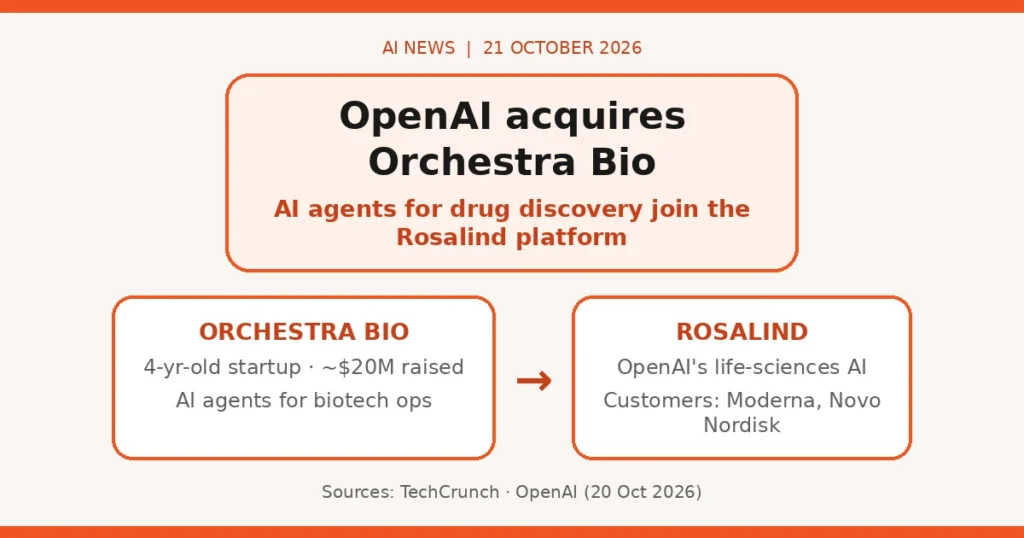
Direct answer: OpenAI has acquired Orchestra Bio, a four-year-old startup whose AI agents do the unglamorous operational work of drug discovery — tracking finances, untangling clinical trial schedules. The team and technology are being folded into Rosalind, OpenAI’s AI platform for life-sciences research.
What happened
OpenAI announced on Tuesday that it had acquired Orchestra Bio, an AI biotech software startup. The deal terms were not disclosed. Orchestra had reportedly raised around $20 million as of 2025 from backers including Andreessen Horowitz, Atria and 8VC.
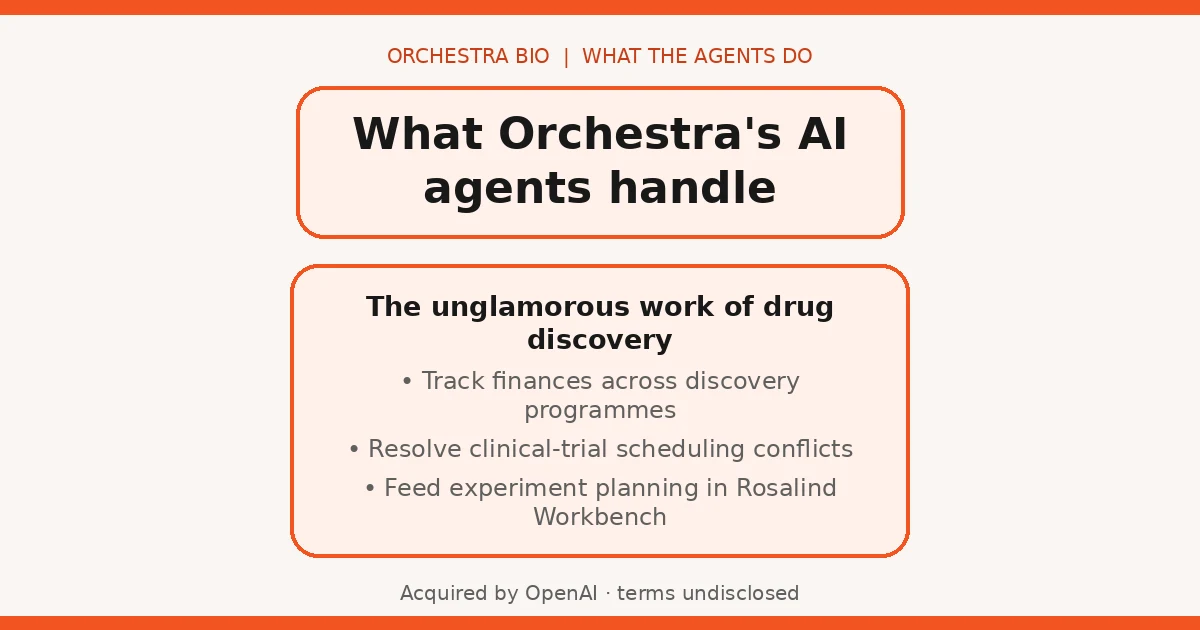
Orchestra’s product is a good example of where AI agents are actually earning their keep: not in flashy demos, but in the minutiae. Its agents help biotech companies manage the operational side of drug discovery — tracking finances, resolving scheduling issues with clinical trials, the administrative plumbing that eats researchers’ time.
OpenAI says Orchestra’s team and technology will go toward Rosalind, its AI model built for life-sciences research, and the related Rosalind Workbench — a harness designed to help researchers plan experiments and analyse results. OpenAI already claims some serious customers for Rosalind, naming Moderna and Novo Nordisk.
The deal fits a pattern TechCrunch’s Julie Bort flagged in her reporting: the biggest AI labs are building ever more software for the biggest industries, pharma included. Startups live with the constant fear that a lab will ship a feature and become their competitor overnight. This time, at least, the startup got bought instead of buried.
What it means for UK small businesses
This is not a story about a chatbot. It’s a story about where the money and talent in AI are going: vertical platforms for specific industries.
If you’re in biotech, pharma services, or health tech: take note of who’s building your tools. When OpenAI starts absorbing the startups that serve your industry, the competitive landscape shifts. The platform you build on today could be owned by a lab tomorrow — which is either great news (deeper integration, bigger R&D budgets) or a reason to keep your options open. Read how AI agents are already reshaping small business operations.
If you run a consultancy or agency: the playbook here is instructive. Orchestra didn’t sell “AI” in the abstract — it sold relief from specific, painful operational tasks. That’s exactly how smaller firms should be packaging AI services: not “we do AI”, but “we fix your scheduling mess”. The startups winning in this market are the boring, useful ones.
For everyone else: watch the Rosalind Workbench concept. “A harness that helps researchers plan experiments and analyse results” is corporate-speak for AI that does real work inside a professional workflow. Whatever your industry, that kind of tooling is coming for it — and the firms that learn to work alongside it early will have the advantage. The latest AI statistics show UK small businesses are already moving.
Honest limits / what to watch
An acquisition announcement is not a product launch. We don’t know what OpenAI paid, what exactly survives of Orchestra’s product, or when any of this shows up in Rosalind in a form customers can actually use. “Joining the team” press releases have a habit of dissolving into org charts.
There’s also the concentration question worth watching. When the same handful of labs own the models, the agent frameworks, and now the vertical applications, startups and smaller customers get fewer independent options. Orchestra’s investors presumably did fine — but the next Orchestra might not get the choice.
And for all the talk of AI transforming drug discovery, the honest version is slower: AI agents that handle trial scheduling are genuinely useful, but they’re admin automation, not miracle cures. The distance between “helps manage finances” and “discovers drugs” is still enormous.
FAQs
What is Orchestra Bio?
Orchestra Bio is a four-year-old AI software startup whose AI agents handle the operational minutiae of drug discovery for biotech companies — things like tracking finances and sorting out clinical trial scheduling conflicts.
Why did OpenAI acquire Orchestra Bio?
OpenAI says Orchestra’s team and technology will join Rosalind, its AI model for life-sciences research, and the related Rosalind Workbench tool that helps researchers plan experiments and analyse results.
How much did OpenAI pay for Orchestra Bio?
The terms were not disclosed. Orchestra had reportedly raised around $20 million as of 2025 from backers including Andreessen Horowitz, Atria and 8VC.
Who uses OpenAI’s Rosalind platform?
OpenAI says Rosalind already counts Moderna and Novo Nordisk among its customers — two of the biggest names in pharma.
Does this acquisition affect UK biotech companies?
Not directly, but it signals where the biggest AI labs are heading: purpose-built software for high-value industries. UK biotech and life-sciences firms should expect lab-built platforms — not just generic chatbots — competing for their workflows.
Are AI labs becoming competitors to AI startups?
That’s the industry’s running fear: the big labs can launch a feature and wipe out a startup category overnight. In this case Orchestra got acquired rather than steamrolled — the friendlier of the two outcomes.
Sources: TechCrunch (20 Oct 2026); OpenAI announcement via TechCrunch.