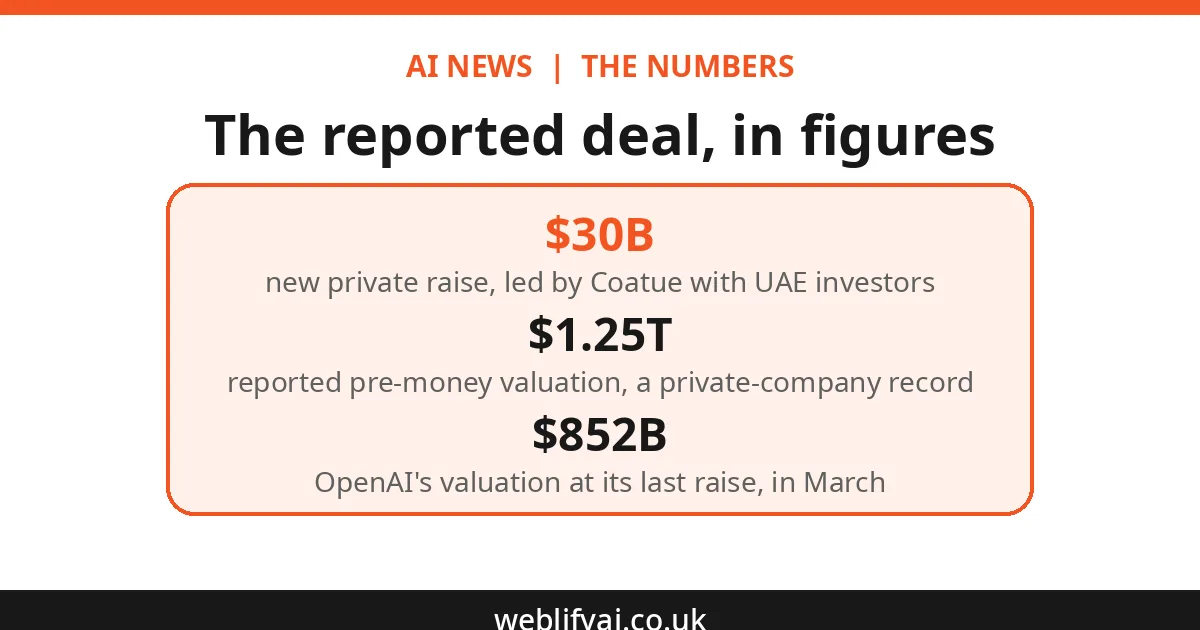

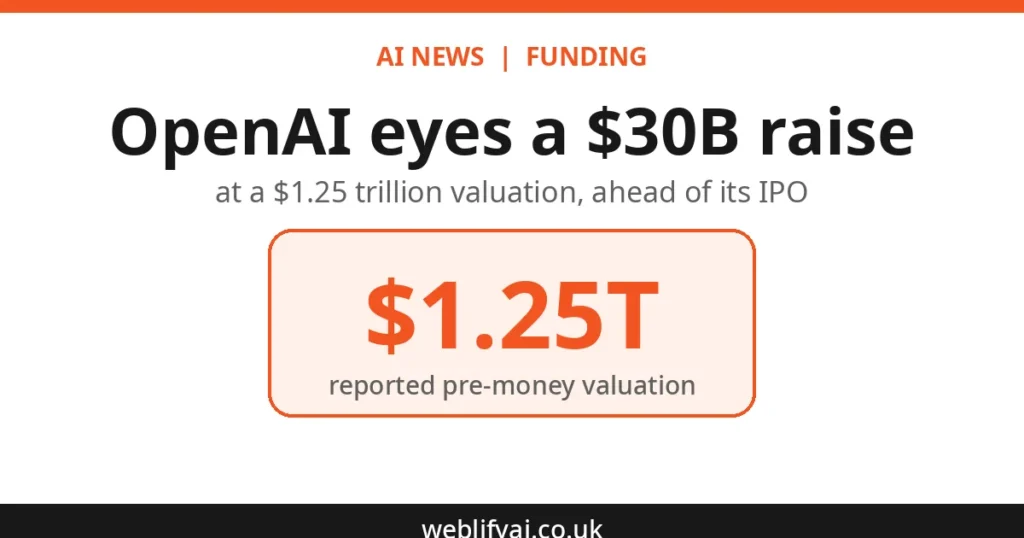
Direct answer: OpenAI is reportedly working on raising up to $30 billion at a $1.25 trillion pre-money valuation in a round led by Coatue with investors from the UAE, according to CNBC. If it lands, it would make OpenAI the most valuable private company in history — and it sets the stage for one of the biggest IPOs ever.
What happened
The report, citing unnamed sources, says the fundraising is in progress but terms are still being negotiated, so the numbers could change. A Bloomberg report a month earlier described a similar $30 billion raise, but at a $1.4 trillion valuation — so the figure has shifted slightly downward, if the reports are accurate.
Two details stand out. First, the UAE’s participation may be coupled with a deal to secure more computing capacity for OpenAI from the Emirates — AI labs are now as hungry for chips and data centres as they are for cash. Second, this comes after OpenAI filed confidential paperwork for an IPO in June, following its last raise in March which valued the company at $852 billion post-money.
The race is not happening in isolation. Anthropic, widely believed to be closer to a public listing, reportedly seeks a $1.5–2 trillion valuation for its own debut, after raising $65 billion at a $965 billion valuation in May. Anthropic also filed confidential IPO paperwork in June, and rumours suggest its public S-1 filing could arrive any day.
What it means for UK small businesses
Valuations like this can feel like another planet from a small firm’s reality — but they shape the tools on your desk. This kind of funding is what pays for the research that pushes models forward and, crucially, pushes prices down. Competition between OpenAI and Anthropic at this scale is why capability keeps rising while per-task costs keep falling.
For a UK small business, the practical takeaway is straightforward: the AI tools you can buy today are better and cheaper than six months ago, and the trajectory is still steep. Firms like Uber are now rolling ChatGPT Work out to all 30,000 employees, which shows how fast enterprise adoption is normalising — and the same models are available to a five-person company in Leeds.
The other lesson is OpenAI’s direction: computing capacity is the bottleneck, and the lab is pairing this raise with compute deals. Expect AI to keep getting more capable in areas that cost you time today — drafting, analysis, customer support — while the infrastructure to run it keeps consolidating around a few giants.
Honest limits: what to watch
This is all still reportage, not a done deal. CNBC and Bloomberg cite unnamed sources, terms are explicitly still being negotiated, and OpenAI declined to comment. The valuation number could move — it already has once, from $1.4 trillion in the Bloomberg report to $1.25 trillion in the CNBC one.
Also keep a sense of proportion: a record private valuation does not mean OpenAI is profitable at this scale, and sky-high expectations are exactly what make bubbles. For your business, none of this changes the fundamentals — pick tools for what they do today, not for the press release.
One more angle worth watching: OpenAI is expanding into biotech and striking compute deals with governments. The company is becoming infrastructure, and infrastructure providers eventually set prices. Small businesses should keep their AI workflows portable rather than locking everything into one vendor.
FAQs
Is the OpenAI $30 billion raise confirmed?
Not yet. Reports from CNBC and Bloomberg, both citing unnamed sources, say OpenAI is working on the raise with terms still being negotiated. OpenAI declined to comment.
What would a $1.25 trillion valuation mean?
It would make OpenAI the most valuable private company ever, roughly half again its $852 billion valuation from its March raise.
Is OpenAI going public?
OpenAI filed confidential IPO paperwork in June. This private raise would happen first and would likely raise the bar for its eventual listing.
What does this mean for Anthropic?
Anthropic, widely believed to be closer to an IPO, reportedly seeks a $1.5–2 trillion public valuation after raising $65 billion at a $965 billion valuation in May.
Should small businesses care about AI company valuations?
Indirectly, yes — the funding flood is what keeps models improving and prices falling. The bigger takeaway is to build on today’s tools rather than wait for tomorrow’s.