Direct answer
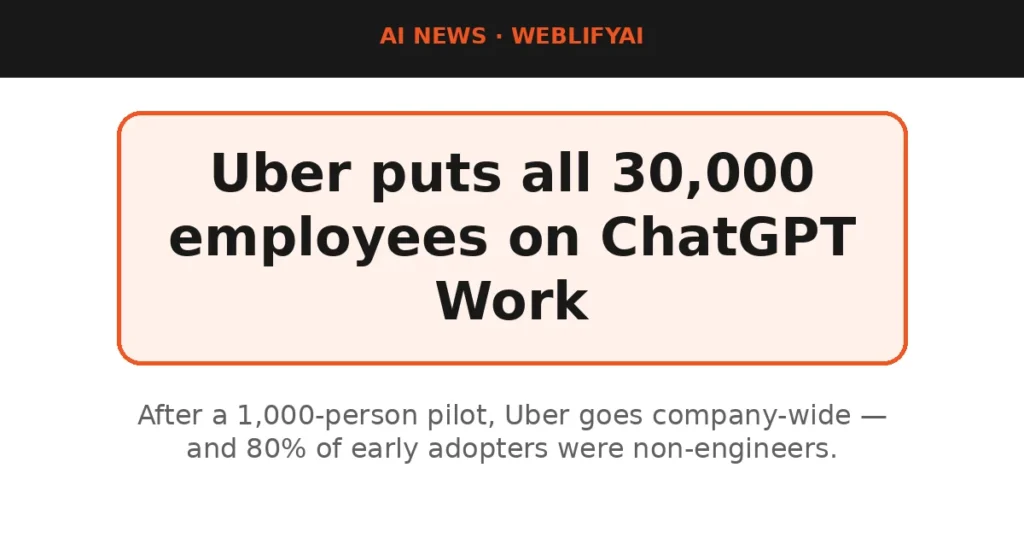
Direct answer: Uber has expanded its OpenAI partnership to roll out ChatGPT Work to its entire global workforce of around 30,000 people, up from a 1,000-person pilot earlier this year. The pilot found 80% of early adopters were non-engineers — finance, operations and product staff — using it for data analysis, localisation and dashboards. Uber has not said what it is spending, but will track usage to guide further AI deployment.
What happened
Uber and OpenAI announced the expansion on Thursday 22 October. The ride-share giant piloted ChatGPT Work — OpenAI’s enterprise AI agent introduced in July 2026 — with 1,000 employees this year, then decided to go company-wide.
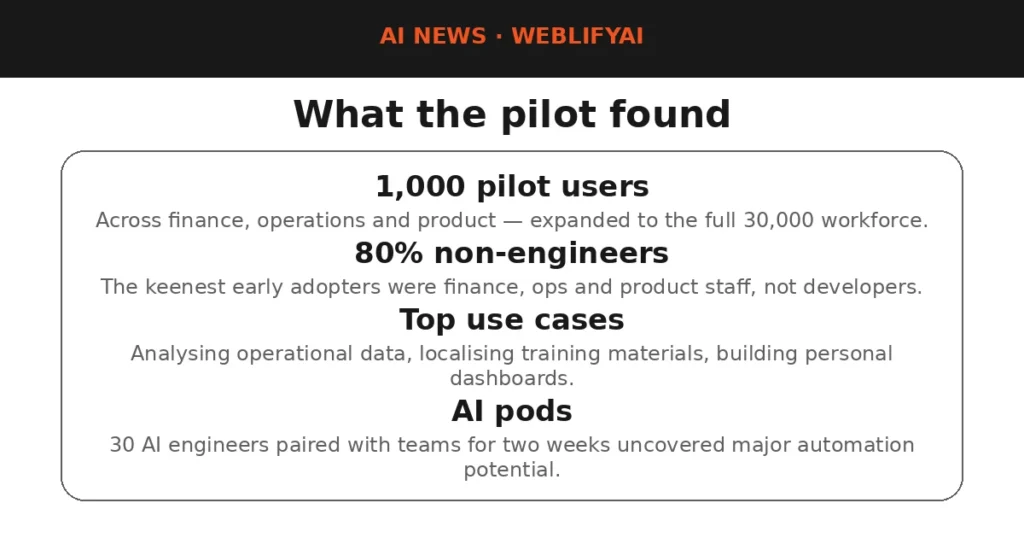
The striking detail from the pilot: most early adopters were not engineers. Uber VP of engineering Sumanth Sukumar told TechCrunch that around 80% were non-engineers from finance, operations and product, using the tool for tasks like analysing complex operational data to spot trends, localising training materials for different markets and languages, and building personalised interactive dashboards for daily work.
Uber also ran “AI pods” earlier this year — pairing 30 AI engineers with teams across the company for two weeks to automate key parts of their jobs. Sukumar said those pods revealed how much opportunity appears when technical expertise meets deep job knowledge.
Notably, Uber has not decided exactly how employees will use the tool. “Our approach is to make powerful AI tools available across Uber while giving teams room to experiment,” Sukumar said. Cost was not disclosed; instead Uber will measure usage patterns, the workflows employees build, and how effectively people work, TechCrunch reports.
What it means for UK small businesses
- Your non-technical staff are the opportunity. If 80% of Uber’s keenest early adopters were non-engineers, your finance, admin, marketing and ops people are too. The barrier is access and encouragement, not skill.
- Copy the “AI pod” idea cheaply. Pair one AI-savvy person with a department for two weeks to find automatable work. No enterprise budget required.
- Start with your own data. Uber’s wins came from analysing operational data and localising materials — every small business has spreadsheets and documents that could benefit.
- Measure outcomes, not hype. Uber’s approach of tracking real workflows before committing further is exactly the discipline smaller firms should copy: pilot, measure, then expand.
If you are exploring agents for your business, our guide to AI agents for UK small businesses and the RapidCanvas $29M raise for agentic AI give useful background.
Honest limits / what to watch
- Uber has not published productivity data — enthusiasm is not the same as measured ROI.
- Enterprise rollouts come with data-governance questions: make sure your own AI use keeps customer data where it should.
- ChatGPT Work pricing for small businesses may differ from Uber’s deal; check OpenAI’s current business pricing.
- “Room to experiment” without guardrails can produce shadow AI; pair access with a simple acceptable-use policy.
FAQs
What is ChatGPT Work?
ChatGPT Work is OpenAI’s enterprise-focused AI agent, introduced in July 2026, that corporate teams can deploy for workflows such as data analysis, localisation and dashboards.
Why is Uber rolling it out to everyone?
A 1,000-employee pilot across finance, operations and product found heavy use among non-engineers. Uber then ran “AI pods” pairing 30 AI engineers with teams for two weeks, which showed big automation potential. The full 30,000-person rollout is an expansion of that.
How much is Uber spending on this?
Uber did not disclose the cost. It says it will track usage patterns, the workflows employees develop, and how effectively they work, and use those outcomes to guide further AI deployment.
What did the pilot find?
Some 80% of early adopters were non-engineers. They used ChatGPT Work to analyse complex operational data, localise training materials across markets and languages, and build personalised interactive dashboards.
What should UK small businesses take from this?
That the biggest AI wins are often not in engineering: finance, admin, marketing and operations staff can pick up serious productivity gains, and a short paired experiment — a non-technical team member plus someone AI-savvy — is a cheap way to find your best use cases.