

What happened
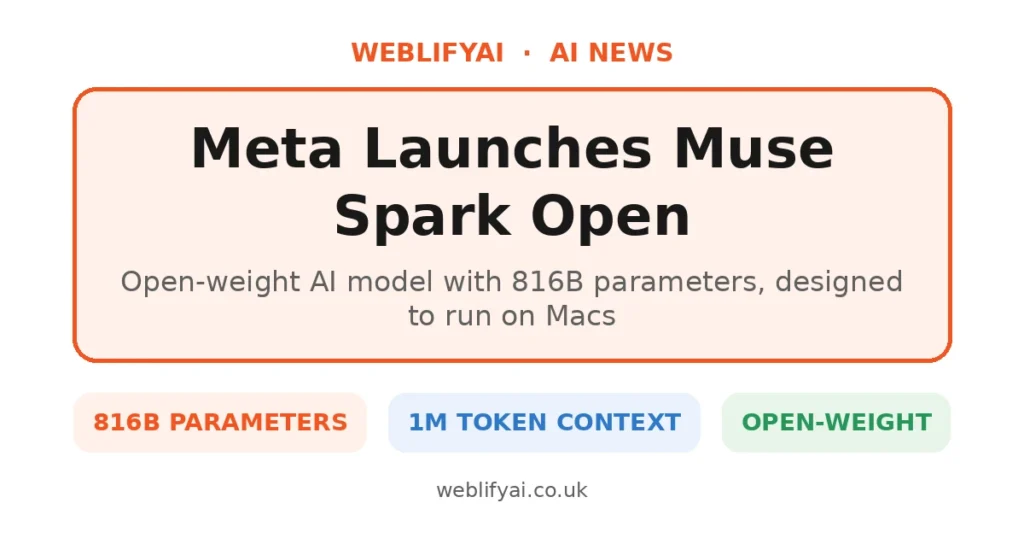
Meta has launched Muse Spark Open, an open-weight AI model it describes as the most capable of its kind in the United States. The numbers are striking: 816 billion parameters and a 1-million-token context window, which puts it among the largest openly available models.
Direct answer: Meta’s Muse Spark Open is a huge, openly available AI model built for coding and agentic tasks — and it’s designed to run locally on a Mac, provided your Mac has an enormous amount of memory (at least 1TB of RAM).
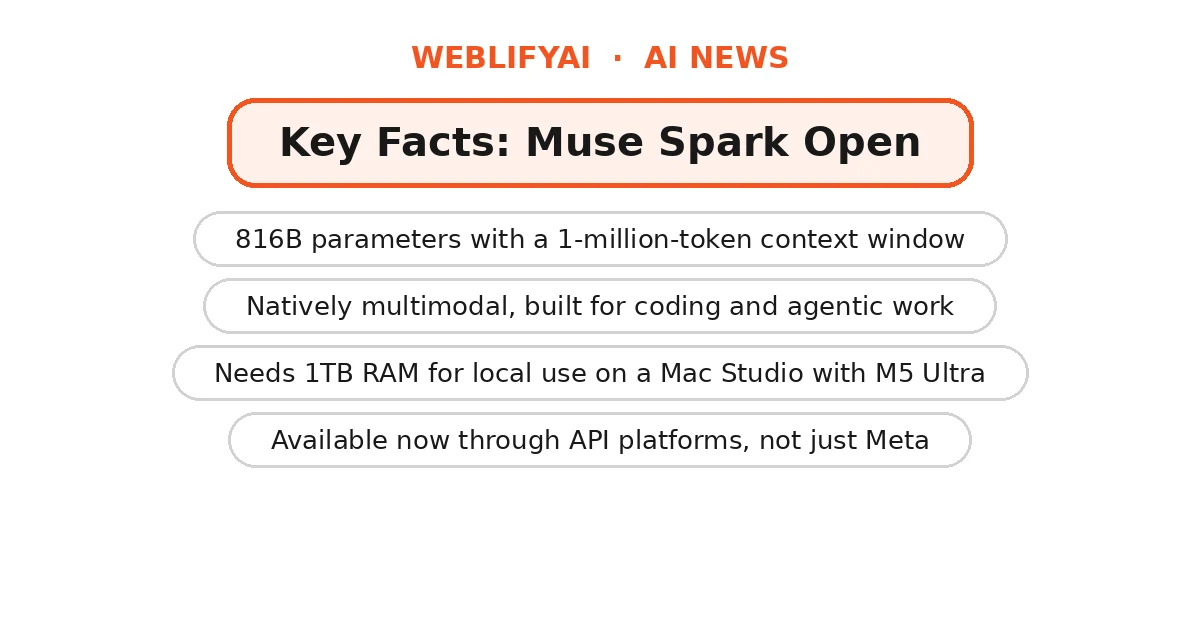
The model is natively multimodal, meaning it can work across text and other media, and Meta has aimed it squarely at complex coding work and AI agents. To show what’s possible, Meta paired it with Muse Code, its AI coding terminal, and set it loose on real tasks: fixing bugs and shipping new features in a Mastodon client, including a full build, and reviewing and cropping footage inside DaVinci Resolve, the professional video editor.
The headline twist is Mac compatibility. Muse Spark Open was designed to run locally on Apple’s computers — a notable step, since models of this size almost always live in data centres. The catch, flagged by reviewers, is hardware: you need at least 1TB of RAM to run it locally, and Meta says it runs best on a Mac Studio equipped with the M5 Ultra chip. For most developers and companies, the practical route will be one of the API platforms Meta is offering the model through.
Open-weight models carry real industry advantages over closed alternatives: they can be much more cost-efficient at scale, and they give developers transparency and flexibility that proprietary models don’t.
Source: TechCrunch
What it means for UK small businesses
- AI you can actually inspect. Open-weight models like Muse Spark Open let a business or its developers see what’s under the hood — useful if you’re in a regulated sector or simply want to know where your data goes. Closed models keep that hidden.
- Coding help is getting cheaper. A model this capable, available via APIs and aimed at agentic coding, pushes down the cost of building custom software and automations. If you’ve been quoted five figures for an internal tool, the economics are shifting in your favour.
- Local doesn’t mean your laptop. Don’t read “runs on a Mac” as “runs on your MacBook”. The 1TB RAM requirement means true local use is for well-funded studios right now — everyone else uses the cloud APIs.
If you’re exploring which AI models actually suit business workloads, our look at Microsoft’s Decision 1 AI model covers a model built with small-business tasks in mind, and our guide to AI agents for small businesses explains how agentic tools fit real workflows.
Honest limits / what to watch
- The performance claims are Meta’s own. The “most capable open-weight model in the US” line and the benchmark results come from Meta’s release materials. Independent evaluations will be the real test.
- The Mac angle is aspirational for now. Requiring 1TB of RAM means this is a Mac Studio with the top chip — not the machine on your desk. Treat the “runs locally” story as a direction of travel, not today’s reality.
- Open weights aren’t the same as open everything. Meta is sharing the weights, but training data and full methodology typically stay closed. Transparency is better than with closed models, not total.
- Cost of running at scale is still real. Open-weight can be cheaper, but a model this large still needs serious compute whether you host it or pay per API call. Get real quotes before committing.
FAQs
What is Meta’s Muse Spark Open?
Muse Spark Open is Meta’s new open-weight AI model, launched on 15 October 2026. Meta describes it as the most capable open-weight model in the US, with 816 billion parameters and a 1-million-token context window.
Can Muse Spark Open run on a normal Mac?
Not exactly. While it’s designed to run locally on Macs, it needs at least 1TB of RAM to run locally, so realistically it suits top-end hardware like the Mac Studio with Apple’s M5 Ultra chip. Most users will access it through API platforms instead.
What is an open-weight model?
An open-weight model publishes its trained parameters openly, so developers can download, inspect and run it themselves. They tend to be cheaper to run at scale and offer more transparency and flexibility than closed, proprietary models.
What tasks is Muse Spark Open built for?
Meta says it’s natively multimodal and aimed at complex coding tasks and agentic work. Meta has paired it with Muse Code, its AI coding terminal, and demonstrated it fixing bugs and adding features to a Mastodon client and reviewing video footage in DaVinci Resolve.
How can I access Muse Spark Open?
Meta is making it available now through a number of API platforms, according to the launch announcement.


