

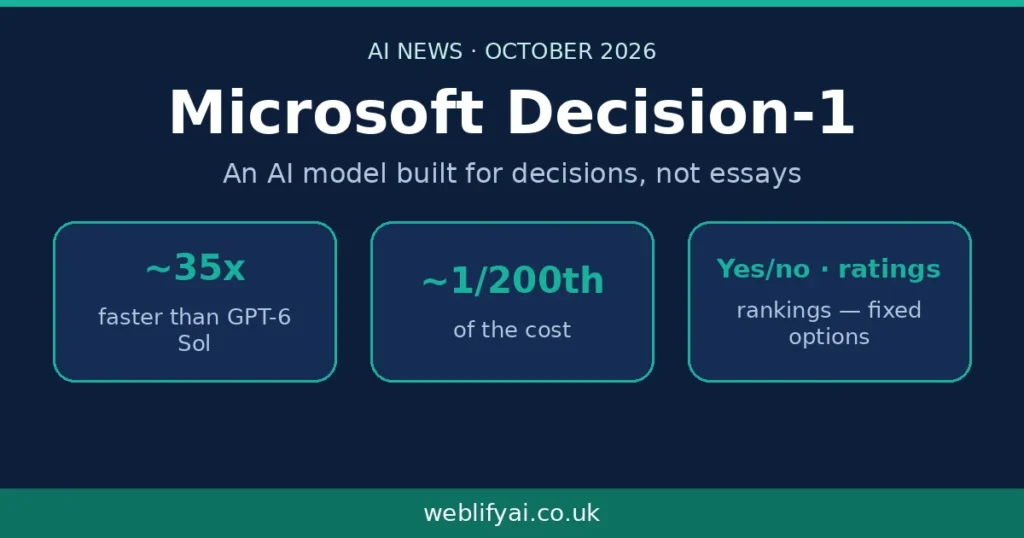
Direct answer: Microsoft has launched Decision-1, a new AI model that doesn’t chat — it decides. Instead of writing free-form answers, it takes a fixed set of options and returns a probability for each, making it dramatically cheaper and faster than general-purpose LLMs for structured choices like yes/no judgments, ratings and rankings. Microsoft reports it is up to roughly 35x faster than GPT-6 Sol in its own testing, at about one-two-hundredth of the cost.
What happened
Microsoft announced Decision-1 on 13 October 2026, a model built specifically for decision-making rather than text generation. The idea is straightforward: most business AI work isn’t really about writing essays. It’s about classifying, routing, ranking, scoring and verifying — tasks where you need a structured answer, not a paragraph.
Decision-1 was built by post-training Qwen3.5-9B, and Microsoft says it plans to rebase the model on its own Microsoft AI (MAI) models and OpenAI models in future versions. It supports yes-or-no judgments, choices among predefined options, ratings, and rubric-based assessments of AI responses and agent actions — and it can evaluate multiple decisions in parallel within a single request, according to Computerworld’s report.
The performance numbers are Microsoft’s own, and they are striking: top accuracy across a 36-benchmark evaluation of nearly 150,000 questions, about 35x faster than GPT-6 Sol, 2.5x faster than H2O-Lightning-4B v1.1, and roughly 1/200th of the cost. Microsoft also tested consistency — modifying equivalent requests in eight ways — and reported an average “decision flip” rate of just 1.3%, plus safety testing across 5,250 requests covering harmful content, jailbreak attempts and prompt injection. As independent analysis notes, these are Microsoft-run measurements, and developers will need to benchmark it on their own traffic.
What it means for UK small businesses
This one matters for UK SMEs not because of the model itself — most small firms won’t touch Decision-1 directly — but because of what it signals: AI is splitting into specialist parts, and the decision layer is getting cheap. Practical implications:
- Cheaper automation of judgment calls. Tasks like triaging support tickets, scoring job applications, flagging suspicious transactions or grading supplier quotes are yes/no and ranking decisions. Models like this could make those workflows affordable at SME scale, cutting the per-decision cost of AI by orders of magnitude.
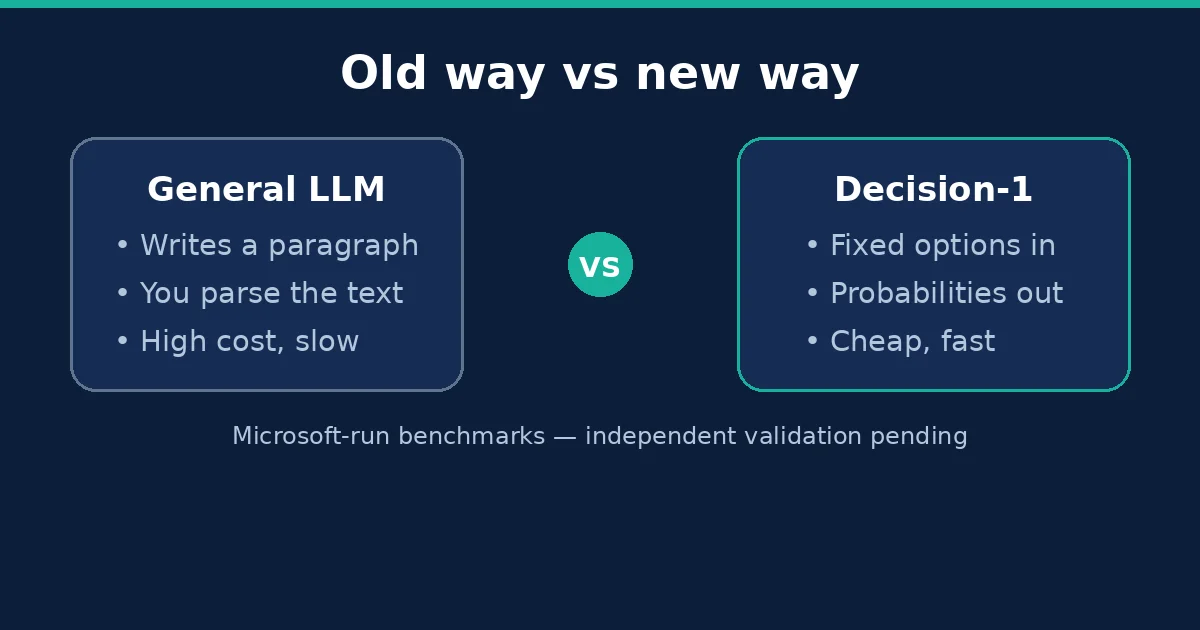
- More reliable AI agents. If you run — or are sold — AI agents for your business, the weakest point is usually the agent’s own judgment about what to do next. A dedicated decision layer that returns calibrated probabilities is a much safer foundation for agent workflows than asking a chatbot “so what should we do?” — and expects the agent to parse its own paragraph.
- Quality control at scale. Anyone using AI-generated content or responses can use a decision model as a checker: is this response on-brand, is it accurate, does it need human review? That’s rubric-based assessment, exactly what Decision-1 is for.
Honest limits / what to watch
Don’t let the headline numbers carry you away. Everything quoted above comes from Microsoft’s own evaluations — there is no independent third-party validation yet, and real-world accuracy will depend on your data, your definitions of “yes” and “no”, and how stable those definitions stay. The model also can’t do anything open-ended: no explanations, no reasoning traces, no planning. If your task can’t be reduced to predefined options, it’s the wrong tool.
Watch for the rebasing plans too — the Qwen3.5-9B base may matter for licensing and data-sovereignty questions some UK firms care about, and whether the MAI/OpenAI-based versions differ in behaviour is unknown. As always, pilot on your own traffic before trusting a vendor benchmark.
FAQs
What is Microsoft Decision-1?
Decision-1 is a new AI model from Microsoft designed for structured decision-making. It takes a fixed set of answer options and returns a calibrated probability for each one in a single pass, instead of generating free-form text.
How is Decision-1 different from ChatGPT-style models?
General-purpose LLMs write natural-language responses that software then has to interpret. Decision-1 outputs structured probabilities for predefined answers — yes/no, ratings, rankings — that applications can consume directly, which cuts cost and latency.
What tasks is Decision-1 good at?
Classifying requests, prioritising incidents, ranking work, verifying AI-generated responses, safety filtering, routing between models, and deciding next actions in AI agent workflows. Anything open-ended — writing, explaining, planning — is out of scope.
Are the speed and cost claims verified?
No, not independently. The ~35x speed and ~1/200th cost figures are from Microsoft’s own testing against GPT-6 Sol. They are promising but directional; real-world validation is still needed.
Should my small business use Decision-1?
Probably not directly — it’s a developer tool accessed through Microsoft Foundry. But expect the AI tools you buy (support automation, agents, quality-control features) to get cheaper and more reliable as this kind of specialist model reaches them.


