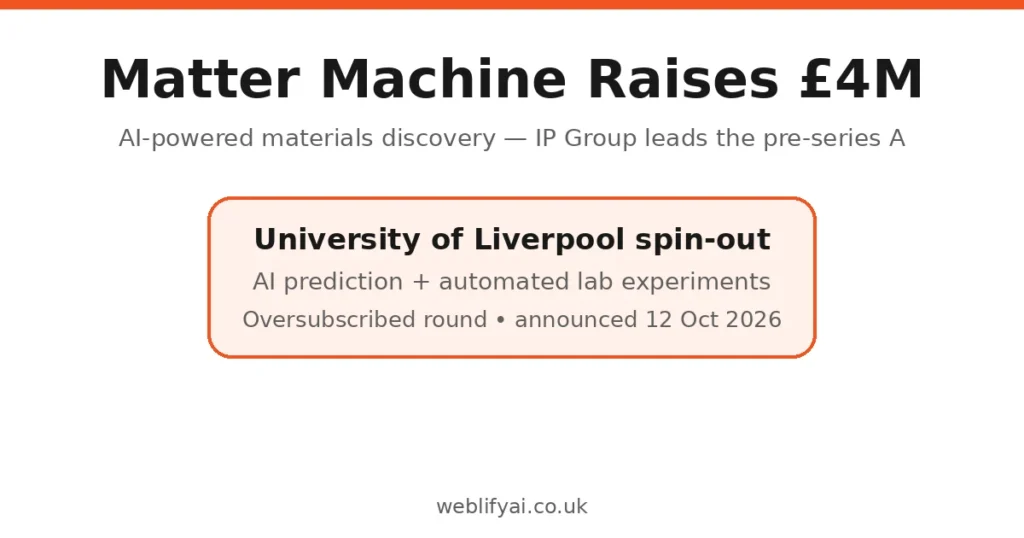
Direct answer: Matter Machine, an AI-driven materials discovery company spun out of the University of Liverpool, has closed an oversubscribed £4m pre-series A funding round led by IP Group, announced on 12 October 2026. Dr Gordon Sanghera CBE — the co-founder and former CEO of Oxford Nanopore — has joined to lead its commercialisation. The company combines materials chemistry, automated lab experiments and machine learning to find new materials faster, aimed at batteries, catalysts and advanced manufacturing.
What happened
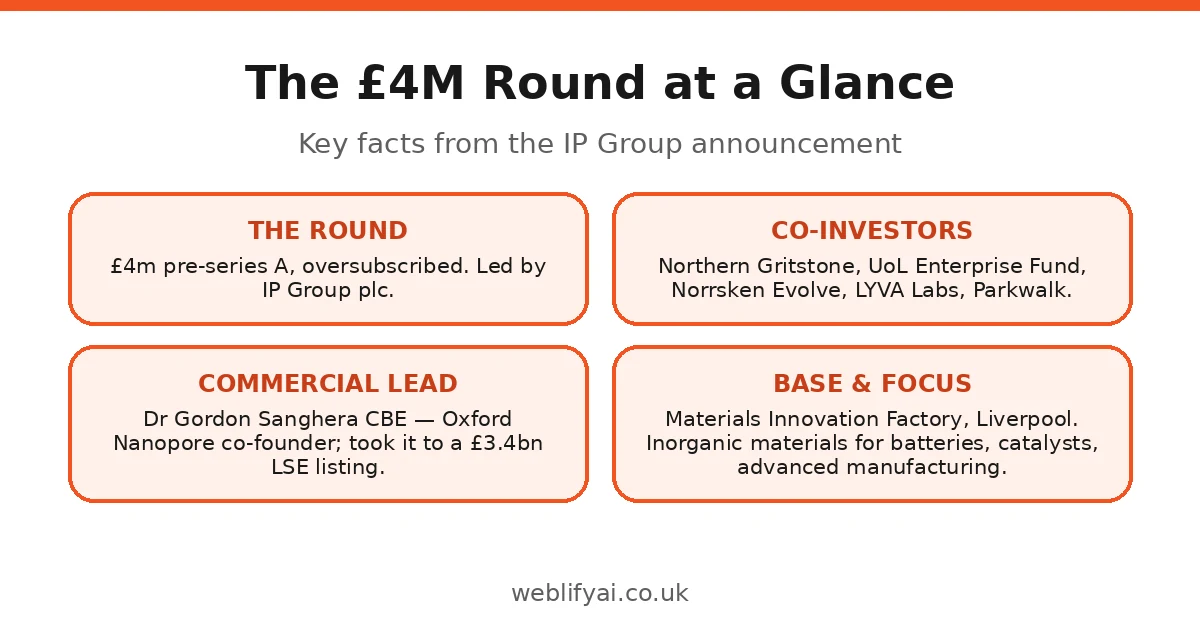
IP Group plc announced on Monday that it led an oversubscribed £4m pre-series A round into Matter Machine, a University of Liverpool spin-out building an inorganic crystalline materials discovery platform. The company’s approach combines deep experimental and materials characterisation expertise with AI prediction, aiming to dramatically shorten how long it takes to identify and optimise novel materials.
Alongside IP Group, the round drew investment from Northern Gritstone, the University of Liverpool Enterprise Fund, Norrsken Evolve, LYVA Labs and the Northern Universities Venture Fund managed by Parkwalk, IP Group’s EIS fund management business. It is the largest investment secured by a newly formed University of Liverpool spin-out.
The headline hire is Dr Gordon Sanghera CBE, co-founder and former chief executive of Oxford Nanopore Technologies, who joins Matter Machine to lead its commercialisation strategy. Dr Sanghera helped build Oxford Nanopore from its beginnings through to a £3.4bn listing on the London Stock Exchange, and IP Group’s chief executive Greg Smith said his appointment reflected the ambition behind the company — noting Matter Machine could dramatically shorten the time required to develop new materials across batteries, catalysts and advanced manufacturing.
Matter Machine’s founder is Professor Matt Rosseinsky OBE FRS, who said the combination of advanced materials science and AI creates a powerful opportunity to transform how new materials are discovered. The company is headquartered at the university’s Materials Innovation Factory — an £81m centre for advanced materials discovery co-created with Unilever — and contributes to the AI Materials Hub for Innovation (AIM-HI) programme, which aims to position Liverpool and the UK as leaders in AI-enabled materials research. The raise is also the first investment under the university’s multi-year partnership with Northern Gritstone, the venture building company chaired by Lord Jim O’Neill.
What it means for UK small businesses
No small business is buying AI-designed battery materials this year. But this round is worth your attention for three reasons.
First, it shows where investor money thinks the value is. Funding rounds are a forecast: serious investors are betting that AI-guided materials discovery will cut the time and cost of innovation in batteries, catalysts and advanced manufacturing over the next decade. If your business depends on batteries — tools, EVs, equipment, energy storage — or on industrial inputs, the long-run direction is toward cheaper, better-performing materials. You don’t need to act today, but this is the kind of story to file under “why supplier quotes may look different in five years.”
Second, it’s a regional signal. This is Liverpool, not the usual Oxford-Cambridge-London triangle, and it’s the biggest spin-out raise the University of Liverpool has seen. AI adoption and investment aren’t only a southern story — UK small businesses across the country are already moving — and regional deeptech hubs create regional supply chains, partnerships and skilled jobs. If you run a manufacturer in the North West, the Materials Innovation Factory and the AIM-HI programme are now on your radar as potential future partners.
Third, it underlines the pattern behind the funding. Matter Machine’s formula — AI prediction plus automated experimentation plus domain expertise — is the same pattern succeeding elsewhere: AI proposes, the real world tests. That pattern applies to ordinary firms too. You don’t need a chemistry lab to benefit from pairing AI suggestions with fast, disciplined real-world testing — that’s exactly what AI tools for quoting, design iteration or demand forecasting do.
Honest limits / what to watch
A £4m pre-series A is a bet, not a result. Watch what follows before drawing conclusions:
- The lab bottleneck is real. AI can propose thousands of candidate materials in silico; each still has to be synthesised, characterised and tested physically. That validation step is slow and expensive, and it’s where materials-discovery startups live or die. An oversubscribed round reflects investor appetite — it doesn’t prove the platform works at commercial scale.
- Timelines are long. Nobody should expect new commercial materials this year or next. “Addressing societal needs in energy and sustainability over the next decade” is the company’s own framing — a decade, not a quarter.
- The Sanghera effect cuts both ways. His Oxford Nanopore track record is genuinely strong, but star hires don’t derisk science. What to actually watch: peer-reviewed publications from the Rosseinsky group’s work feeding into the company, and named commercial partnerships beyond the funding announcement.
- Northern Gritstone’s first Liverpool investment is worth tracking. The university–Northern Gritstone partnership is new; whether it produces more companies like this will tell you if this is a pipeline or a one-off.
Sources: IP Group RNS announcement via Reuters/TradingView and TipRanks
FAQs
What is Matter Machine?
Matter Machine is an AI-driven materials discovery company spun out of the University of Liverpool. It combines materials chemistry, automated experimentation and machine learning to accelerate the discovery and optimisation of novel materials, with a focus on inorganic crystalline materials.
Who led the £4m funding round?
The oversubscribed £4m pre-series A round was led by IP Group plc, with investment from Northern Gritstone, the University of Liverpool Enterprise Fund, Norrsken Evolve, LYVA Labs and the Northern Universities Venture Fund managed by Parkwalk. The round was announced on 12 October 2026.
Who is leading Matter Machine’s commercialisation?
Dr Gordon Sanghera CBE, co-founder and former CEO of Oxford Nanopore Technologies, has joined Matter Machine to lead its commercialisation strategy. He helped build Oxford Nanopore from inception to its £3.4bn London Stock Exchange listing.
What kinds of materials is Matter Machine trying to discover?
The company’s platform targets inorganic crystalline materials with applications in batteries, catalysts and advanced manufacturing — addressing energy and sustainability needs over the coming decade.
When will small businesses see any benefit from this?
Not quickly. This is pre-series A research funding — commercial materials are years away, and every AI-suggested material still has to be synthesised and tested in the lab. The realistic near-term effect for small firms is as a signal: UK deeptech funding is flowing into regional hubs like Liverpool, and supply chains in batteries and advanced manufacturing are where the payoff will eventually land.
Why does this matter for the North of England?
The raise is the largest investment secured by a newly formed University of Liverpool spin-out, and the first investment under the university’s multi-year partnership with Northern Gritstone. Matter Machine is based at the university’s Materials Innovation Factory and contributes to the AI Materials Hub for Innovation programme — part of positioning Liverpool as a centre for AI-enabled materials research.