

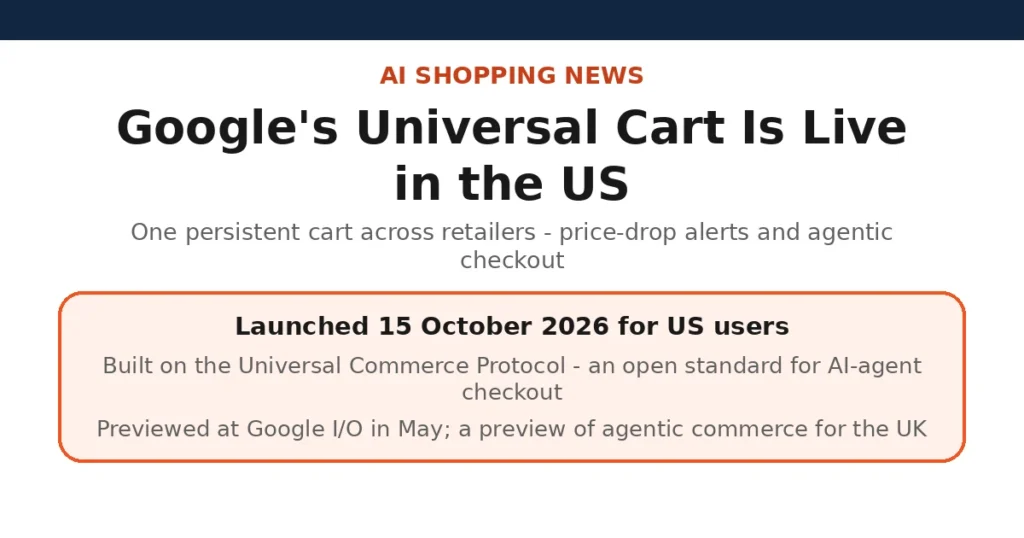
Direct answer: Google has launched Universal Cart, a shopping tool that collects products you spot across Google Search and the Gemini app into one persistent, cross-retailer cart. It’s live for US users now — and it’s Google’s clearest signal yet that AI agents are about to sit between shoppers and checkout.
What happened
TechCrunch reports that Universal Cart, which Google first previewed at its I/O developer conference in May, became available to US users on Thursday, 15 October 2026:
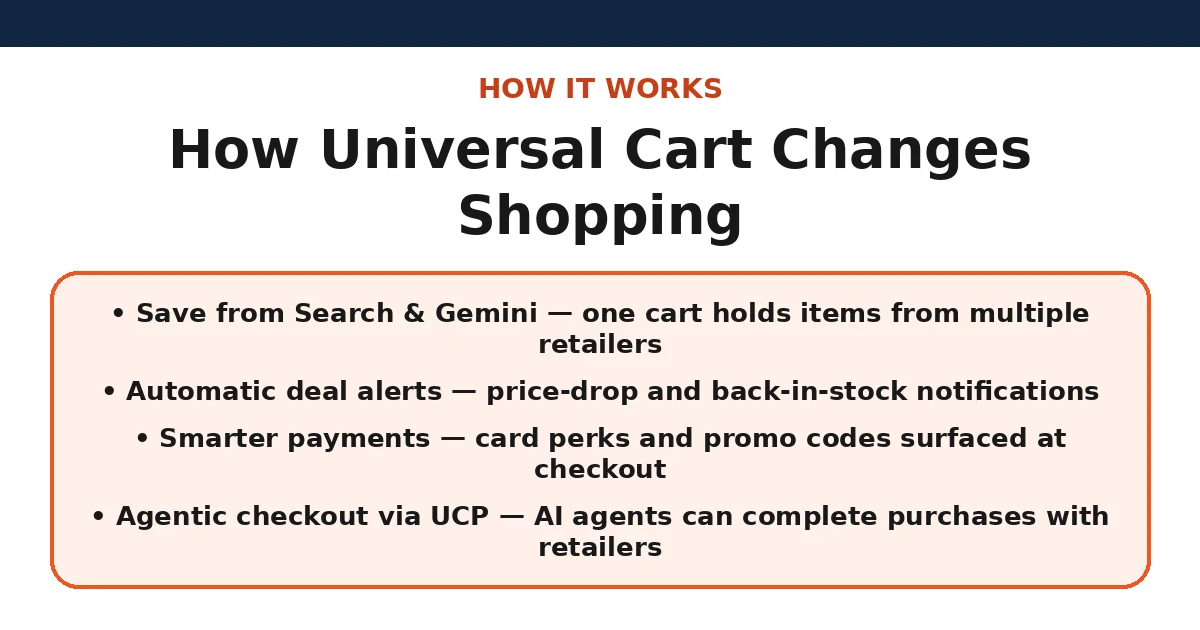
- One cart, many retailers. Find something you like, save it, and move on — when you come back, your items and shopping progress are still there, without having to re-hunt the same products or start over. The cart can collect items from multiple retailers, acting as a central hub for browsing and tracking potential purchases.
- Proactive deal alerts. The tool sends notifications when a saved product’s price drops, or when an out-of-stock item comes back into stock.
- Smarter payment help. Google says the tool can take your credit card perks into account when helping you choose how to pay, and surfaces relevant promo codes during checkout.
- Agentic checkout under the hood. Checkout is tied to Google’s Universal Commerce Protocol (UCP), an open standard introduced earlier this year that lets AI agents and retailers work together across the shopping journey — including actually completing the purchase.
Universal Cart joins a growing set of AI shopping features from Google: conversational product discovery in Search’s AI Mode, and the “Let Google Call” tool, which uses an AI agent to phone nearby stores and check whether an item is in stock. And Google isn’t alone — Amazon, OpenAI and others have all added agentic commerce features this year as chatbots move from answering questions to doing things.
What it means for UK small businesses
Universal Cart is US-only today, but the pattern it sets matters for any UK business that sells online:
- Discovery is moving into AI summaries. Shoppers are starting journeys in a chatbot or a saved cart rather than on a search results page. The businesses that show up are the ones with clean, structured product data — accurate prices, real stock levels, good images, genuine reviews. If your product feed is sloppy, an agent may skip you entirely. Our guide to agentic commerce for brands covers what “being visible to agents” looks like in practice.
- Your checkout needs to be agent-ready. The Universal Commerce Protocol is open, which means any retailer can plug in — but only if your checkout flow is clean, standard and trustworthy. Fiddly checkouts with surprise fees get filtered out by agents faster than they do by human shoppers. This is a good moment to audit your online purchase path.
- Price monitoring just got easier for customers. Price-drop alerts across retailers mean your prices are now transparently comparable in one view. Competing purely on price becomes harder — but it also raises the value of things agents can’t easily compare: service, expertise, delivery speed, and trust.
- Small businesses can use the same playbook. The same AI agent technology Google is building for shopping can power your customer service, quoting and follow-up. The businesses winning in the next two years won’t necessarily be the biggest — they’ll be the ones where AI handles the routine while humans handle the relationships.
Honest limits / what to watch
- US-only, for now. There’s no UK launch date. Agentic commerce is coming to Britain, but on Google’s timetable — UK retailers get a preparation window, not a live tool.
- The agent is still the middleman. If a Google agent summarises your product to a shopper, your brand story, upsells and cross-sells may never be seen. Businesses that rely on storytelling or high-touch selling need to think about what survives the agent’s summary.
- UCP adoption is the real question. An open standard only matters if retailers adopt it. Watch whether major UK retailers and platforms plug in over the next few quarters — that’s the signal this is moving from demo to infrastructure.
- Privacy and trust trade-offs. The tool needs deep access to your shopping behaviour to work well. Expect scrutiny — and customer hesitation — around how much Google learns about purchasing habits.
- Google isn’t alone, and the standards war is on. Amazon, OpenAI and others are building their own agentic commerce rails. Fragmentation could slow the whole thing down, or produce several incompatible agent-checkout systems.
FAQs
What is Google’s Universal Cart?
Universal Cart is a shopping tool from Google that collects products you find across Google Search and the Gemini app into one persistent cart. It can pull items from multiple retailers, send price-drop and back-in-stock alerts, factor in credit card perks when you pay, and surface relevant promo codes.
Is Universal Cart available in the UK?
Not yet. Google launched Universal Cart for US users on 15 October 2026, after first previewing it at Google I/O in May. There is no confirmed UK launch date, but the underlying technology is built for cross-border commerce.
What is the Universal Commerce Protocol?
The Universal Commerce Protocol (UCP) is an open standard Google introduced earlier in 2026. It is designed to let AI agents and retailers work together across the shopping journey, including checkout — so an AI assistant can complete a purchase on your behalf at a participating retailer.
How is Universal Cart different from Google Shopping?
Google Shopping is a comparison surface you visit and leave. Universal Cart is persistent and proactive: saved items and shopping progress stay in one place across retailers, and it pushes alerts about price drops and availability instead of waiting for you to check.
What does agentic checkout mean for small retailers?
It means the buying decision may increasingly happen inside an AI agent’s summary rather than on your product page. Retailers that feed clean, structured product data — accurate prices, stock levels, images and reviews — to systems like Google’s are more likely to be recommended when an agent does the choosing.


