

Direct answer: AI agents are no longer a shopping experiment — they’re a shopping layer. Meta’s Muse is already pulling purchases away from Amazon (Business Insider, October 2026), and both Muse and ChatGPT Dots can shop for users, with brands scrambling to get included (Forbes, October 2026). If you sell in the UK, the question is no longer “will AI agents shop?” — it’s “will they pick mine?” Here’s what agentic commerce is, the evidence it’s live, and the playbook for getting your products recommended.
If you’ve been following our coverage of Muse AI UK availability and the OpenAI Dots UK lockout, you know the agents exist. This is the other half of the story: the commercial upside — and the work brands need to do right now.
What Is Agentic Commerce, Exactly?
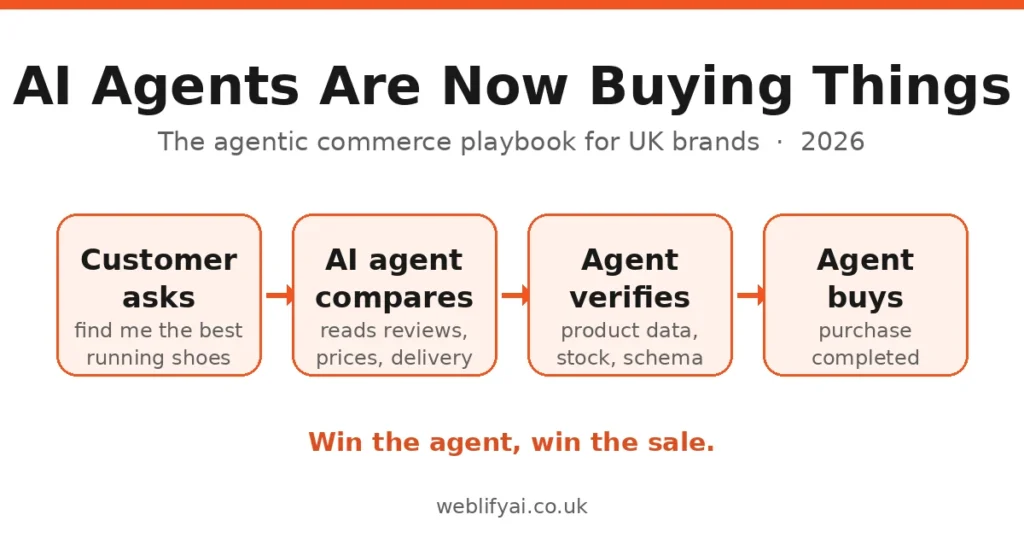
Agentic commerce is what happens when an AI agent does the shopping instead of your customer. The customer says “find me the best running shoes under £80 that arrive by Friday” — and an agent like Meta Muse or ChatGPT Dots compares options, reads reviews, checks prices and delivery dates, and completes the purchase. The human approves; the agent executes.
In traditional ecommerce, you optimise for a human who scrolls and compares tabs. In agentic commerce, your audience is software: it doesn’t see your hero banner — it reads your structured data and picks a winner in seconds. It changes who the buyer is.
The Proof It’s Already Happening
This isn’t a forecast — the receipts are dated this week:
- Forbes (October 6, 2026): “Meta Muse And ChatGPT Dots Can Shop For You — Now Brands Want In.” Brands are actively working out how to get into agent recommendations.
- Business Insider (October 6, 2026): Muse is pulling purchases away from Amazon — redirecting buying behaviour, not just assisting it.
- Forbes: Shopify and Amazon are taking opposite approaches to agentic checkouts. When the two biggest commerce platforms disagree on strategy, the shift is real.
- Google Trends data: “muse for small business” is a Breakout rising query in the US; “chatgpt dots” is up 900% in the US and 350% in the UK.
Agentic checkouts are live, the platforms are positioning, and brands are already competing for agent attention. The only question is whether you’re in the race or watching it.
Amazon vs Shopify: Two Opposite Bets on the Agent Future
Amazon’s instinct is to keep customers inside Amazon: it has reportedly moved to block Muse from its shopping flows, because if an AI picks the product, Amazon’s sponsored listings lose their grip. Shopify’s instinct is the opposite — open the pipes and let agents check out directly on independent stores, turning every small merchant’s site into an agent-readable storefront.
| Amazon’s approach | Shopify’s approach | |
| Stance on agents | Defensive — reportedly blocking Muse from shopping flows | Open — building for agentic checkouts |
| Who controls the recommendation | Amazon’s own algorithms | The agent (and whoever it picks) |
| Winner | Amazon keeps the customer in-house | Independent stores get a new sales channel |
| Risk | Agents route around Amazon entirely | Fragmented standards across stores |
For a UK brand, the takeaway is practical: don’t bet everything on one platform’s approach. The agent layer sits above all of them — win by being readable, verifiable and buyable to any agent, wherever the customer is.
How Agents Actually Choose: The Mechanics Nobody Explains
When a customer asks an agent for a product, it doesn’t browse the way you do — it queries. It pulls product feeds, reads schema.org markup, checks reviews, verifies prices and stock, compares delivery options, and synthesises a recommendation in seconds. That means three things:
- Your data is your storefront. The agent never sees your design. It reads your Product schema, price feed and availability signals. Sloppy data means you don’t get considered.
- Consistency is credibility. If your price on Google Shopping differs from your site, the agent flags the conflict. A person shrugs at inconsistency; an agent disqualifies.
- Reviews are trust infrastructure. An agent can’t try your product, so it proxies trust through reviews — volume, recency, authenticity. Fake or thin reviews aren’t just a marketing problem now; they’re a disqualification risk.
None of this requires new technology on your side. It requires boring, disciplined data hygiene — the kind most businesses keep postponing.
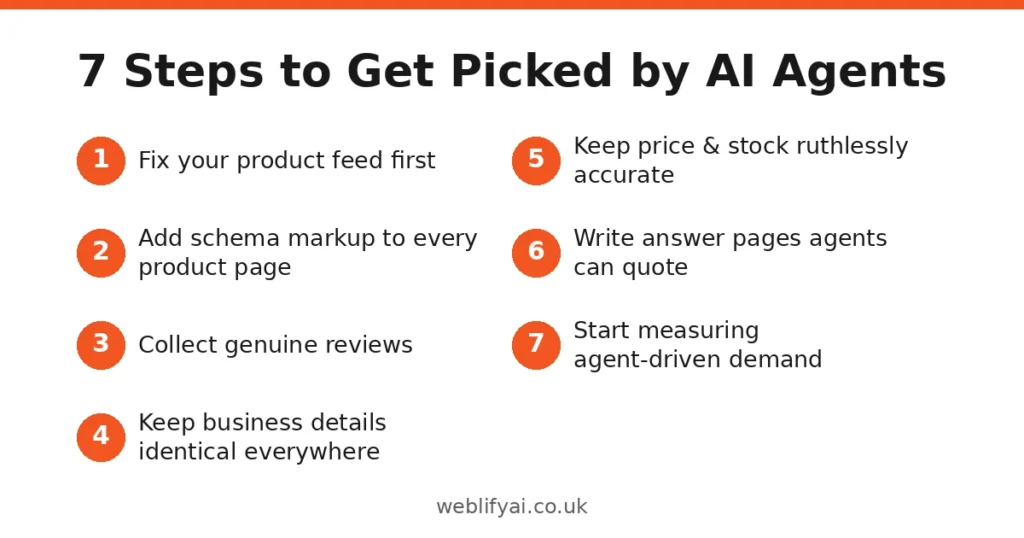
The UK Brand Playbook: 7 Steps to Get Picked by Agents
Here’s the practical work, ordered by impact.
1. Fix your product feed first
Your product feed — every product with price, availability, attributes and images — is the single most important asset in agentic commerce. Submit it to Google Merchant Centre, refresh it daily for price and stock, and populate every required attribute. A stale feed teaches agents not to trust you.
2. Add proper schema markup to every product page
Schema.org Product markup tells machines exactly what they’re looking at: name, price, currency, availability, brand, ratings, images. Run your key pages through Google’s Rich Results Test and fix what’s missing — the cheapest high-impact work on this list.
3. Treat reviews as infrastructure, not decoration
Actively collect genuine reviews — on Google, your site, category platforms — and respond to them. Never fake them: getting caught destroys the trust signal entirely. Volume plus recency plus authenticity is the formula.
4. Make your business details identical everywhere
Name, address, phone, hours, delivery areas — identical, character for character, on your site, Google Business Profile, directories and social profiles. Inconsistency a human would never notice is exactly what trips up machine verification.
5. Keep price and availability ruthlessly accurate
Nothing kills agent trust faster than an out-of-stock or mispriced recommendation. If your inventory system and website disagree, fix the plumbing first — agents remember which sources were wrong.
6. Write answer pages agents can quote
Agents recommend businesses they can cite. Clear pages that directly answer buyer questions — sizing, compatibility, delivery, returns, comparisons — in plain language become the sentences agents repeat. This is the same discipline as our generative AI SEO guide: be the clearest answer, not the loudest voice.
7. Start measuring agent-driven demand
You can’t optimise what you don’t measure. Watch for the signals: referral patterns that don’t look like human browsing, agent user-agent strings in your logs, customers mentioning they were “recommended” something. The brands that build measurement early will see the shift first.
Agentic Commerce vs Traditional Ecommerce SEO
| Traditional ecommerce SEO | Agentic commerce optimisation | |
| Audience | Human shoppers | AI agents |
| Goal | Rank in results, earn the click | Be named in the agent’s answer |
| Key asset | Category and product page copy | Structured product data and feeds |
| Trust signal | Backlinks and domain authority | Reviews, consistency, verifiable data |
| Conversion | Happens on your site | Often happens inside the agent |
| Measurement | Clicks, rankings, sessions | Recommendations, agent referrals |
| Speed of change | Gradual algorithm updates | Live now, evolving monthly |
Notice what doesn’t change: the fundamentals of being a trustworthy business. What changes is the interface — and the interface is now a machine reading your data, not a person reading your copy.
What Not to Do
- Don’t chase “agent optimisation” snake oil. Anyone selling a proprietary “agentic SEO” tool with secret methods is selling certainty that doesn’t exist. The playbook above is public, boring and effective.
- Don’t block agents out of fear. Blocking agent traffic might feel protective, but it’s the equivalent of delisting yourself from Google in 2005. You don’t win by hiding from the new channel.
- Don’t neglect the human experience. Agents handle the finding; humans handle the receiving. Packaging, delivery, returns, service — still entirely human, and what earns the review that feeds the next recommendation.
FAQs
What is agentic commerce?
Shopping where an AI agent — not a human — compares products and completes the purchase. The customer asks an agent like Meta Muse or ChatGPT Dots to find the best option, and the agent decides what gets recommended and bought.
Can AI agents really buy things now?
Yes — it’s live. Business Insider (October 2026) reports Meta’s Muse is pulling purchases away from Amazon, and Forbes reports both Muse and ChatGPT Dots can shop for users, with brands racing to get included.
How is agentic commerce different from ecommerce SEO?
Ecommerce SEO is about ranking for humans to click. Agentic commerce is about being the product an AI agent names in its answer — it reads your structured data, prices, availability and reviews, then picks a winner. Optimisation shifts from clicks to being cited.
Do I need to be on Amazon for agentic commerce?
No. Shopify and Amazon are taking opposite approaches (Forbes, October 2026), and a well-structured independent store with clean product data can be picked just as easily. What matters is machine-readable product information, wherever you sell.
What is the most important thing to fix first?
Your product data feed and structured markup. Agents choose from what they can verify: accurate prices, live availability, clear attributes, genuine reviews. A stale feed or missing schema makes you invisible.
Will agentic commerce replace my website?
No — it makes your website’s data more important. The agent still reads your product pages, reviews and structured data; it just skips the browsing. Clean, consistent, well-marked-up product information wins.
How can a UK small brand compete with big retailers here?
This shift favours the nimble: a small brand can fix feeds, schema and reviews in days; a retail giant needs quarters. Agents don’t care about your brand budget — they care about verifiable data. Our generative AI SEO guide covers the foundations.


