
Direct answer:
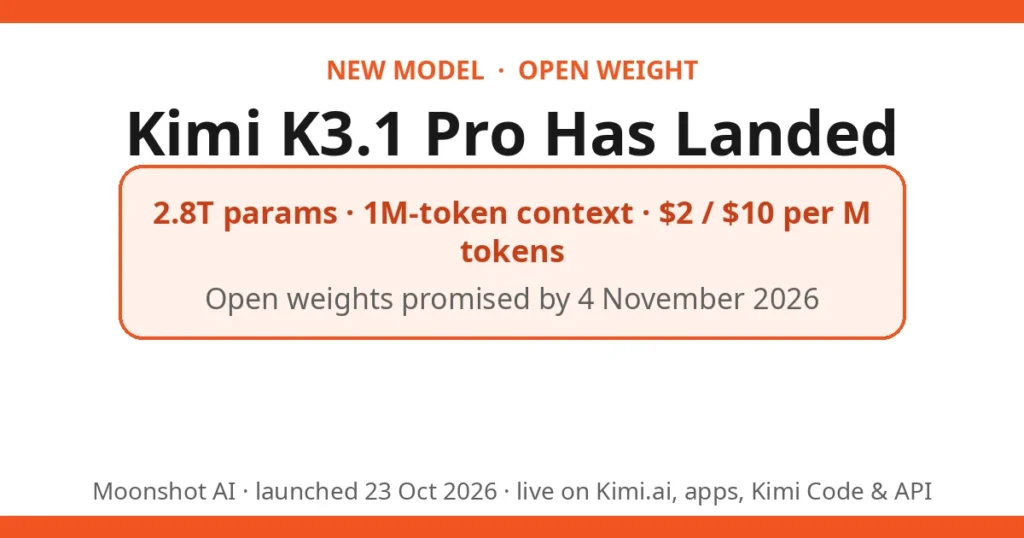
Moonshot AI has launched Kimi K3.1 Pro — an open-weight model that, on the company’s own figures, sits within a point of Anthropic’s Claude Opus 5.5 on hard coding-agent tests. Launched on 23 October 2026, it’s live now through Moonshot’s apps and API, with the full model weights promised by 4 November. At $2 per million input tokens, it’s also dramatically cheaper than the closed frontier models it’s chasing.
What happened
Moonshot AI, the Chinese startup behind the Kimi line, introduced Kimi K3.1 Pro on 23 October 2026 — the first model in its new K3.1 series. It is a post-trained version of Kimi K3 (2.8 trillion total parameters, 104 billion active per token through a mixture-of-experts architecture), upgraded with what Moonshot says is far more reinforcement learning across “hundreds of downstream domains.” It keeps a 1-million-token context window and accepts text and image input.
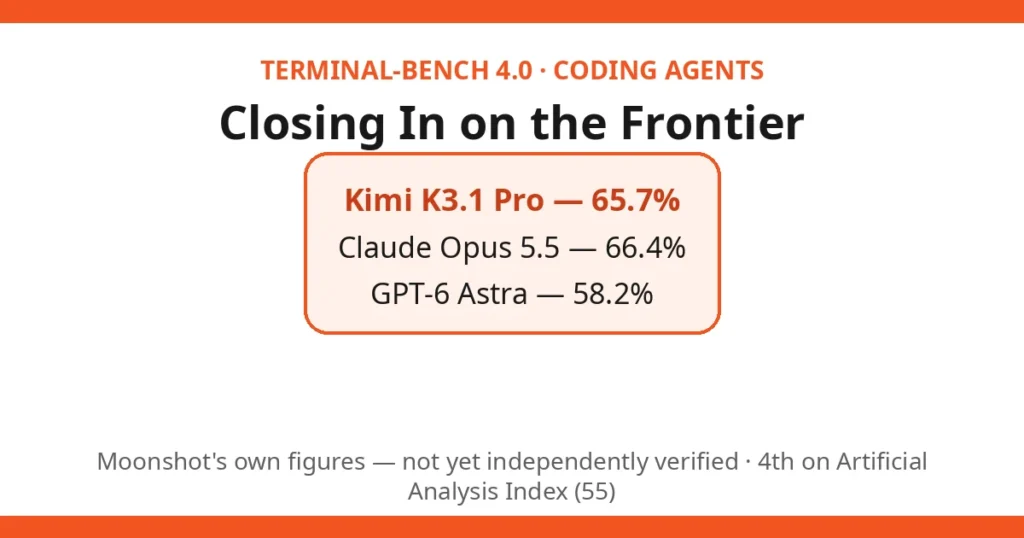
The benchmark story, as reported by multiple outlets, is the attention-grabber: on Terminal-Bench 4.0, a test scoring coding agents on realistic terminal tasks, Moonshot reports 65.7% for K3.1 Pro — against 66.4% for Claude Opus 5.5 and 58.2% for OpenAI’s GPT-6 Astra. On BenchCAD, which asks models to rebuild 3D objects as CAD code, it claims 92.7% (behind Opus 5.5’s 96.2% but just ahead of Claude Fable 5.1). And it ranks fourth on the Artificial Analysis Intelligence Index with a score of 55, behind only Opus 5.5, Claude Sonnet 5.5 and Muse Wonder Full — which would make it the top open-weights model once the weights are published.
Pricing is aggressive: $2 per million input tokens and $10 per million output, down from K3’s $3/$15, with cached input at $0.20. A companion variant, Kimi K3.1 Pro Highspeed, runs two to three times faster for $4/$20. Both are live now on Kimi.ai, the Kimi apps, Kimi Work (3.1.0+), Kimi Code and the Kimi API. The full open weights arrive by 4 November.
One unusual detail: Moonshot says it deliberately removed hacking-related training data before the open-weight release, as part of a cybersecurity section in the launch post — a reminder that open-weight releases carry misuse risk the company is actively trying to manage.
This continues the pattern of Chinese labs closing the gap we tracked with DeepSeek’s open models and the DeepSeek $15 billion raise — the open-model race is now being run at frontier quality and bargain prices.
What it means for UK small businesses
- Cheaper serious coding help. If you pay for Claude or GPT API access for development, document processing or data work, Kimi K3.1 Pro at $2/$10 per million tokens is worth a benchmark on your own tasks. The gap on agentic coding is, per Moonshot’s figures, small.
- Long-context document work. A 1M-token window plus claimed improvements on finance document tests (Moonshot claims hallucination rates on financial modelling fell 65% vs K3) make it a candidate for contract review, spreadsheet modelling and research summaries — but verify against your own documents before trusting it.
- Open weights = data control. Once the weights land on 4 November, you can run Kimi K3.1 Pro on private infrastructure. For UK firms handling client data under GDPR, that’s the real prize: frontier-ish capability without sending data to a US or Chinese cloud. (Zero Data Retention is already offered for API customers, per Moonshot.)
- Test, don’t switch blind. The benchmarks are Moonshot’s own numbers — the coding scores were partly run inside Anthropic’s own Claude Code harness, and rival scores were taken from published reports. Independent verification hasn’t landed yet. Pilot it on non-critical work first.
Honest limits / what to watch
- Vendor benchmarks, not independent ones. Almost every impressive score is Moonshot’s own. The model trails Opus 5.5 “badly” on science terminal tasks (per early analysis), and Artificial Analysis found it very wordy. Wait for independent replication before planning around the headline numbers.
- Weights are a promise, not a download. The 4 November date is a commitment; until the weights actually ship, you’re on hosted API terms. Open-weight value only materialises when the files are public.
- Geopolitical overhang. Kimi comes from a Chinese lab. UK firms in regulated or public-sector-adjacent work should run the same supply-chain and data-sovereignty checks they’d apply to any Chinese-origin model — the same caution behind the US federal restrictions on DeepSeek.
- Wordiness costs tokens. If the model is genuinely more verbose, the cheaper per-token price is partly offset by higher token counts per task. Measure cost per completed task, not per token.
FAQs
What is Kimi K3.1 Pro?
Kimi K3.1 Pro is Moonshot AI’s new open-weight large language model, launched on 23 October 2026. It’s a post-trained upgrade of Kimi K3 with about 2.8 trillion total parameters (104 billion active per token via mixture-of-experts), a 1-million-token context window, and text and image input. Moonshot calls it its ‘most capable 3T-class open-weight model to date.’
How good is Kimi K3.1 Pro compared to Claude and GPT?
On Moonshot’s own benchmark figures, it’s close: 65.7% on Terminal-Bench 4.0 against 66.4% for Claude Opus 5.5 and 58.2% for OpenAI’s GPT-6 Astra. It ranks fourth on the Artificial Analysis Intelligence Index with a score of 55. These are vendor-published numbers not yet independently verified, so treat the gap — and Moonshot’s test setup — with healthy scepticism.
When are the open weights released?
Moonshot has committed to publishing the full model weights by 4 November 2026. Until then the model is available hosted: on Kimi.ai, the Kimi mobile apps, the Kimi Work desktop app, Kimi Code and the Kimi API (as kimi-k3.1-pro), with a faster ‘Highspeed’ variant running two to three times quicker.
How much does the Kimi K3.1 Pro API cost?
$2 per million input tokens and $10 per million output tokens — a third cheaper than Kimi K3’s $3/$15 — with cached input at $0.20. The Highspeed variant costs $4/$20. At these prices it’s positioned as a cheaper alternative to closed frontier APIs for coding and document work.
Why does open-weight matter for a small business?
Open weights mean you can eventually run the model on your own infrastructure or a private cloud — no data leaves your systems, no per-token bills for sensitive work, and no vendor can change the terms under you. For finance, legal and healthcare-adjacent work in the UK, that’s a meaningful compliance advantage once the weights land.