
Direct answer: DeepSeek has released an upgraded AI model called DeepSeek-V4.1-Flash-1017, launched on 17 October 2026. The Chinese company says it is faster, produces shorter answers, and scores better on coding and reasoning benchmarks than its predecessor — and the open weights are available under the MIT licence. It arrives days after a five-hour API outage that knocked DeepSeek’s servers offline.
What happened
DeepSeek unveiled the new model late Saturday, 17 October, as a minor upgrade over the V4.1-Flash version it launched in early September. The September release was already aggressive: DeepSeek priced it so cheaply that shares of rival model makers MiniMax, Z.ai and Alibaba fell on the Hong Kong stock exchange after its launch, Bloomberg reported.
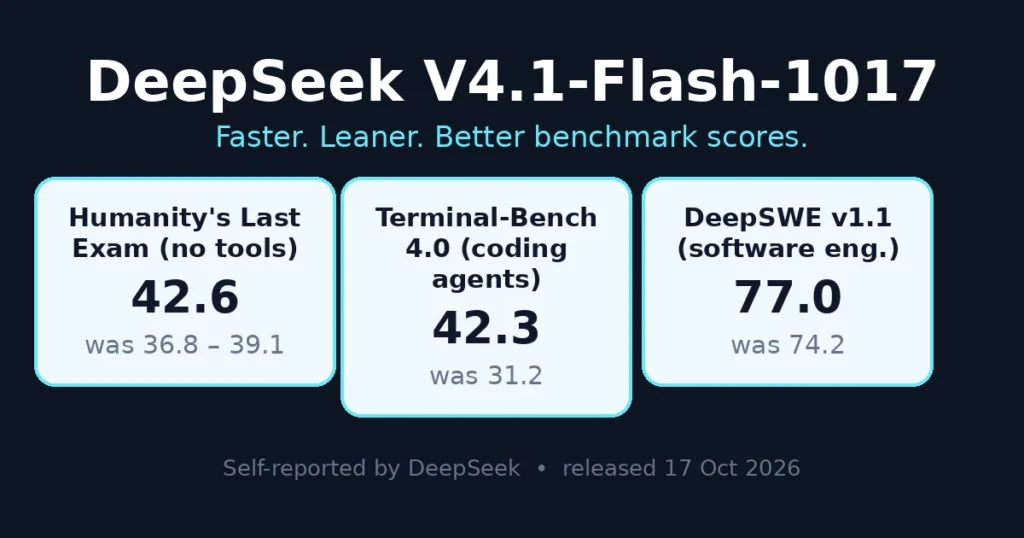
This time the headline claims are about speed and efficiency. In a technical report published on Hugging Face, DeepSeek said the update delivers “substantial improvements across reasoning, coding, agentic tasks, and visual benchmarks.” Specific self-reported scores:
– Humanity’s Last Exam (thousands of difficult questions across maths, science and the humanities, answered without tools): 42.6, up from 36.8–39.1 for the previous version – Terminal-Bench 4.0 (tests coding agents): 42.3, up from 31.2 – DeepSWE v1.1 (software engineering): 77.0, up from 74.2
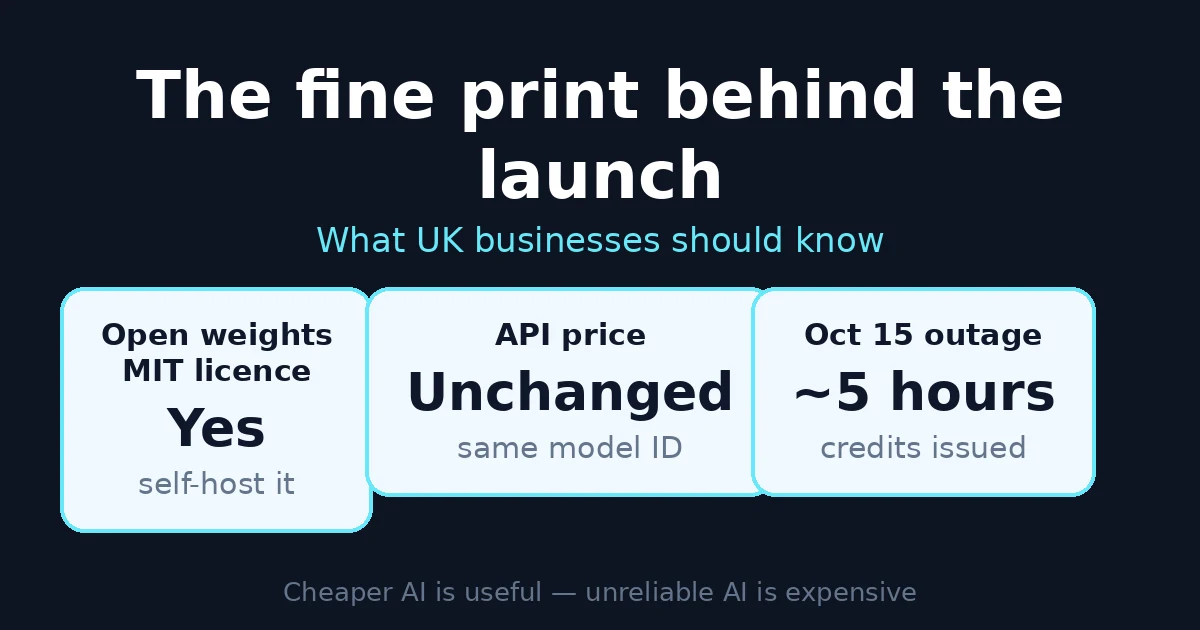
DeepSeek says the model uses “reinforcement learning with self-feedback” and is geared toward end-to-end project development, from game creation to 3D modelling. It is live now in DeepSeek’s web and mobile apps, and API customers reach it through the existing deepseek-flash model ID at unchanged prices. The weights are on Hugging Face under the MIT licence.
The release follows a rough week. On 15 October DeepSeek suffered an API outage lasting about five hours — described by Yicai Global as among its worst this year. The company apologised, gave affected users credits pegged to what they had spent the previous week, and said it would remove single points of dependency to stop it recurring. Some experts quoted by Bloomberg blamed insufficient computing capacity, and slowdowns and disruptions have become more frequent as demand grows for DeepSeek’s aggressively priced models.
What it means for UK small businesses
For a small business running chatbots, coding assistants or automated workflows on APIs, this is genuinely useful news. DeepSeek’s models are far cheaper than the big US alternatives, and a faster model that produces shorter answers can shrink per-task API costs further. The MIT licence on the weights is arguably the bigger deal: you are not locked into any single company’s servers, and a developer can self-host or fine-tune the model instead.
It also continues a trend worth watching: Chinese open-weight models are now competing directly with US proprietary systems on capability, not just price. For anyone building AI features on a budget, the number of serious options keeps growing. (See also our roundup of the wider AI agent trend for brands.)
Honest limits / what to watch
Three caveats before you get excited. First, every performance number comes from DeepSeek itself. Company-published benchmarks show you what the model can do under its own conditions, not how it handles your real workload — the Malay Mail’s AFP report made exactly this point. Treat the figures as directional until independent evaluations land.
Second, reliability is the elephant in the room. A cheaper model that goes down for five hours mid-day can cost you more than a pricier one that stays up. If you are considering DeepSeek for anything customer-facing, have a fallback model or provider wired up.
Third, the data question has not gone away. DeepSeek is a Chinese company, and UK businesses handling customer data need to think carefully about where that data flows and what their privacy obligations are. Our GDPR and AI guide for UK small businesses walks through the practical checks.
FAQs
What is DeepSeek V4.1-Flash-1017?
It’s an updated version of DeepSeek’s V4.1-Flash model, released on 17 October 2026. DeepSeek describes it as a minor upgrade offering stronger benchmark performance, faster task completion and shorter outputs than the previous version, available via its website, app and developer platform.
How much better are the benchmark scores?
Based on DeepSeek’s own published figures: Humanity’s Last Exam (without tools) rose from the 36.8–39.1 range to 42.6; Terminal-Bench 4.0 rose from 31.2 to 42.3; DeepSWE v1.1 rose from 74.2 to 77.0. These are self-reported scores, not independent evaluations.
Does it cost less to use?
API customers reach the new model through the existing deepseek-flash model ID at unchanged prices, according to SiliconANGLE’s changelog report. The savings argument is about speed: faster task completion and shorter outputs can mean fewer billable tokens per job.
Is DeepSeek V4.1-Flash-1017 open source?
The model weights are published on Hugging Face under the MIT licence, per SiliconANGLE, so developers can run or fine-tune it themselves rather than depending on DeepSeek’s API.
Should UK businesses rely on DeepSeek’s API?
It depends on your tolerance for downtime. A five-hour API outage on 15 October, plus recurring slowdowns, show the service is under strain. For critical workflows, keep a fallback provider or a self-hosted option ready.
Sources: Malay Mail / AFP, SiliconANGLE, Economic Times / Bloomberg