Direct answer: An AI consultant helps a small business figure out where AI actually pays off, then gets it working — usually starting with one workflow, not a grand "AI transformation". Hire one when you've tried the DIY tools and stalled, when the project touches customer data or compliance, or when you need it live in weeks rather than months. Expect to pay by the project or by the day; the cheapest quote is rarely the one that ships.
What an AI consultant actually does
Forget the "AI transformation partner" slide decks. For a small business, useful AI consulting is narrow and practical:
| Service | What you actually get | Typical shape |
|---|---|---|
| AI opportunity audit | A shortlist of 2–3 workflows worth automating, ranked by payback | 1–2 week diagnostic |
| Tool selection | Which tools fit your stack and budget, and which to avoid | Part of the audit, or standalone |
| Build and integrate | The workflow, automation or agent built and connected to your apps | Fixed-scope project |
| Team training | Your staff able to run and maintain what's built | Half-day to two-day sessions |
| Ongoing support | Someone to call when an integration breaks at 2am | Monthly retainer |
Notice what's missing: the 60-page strategy document. If a consultant's first deliverable is a deck rather than a working prototype, that's a tell.
Four signs you've outgrown DIY
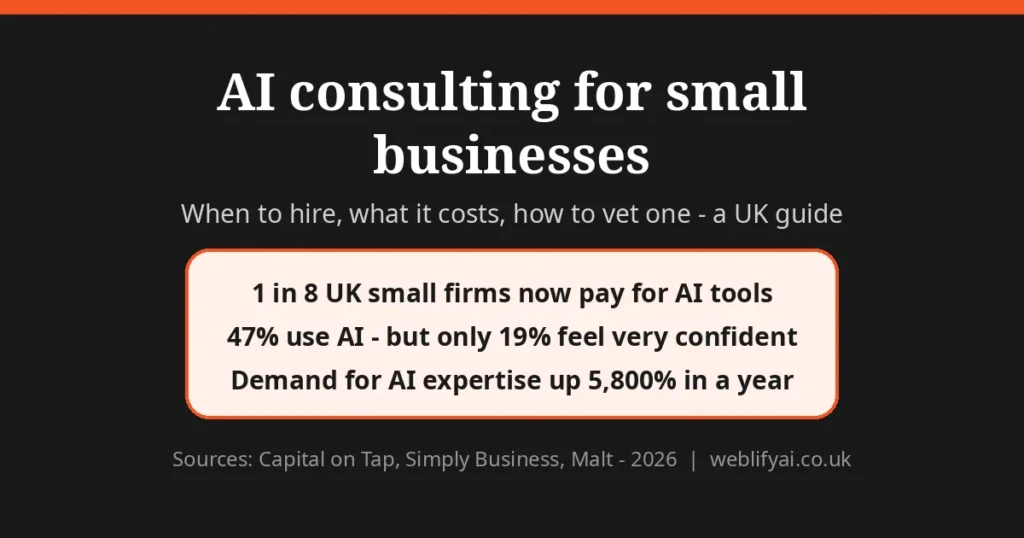
The DIY tools are genuinely good — Capital on Tap's October 2026 analysis of UK small-business card spending found one in eight small firms now pays for AI tools, up from barely one in a hundred in early 2023. But Simply Business's 2026 survey of 1,842 UK small businesses found the gap a consultant fills: 47% use AI, yet only 19% feel "very confident" doing so, and 44% name security and privacy as their top concern. Hire one when:
1. You've stalled. You tried the tools, got a few wins, and can't see the next step. A consultant's job is pattern recognition from dozens of similar businesses.
2. Customer data is involved. The moment AI touches customer names, financial details or anything sensitive, you want someone who thinks about UK GDPR and contracts as standard — our GDPR and AI guide covers what can go wrong.
3. You need it live fast. DIY learning curves are measured in months. A consultant who has built the same workflow five times ships in weeks.
4. The stakes are high. Customer-facing chat, pricing decisions, anything regulated — get expertise before you get a complaint.
If none of those apply, keep going DIY. Our AI workflow example walks through automating your first workflow yourself, step by step.
What it costs (honestly)
Nobody publishes a reliable UK price list for AI consulting, so treat any exact figure you see online with suspicion — including anyone else's. What I can tell you honestly is how the pricing models work and what moves the number:
| Model | How it works | Best for |
|---|---|---|
| Paid audit / diagnostic | Fixed fee for a short assessment ending in a ranked action list | Deciding whether to proceed at all |
| Fixed-scope project | One price for one defined build, e.g. "automate enquiry follow-up" | A single workflow with clear boundaries |
| Day rate | You buy the consultant's time by the day | Ongoing advice, training, oversight |
| Monthly retainer | Fixed monthly fee for support and iteration | Businesses running several automations |
What moves the price: how messy your data is, how many systems need connecting, whether the build needs custom development or off-the-shelf tools, and how fast you want it. A tidy single workflow on standard tools is a small project; a bespoke AI agent wired into a legacy CRM is not. Always ask for fixed-scope quotes with a defined "done" — open-ended day-rate engagements with no milestones are where budgets go to die. And note the market direction: freelancer platform Malt reports demand for AI agent expertise up 5,800% in a year — scarce expertise is not getting cheaper.
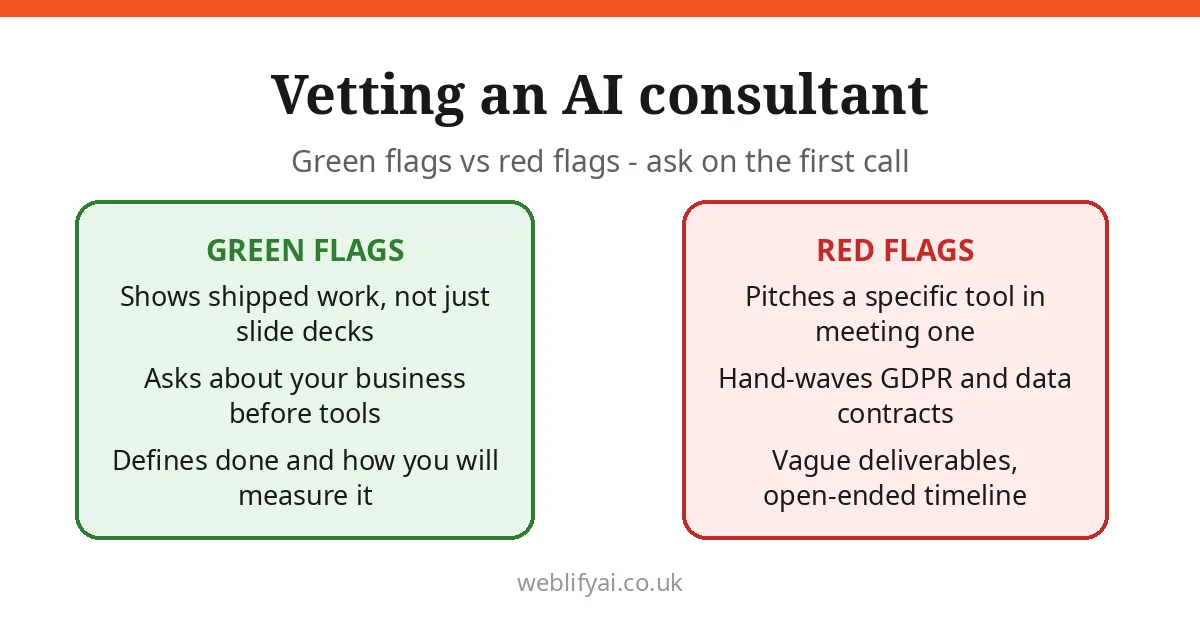
How to vet one: green flags vs red flags
| Green flag | Red flag |
|---|---|
| Asks about your margins and workflows before mentioning tools | Pitches a specific tool in the first meeting |
| Shows a working demo from a similar business | Only shows slide decks and client logos |
| Talks about data protection and contracts unprompted | Hand-waves GDPR ("the tool handles that") |
| Defines "done" and how you'll measure it | Vague deliverables, open-ended timeline |
| Trains your team to run it afterwards | Wants you dependent on them forever |
| Has built with the tools, not just talked about them | CV is all "AI strategy", no shipped work |
Three questions for the first call: "Show me something like this you've shipped." "What happens to my data at every step?" "What does 'done' look like, and what do I own afterwards?" A good consultant lights up at the third question. For context on what the build itself involves, see our guide to AI agents for small business.
Honest limits
- A consultant can't fix a broken process. If your enquiry handling is chaos, they'll automate chaos. Sort the workflow on paper first.
- AI consulting is unregulated. Anyone can call themselves an AI consultant tomorrow morning. The vetting table above is your only protection — there is no licence to check.
- Advice has a shelf life. What's best practice this quarter may be commoditised next quarter. Favour consultants who build on standard platforms over bespoke black boxes you can't leave.
- You still need an internal owner. The consultant leaves; someone on your team has to own the system. Budget for training, not just building.
- Not everything needs AI. A surprising share of "AI projects" are really automation projects with a chatbot garnish. A good consultant will sometimes tell you not to buy AI — if yours never does, that's a red flag in itself.
FAQs
What does an AI consultant do for a small business?
They find where AI pays off in your business and get it working: auditing workflows, picking the right tools, building automations or agents, training your team, and supporting it afterwards. The good ones start with one high-payback workflow, not a company-wide transformation.
How much does AI consulting cost in the UK?
There is no reliable published UK price list, so be wary of exact figures online. Consultants typically charge via paid audits, fixed-scope projects, day rates, or monthly retainers. Cost depends on how messy your data is, how many systems need connecting, custom versus off-the-shelf build, and timeline. Always get a fixed-scope quote with a defined done.
When should a small business hire an AI consultant instead of doing it DIY?
When you have stalled with DIY tools, when the project touches customer data or compliance, when you need it live in weeks rather than months, or when the stakes are high — customer-facing, regulated, or revenue-critical. Otherwise, DIY first: it is cheaper, and you will brief a consultant far better afterwards.
How do I choose a good AI consultant?
Ask to see shipped work rather than slide decks, ask what happens to your data at every step, and ask what done looks like and what you own afterwards. Green flags: they ask about your business before mentioning tools, define measurable outcomes, and train your team. Red flags: tool pitches in the first meeting, GDPR hand-waving, vague deliverables.
Do I need technical staff to work with an AI consultant?
No — but you need one internal owner who will run the system after the consultant leaves. The consultant should train that person as part of the engagement, not as an upsell.
What should I prepare before hiring an AI consultant?
A list of the workflows that eat your week with rough time costs, access to the tools you use, and one decision-maker who can approve things quickly. The clearer your statement of the problem, the cheaper the engagement.