
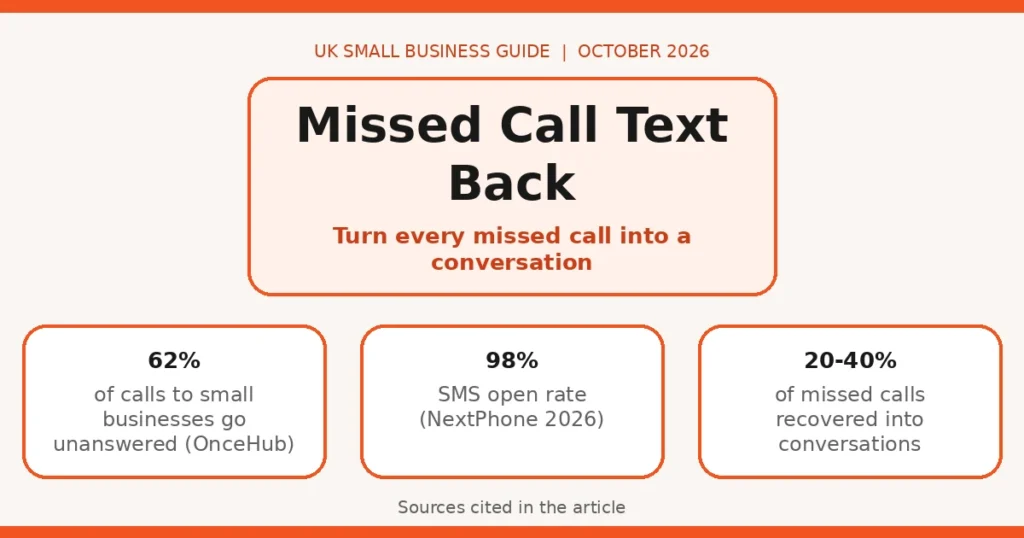
Direct answer: Missed call text back is an automation that texts anyone whose call you miss — within seconds, from your business number — so the caller starts a text conversation instead of ringing your competitor. For UK trades, salons, clinics and agencies, it’s one of the cheapest automations you can run: most setups cost less than one recovered job per month.
Why a missed call costs more than you think
When you’re up a ladder, mid-appointment, or on another call, your phone rings and you can’t take it. The caller hears voicemail. What happens next is the expensive part: most people don’t leave a message. They hang up and call the next business on Google.
The scale of the leak is bigger than most owners guess. OnceHub’s research puts the share of calls to small businesses that go unanswered at 62%, and Ainora’s 2026 missed-call statistics guide reports small firms miss 20–35% of incoming calls during business hours — and nearly 100% after hours. If your average job is worth £150 and you miss even five calls a week, that’s potentially £750 a week walking past your door.
This is exactly the kind of problem automation is good at. Not clever AI, not a chatbot with a personality — just a text that goes out instantly, every time.
What missed call text back actually does
The flow is simple and it all happens in under a minute:
- A customer calls your business number while you’re unavailable.
- The call goes unanswered (or to voicemail).
- Within seconds, they receive a text from your business number: “Hi, this is Sarah at Bright Clean Leeds. Sorry we missed your call — what did you need help with?”
- They reply by text. The conversation lands in your inbox or CRM.
- You (or a team member, or an AI assistant) respond when you’re free — or the system books them straight in.
The reason it works is the channel. NextPhone’s 2026 guide cites a 98% SMS open rate. Voicemail, by contrast, is where messages go to be ignored. A text meets the customer where they already are: on their phone, seconds after they tried to reach you.
The numbers behind it
| What the data says | Source |
|---|---|
| 62% of calls to small businesses go unanswered | OnceHub, via CallMissed 2026 guide |
| 20–35% of incoming calls missed in business hours; ~100% after hours | Ainora 2026 missed-call statistics guide |
| 98% SMS open rate | NextPhone 2026 guide |
| Missed-call services market worth $1.21bn in 2026, growing 7.3% a year to 2033; SMEs are the biggest segment at 43.2% | Coherent Market Insights, 2026 |
| Businesses report recovering 20–40% of missed calls into real conversations | ULTCRM client data (vendor-reported) |
Treat the recovery figures as directional — they come from vendors selling the tools, and your mileage will depend on your trade, your message, and how fast you follow up. But even the conservative end of the range is meaningful: recover two extra jobs a week and the automation has paid for itself many times over.
Three ways to set it up
You don’t need to rebuild your phone system. Pick the path that matches what you already use:
| Path | How it works | Best for | Effort |
|---|---|---|---|
| A. Built into your phone system or CRM | GoHighLevel, RingCentral and most modern business phone systems have a missed-call trigger in their automation settings: missed call → send SMS template. | Businesses already on a CRM or VoIP system | 15–30 minutes in settings |
| B. Standalone text-back tool | A dedicated app sits on the phone your business number rings on (or connects via call forwarding) and texts every missed caller. Some include a booking page and a lead inbox. | Sole traders and small teams on a personal mobile | About 15 minutes; roughly £15–£25/month per line — check current pricing |
| C. Self-build with Twilio | Twilio detects the unanswered call via webhook and fires your SMS. Full control, pay-as-you-go per text. | Businesses with a developer (or an agency) | A few hours of dev time |
If you run everything from an iPhone and want the free option today: iOS Focus modes (Settings → Focus) can auto-reply to calls with a text while the Focus is on. It’s blunt — it can’t hold a conversation or log anything — but it costs nothing and it’s better than silence.
Whichever path you pick, test it the way a customer experiences it: call your own number from another phone, don’t answer, and time the text. If it takes more than 30 seconds, something’s misconfigured.
What a good text-back message actually says
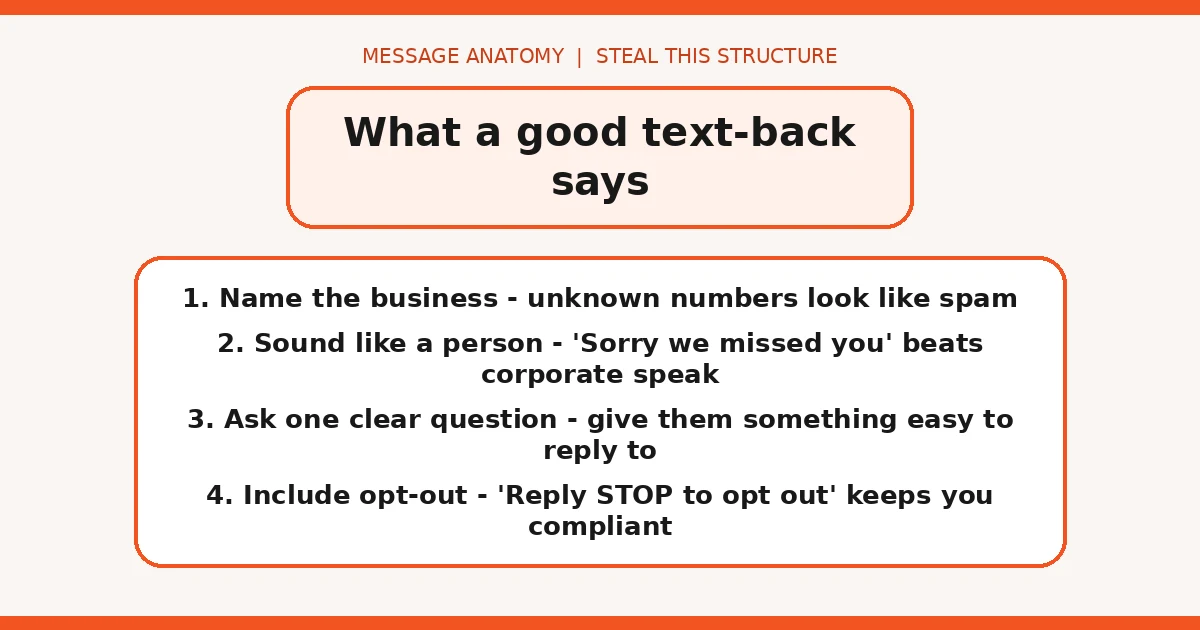
The message matters more than the tool. A generic “Sorry we missed your call” gets ignored; a specific, human one starts conversations. Four rules:
- Name the business. A text from an unknown number with no business name looks like spam and gets blocked by carriers.
- Sound like a person, not a system. “Sorry we missed you — what did you need?” beats “Thank you for contacting [Business]. Your call is important to us.”
- Ask one clear question. Give them something easy to reply to: “Was it about a booking or a quote?”
- Include opt-out wording. “Reply STOP to opt out” keeps you on the right side of the rules and costs you nothing.
Two templates that work:
Hi, this is Dave at Dave’s Heating (Leeds). Sorry we missed your call — is it about a repair or a new boiler quote? Reply here and we’ll sort it.
Hi! You called Bloom Salon — we’re with clients right now. Want me to book you in? Reply with a day that suits you. (Reply STOP to opt out)
Then add one follow-up: if there’s no reply after a couple of hours, a single nudge (“Still here if you need us”) recovers a surprising share of the stragglers. Don’t send a third — at that point you’re pestering.
The UK compliance bit (short, important)
In the UK, business texting is governed by the Privacy and Electronic Communications Regulations (PECR). The key distinction: a text that simply responds to someone who just called you is a service message, not direct marketing, so it’s treated differently from cold promotional SMS.
Three rules keep you safe:
- Keep it about the missed call. The moment you add “PS: 20% off this month!” it starts looking like marketing, which needs prior consent.
- Always include opt-out. “Reply STOP to opt out” is the standard.
- Respect quiet hours. Don’t let the automation text people at 2am unless your business genuinely operates then.
That’s general guidance, not legal advice. If you do a lot of SMS marketing alongside this, get proper advice — the fines for getting PECR wrong are real.
Where AI fits (and where it doesn’t)
Let’s be honest about the AI label: basic missed call text back needs no AI whatsoever. It’s a trigger and a template. Anyone selling you “AI-powered” text-back for the basic version is selling you a word.
AI earns its place one level up:
- AI receptionists answer the call instead of missing it — they talk to the caller, answer common questions and book appointments around the clock. If you’re missing dozens of calls a week, this recovers more than text-back alone. (See our guide to AI receptionists for small business.)
- AI SMS assistants hold the text conversation after the first message: qualifying the caller, answering FAQs and dropping a booking link, escalating to you only when a human is needed.
- AI call answering as a halfway house: the AI takes a message intelligently rather than dumping the caller into voicemail. (See AI call answering for UK small businesses.)
The sensible progression for most firms: start with plain text-back this week (cheap, instant), add AI handling once you can see from your recovered-lead numbers that the volume justifies it.
Honest limits
- It can’t fix a bad follow-up habit. The text starts the conversation; if nobody replies to the replies for six hours, you’ve just built a faster way to disappoint people. Assign someone to watch the inbox.
- It won’t save every caller. Some people only want to talk to a human right now, and no text will keep them. That’s fine — you’re recovering the ones who are happy to text, which is most of them.
- After-hours needs a different message. “We’ll call you back within the hour” at 11pm is a lie. Write a separate after-hours version with honest hours: “We’re back at 8am — reply with what you need and you’ll be first in the queue.”
- Carrier filtering is real. Unregistered business SMS can get flagged as spam. Reputable platforms handle sender registration for you; if you’re self-building, don’t skip that step.
- It’s one automation, not a strategy. Text-back plugs the missed-call leak. Pair it with fast lead follow-up and you’ll feel the difference across the whole pipeline.
FAQs
What is missed call text back?
It’s an automation that sends an instant text message to anyone whose call you miss. Instead of landing in voicemail, the caller gets something like “Sorry we missed you — how can we help?” within seconds, and their reply starts a text conversation you can pick up when you’re free.
How much does missed call text back cost?
It depends on the path. Many business phone systems and CRMs (GoHighLevel, RingCentral and similar) include it in plans that start around £20–£40 per user per month. Standalone text-back tools can cost less per month, while a Twilio-style self-build is pay-as-you-go per text. Check current pricing on each vendor’s site before you commit.
Is missed call text back legal in the UK?
A text that simply responds to someone who just called you is a service message, not marketing, so it sits differently under the UK’s Privacy and Electronic Communications Regulations (PECR) than cold promotional texts. Keep the message strictly about the missed call, don’t add offers or promotions, and always include a way to opt out. This is general guidance, not legal advice — if you’re unsure, check with a professional.
Do I need AI for missed call text back?
No. The basic version is just an automatic SMS and needs no AI at all. AI becomes useful one step up: AI receptionists that answer the call instead of missing it, or AI assistants that hold the text conversation, qualify the caller and book them in while you’re busy.
What’s the difference between missed call text back and an AI receptionist?
Text back reacts after a missed call with a single SMS; an AI receptionist answers the call itself, talks to the caller and can book appointments. Text back is cheaper and simpler. If you’re missing a high volume of calls, an AI receptionist may recover more of them.
Will customers find an automatic text annoying?
Rarely, if it’s written well. The annoyance comes from generic or pushy messages. A short text that names your business, apologises for missing them and asks one clear question reads as good service. Most people prefer it to voicemail — texts get opened far more often than voicemails get listened to.
Can I set this up on just a mobile phone?
On a basic level, yes. iPhones have Focus modes that can auto-reply to calls with a text, and many Android business diallers have a missed-call auto-reply setting. These are blunt tools with no conversation threading or CRM logging, but they’re free and better than silence. For proper two-way texting, you need a business phone system or CRM.