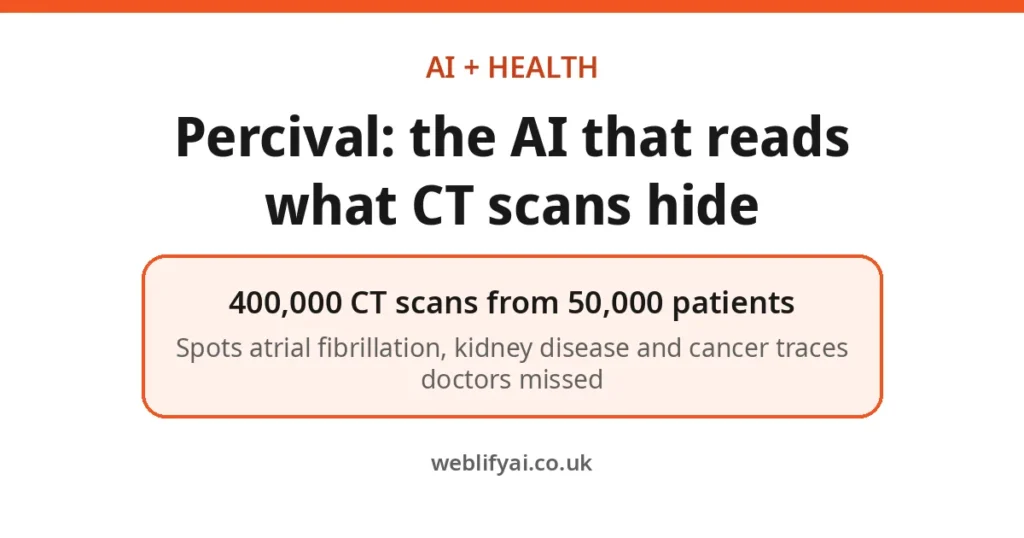
Direct answer: Researchers at Penn Medicine have developed an AI model called Percival that can read a routine CT scan and uncover hidden patterns of disease — spotting conditions the scan was never ordered to find. Trained on around 400,000 CT scans from 50,000 patients, Percival detected traces of atrial fibrillation, chronic kidney disease, and flagged pancreatic cancer, cirrhosis and bacterial pneumonia more reliably than a leading comparable model. The study is published in NPJ Digital Medicine.
What happened
CT scans are ordered for a specific reason — assess pneumonia, check an injury — and everything else in the image is effectively ignored. Penn Medicine’s team asked: what if an AI could run in the background and catch what the radiologist wasn’t looking for?
Percival was built on the Penn Medicine BioBank, one of the most diverse imaging datasets available: data from more than 350,000 people collected across the University of Pennsylvania Health System over two decades. Lead author Cameron Beeche notes that training on larger, more diverse datasets improves performance and makes the model easier to adapt to other hospital populations.
What sets Percival apart is its “opportunistic screening” ability. As senior author Walter Witschey puts it: the goal is finding “the early traces of cancer on a scan that was maybe assessing pneumonia.” Co-author Charles Kahn says the model “can help identify unrecognized disease, predict future progression, and anticipate major cardiovascular and liver complications.”
The model is still preclinical — the team plans to begin testing early next year, with an eye on bringing it into clinics, informed by their experience with an earlier radiology AI, AInSights.
What it means for UK small businesses
Direct medical use is years off for most clinics — but the pattern matters for every small business watching AI:
- AI’s value is in what humans skip. The same “find what’s hidden in existing data” logic applies to invoices, support tickets and sales pipelines. Our guide to AI agents for UK small businesses covers exactly this kind of applied pattern.
- Existing assets, new value. Percival extracts new value from scans that already exist. Small businesses sitting on years of CRM or operations data are in the same position — the asset is already bought and paid for.
- The health-sector opportunity. If you serve healthcare-adjacent clients (care providers, clinics, insurers), opportunistic AI screening is a services wave worth watching.
Honest limits / what to watch
- Not clinical yet. Percival is preclinical — promising research, not a product. Any health business planning around it should wait for the early-next-year testing results.
- False alarms cost real money. Flagging hidden disease sounds great until you consider the follow-up scans, anxiety and insurance implications of false positives. The team’s comparison against TotalSegmentator is encouraging, but real-world false-positive rates are not yet published.
- Dataset bias risk. However diverse the BioBank is, it reflects one US health system’s population. UK regulators (and the NHS) will want validation on UK populations before anything clinical.
FAQs
What is Percival?
Percival is an AI model developed at Penn Medicine that analyses CT scans for health patterns beyond the scan’s original purpose — “opportunistic screening” for hidden conditions and future health risks.
What conditions can Percival detect?
In testing it uncovered traces of atrial fibrillation, chronic kidney disease, and flagged pancreatic cancer, cirrhosis and bacterial pneumonia more reliably than the comparable model TotalSegmentator.
How much data was Percival trained on?
Roughly 400,000 CT scans from about 50,000 patients, drawn from the Penn Medicine BioBank — built on data from more than 350,000 people collected over two decades.
When will Percival reach hospitals?
It is still preclinical. The team hopes to begin testing it early next year with the aim of bringing it into clinical use, drawing on experience from their AInSights radiology AI.
What is opportunistic screening?
Finding disease beyond a test’s original purpose — for example, spotting early traces of cancer on a CT scan that was ordered to assess pneumonia.
Sources: Penn Medicine — “AI model can uncover unseen health issues in CT scans”; study in NPJ Digital Medicine (Oct 2026)