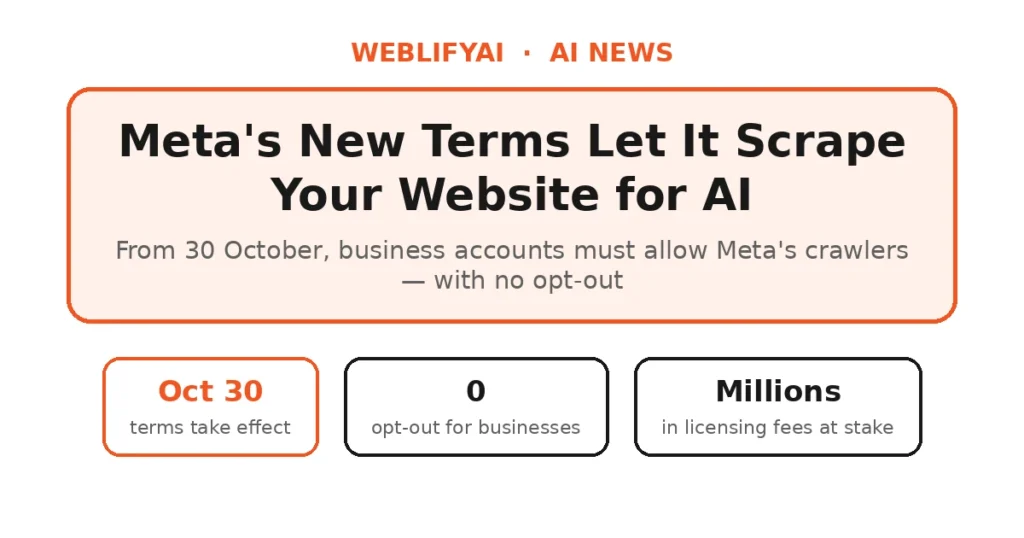
Direct answer: From 30 October, Meta’s updated commercial Terms of Service require every business account holder to let Meta scrape websites linked to their products — using bots, crawlers and spiders — and use what it collects to train and improve its products, with no opt-out. The real target is news publishers and the millions in AI licensing fees Meta would otherwise pay them, but the wording sweeps up every business with a website.
What happened
Meta is consolidating its business terms, and buried in the update is a sweeping grant of scraping rights. Under the new language, business account holders must authorise Meta — or entities acting on its behalf — to deploy automated scraping software (bots, crawlers, spiders, user agents) to access, index, cache, analyse, collect and retrieve any domains, web pages or URLs linked to their products or surfaced through Meta’s services, and to periodically pull fresh copies. Businesses must also allow Meta to create test credentials — accounts that, experts warn, could let its crawlers get past paywalls. Anything harvested can then be used to “provide, develop, improve, research, train and maintain” Meta’s products. Notably, the word “AI” never appears; the intent is inferred from the scraping powers plus a single use of the word “train”.
The catch: there is no opt-out. Businesses that don’t want to agree are told to stop using Meta’s services. For news publishers, the stakes are the ones that matter most — they could otherwise charge Meta millions to license their articles for AI training, and experts told Nieman Lab that even if courts decide AI training on news content is not fair use (the issue currently being litigated between publishers and OpenAI), Meta’s contractual terms could grant it permission regardless. Cornell’s James Grimmelmann warned Meta could even redeploy publisher content in direct competition with them. One critic, Stephen Beale of The Steampunk Explorer, called the update “such an arrogant, in-your-face move” and is considering leaving Facebook.
Meta’s defence is that this is merely “streamlining”: similar crawling language was previously scattered across policies like its ad terms, robots.txt will still be honoured, and it has no plans to override publishers’ anti-scraping instructions. But Ars’s comparison found the new language materially broader — earlier policies limited scraping to ad content, while the new terms cover all Meta products — and likened the bundling to the antitrust “tying” seen when Google made AI Overviews opt-out painful. Three legal experts told Ars courts may not even enforce the clause, but it could still be invoked to justify scraping news sites for training. Nieman Lab notes the second half of the play: Meta recently started charging publishers to post links — charge for the links, then scrape the links for AI. (Source: Ars Technica)
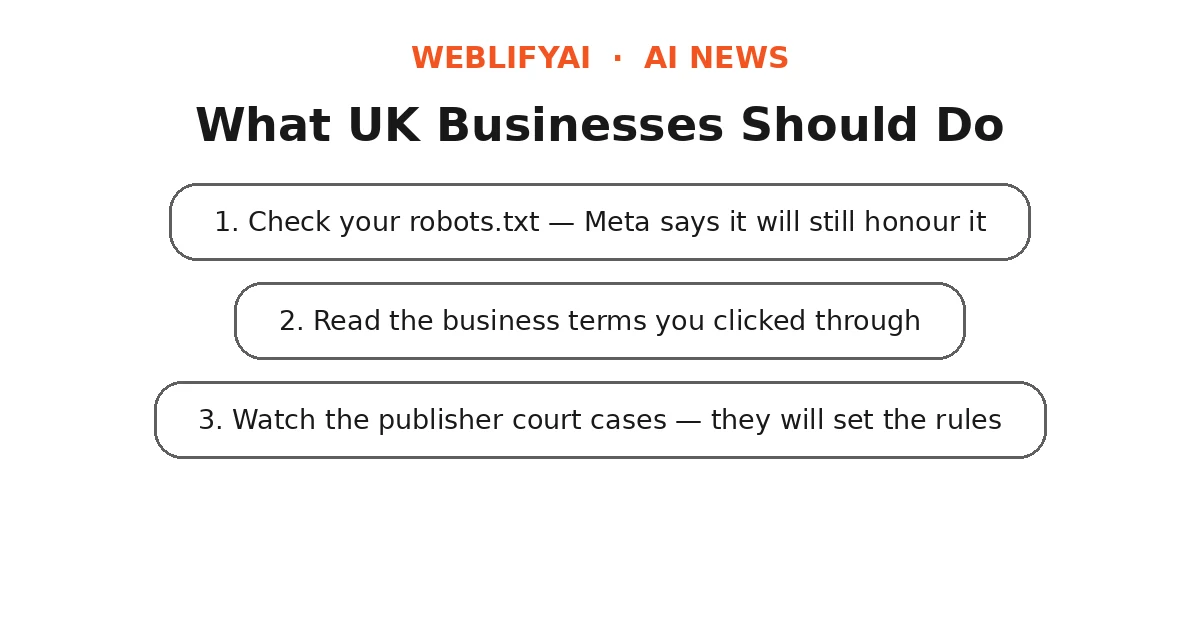
What it means for UK small businesses
This story is really about Meta vs. publishers — but the net is wide enough to catch your business too. If you run Meta ads, a Facebook Page, a WhatsApp Business account, or sell through Instagram, the terms apply to you, and the websites you link are in scope.
Three things worth doing:
- Check your robots.txt. Meta says it will still honour robots.txt, so if you don’t want your site scraped, a properly configured robots.txt is your first line of defence. This is the same file search engines already respect — talk to whoever manages your site.
- Know what you’re giving away. Your product pages, blog posts and pricing are your marketing assets. If an AI can quote your carefully written copy back to users, think about what that does to the value of your content. Our guide on whether ChatGPT recommends your business covers the flip side: being visible inside AI answers.
- Read the terms you already signed. Most small firms click through Meta’s business terms without reading them. This update is a reminder that those terms decide what happens to your data. If AI touching your business data concerns you more broadly, our GDPR and AI guide for UK small businesses walks through your responsibilities.
Honest limits / what to watch
Keep perspective: legal experts say courts may not enforce this clause at all, and Meta denies it plans to override anti-scraping instructions. The gap between what a contract claims and what holds up in court is often wide — especially with the OpenAI publisher litigation still playing out.
But the direction of travel is unmistakable. Big AI companies are shifting from asking for training data to taking it and daring anyone to stop them. For a small business, the practical lesson is simpler than the legal debate: your website content has value to AI companies, and the default setting is increasingly “they take it unless you block them.” Check your robots.txt, read your terms, and watch how the publisher lawsuits land — whatever the courts decide will shape what your content is worth next.
FAQs
What is Meta changing in its commercial terms?
From October 30, 2026, Meta’s business terms require account holders to authorise Meta — and companies acting for it — to scrape any websites linked to their products or surfaced through Meta’s services, using bots, crawlers and spiders, and to use the collected content to train and improve its products.
Can businesses opt out of Meta’s scraping?
No. According to Ars Technica’s reporting, there is no opt-out: businesses unwilling to agree are told to stop using Meta’s services. Meta says it will still honour robots.txt files.
Why is Meta doing this?
Legal experts say the move is aimed at avoiding the millions Meta would otherwise pay news publishers to license articles for AI training. Even if courts rule that AI training isn’t fair use, these terms could give Meta permission regardless.
Does this affect UK small businesses?
Yes. If your business runs Meta ads, a Facebook Page, or a WhatsApp Business account, your linked website falls under the new terms. Your content could be scraped for AI training without extra payment to you.
Can Meta scrape past paywalls?
The terms also require businesses to let Meta create test credentials, which experts warn could let crawlers get past paywalled content. Meta says it has no plans to override publishers’ anti-scraping instructions.
Ready to put AI to work in your business — safely? Get a Free AI Consultation.