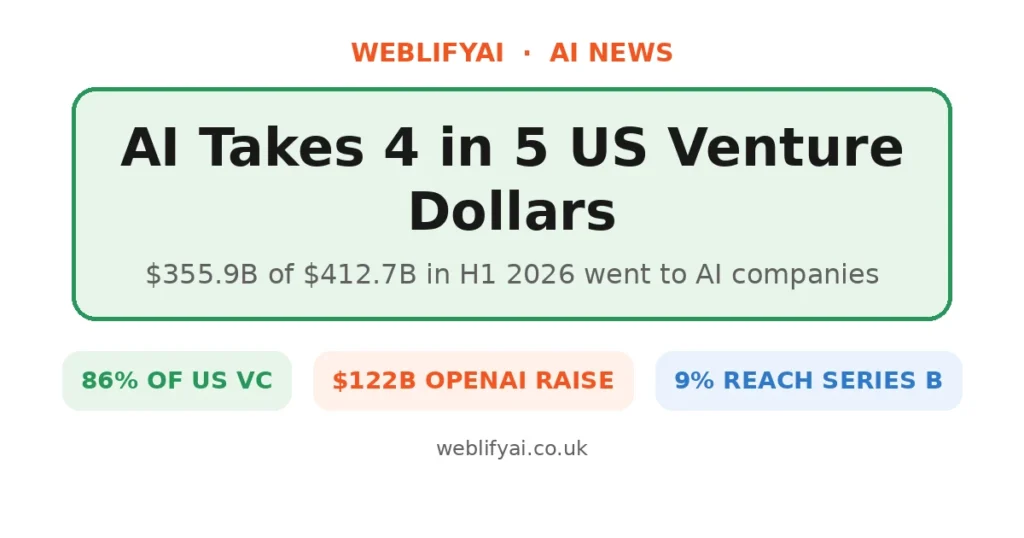
Direct answer: AI startups captured $355.9 billion of the $412.7 billion in total US venture capital deployed in the first half of 2026 — roughly 86% — according to PitchBook and the National Venture Capital Association’s second-quarter Venture Monitor. Four companies alone accounted for nearly two-thirds of all global venture funding.
What happened
New figures reported by Fortune paint the starkest picture yet of AI’s gravitational pull on investor money. In the first six months of 2026, American AI companies absorbed about 86 cents of every venture dollar, leaving every non-AI startup in the country splitting the remaining 14%.
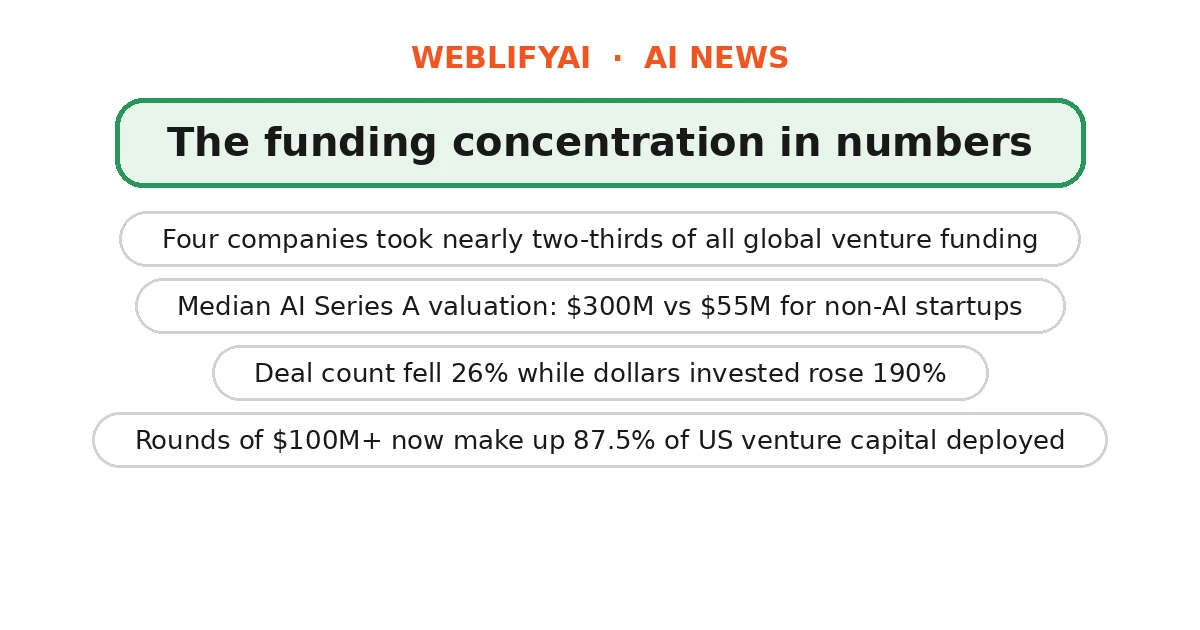
The concentration is most extreme at the very top. OpenAI raised $122 billion in H1 2026, Anthropic added $30 billion, xAI $20 billion and Waymo $16 billion — those four names soaked up nearly two-thirds of global venture funding between them. In the first quarter, the five biggest US deals (the same four plus Databricks) absorbed 73% of all US venture dollars.
Meanwhile the rest of the market is quietly thinning out. North American venture deal count fell roughly 26% year on year even as total dollars invested rose about 190%. And the funding ladder is getting steeper for everyone else: Carta, which tracks cap tables for thousands of private companies, found that AI foundation model startups raising Series A rounds carried a median valuation of $300 million versus $55 million for non-AI startups at the same stage. Rounds of $100 million or more now make up 87.5% of US venture capital deployed, up from 43.8% in 2024.
The report also flags a warning sign deep in the funnel: venture researchers estimate the share of Series A companies advancing to a Series B within two years has fallen from about 25% to about 9%. (Source: Fortune via AlphaMaven; underlying data from PitchBook, NVCA and Carta)
What it means for UK small businesses
You probably aren’t raising venture capital — and that’s exactly why this matters. The concentration of funding in AI means two things for an ordinary small business. First, the AI tools available to you are getting dramatically better and cheaper, because they’re backed by hundreds of billions in investment. You get the benefits without raising a penny. A two-person consultancy today can run on automation that would have needed a whole back office two years ago.
Second, it sets the competitive bar. If most of the capital flowing into startups is flowing into AI, your competitors — however small — increasingly have access to AI agents, automated marketing and AI-driven analytics. The funding story isn’t about you chasing investors; it’s about you using what the investment wave produces.
For the few UK small businesses that do raise money, the data is a reality check: investors want an AI story. Non-AI businesses need to be honest with themselves about whether their round competes with that tide — and whether the AI expansion wave is something to ride rather than fight.
Honest limits / what to watch
The numbers deserve scepticism. An 86% share flattered by a handful of mega-rounds isn’t the same as a broad market trend — Crunchbase’s global tally for Q3 puts AI’s share at 64%, still dominant but notably lower than earlier in the year. The dot-com comparison in the report is instructive: internet companies captured about 50% of venture capital at the peak, and AI has blown past that. But today’s AI leaders are profitable and trade at multiples well below dot-com extremes, so it’s not a clean repeat.
The real risk the data points to is a funding cliff: if enterprise AI adoption slows, or a few heavily capitalised labs stumble, an enormous pile of capital is concentrated in a very small number of bets. For small businesses, the lesson is simple — ride the wave of cheaper, better AI tools, but don’t build your entire strategy on the assumption that today’s frenzy continues forever.
FAQs
How much venture capital went to AI startups in 2026?
According to PitchBook and the NVCA’s second-quarter Venture Monitor, AI companies captured $355.9 billion of the $412.7 billion in total US venture capital deployed in the first half of 2026 — roughly 86%. Crunchbase’s quarterly tally puts AI’s share of global venture funding at 64% in Q3, still the clear majority.
Which companies took the biggest share?
Just four companies — OpenAI ($122 billion), Anthropic ($30 billion), xAI ($20 billion) and Waymo ($16 billion) — accounted for nearly two-thirds of global venture funding in the first half of 2026, per PitchBook data.
What does this mean for non-AI startups?
They’re competing for a shrinking slice. North American deal count fell roughly 26% year on year while total dollars invested rose about 190% — money is concentrating in fewer, bigger bets. The share of Series A companies reaching a Series B within two years has reportedly fallen from about 25% to about 9%.
Are AI valuations running ahead of reality?
Carta data shows AI foundation model startups raising Series A rounds carried a median valuation of $300 million, versus $55 million for non-AI startups — a 5.5x gap. Rounds of $100 million or more now make up 87.5% of US venture capital deployed, up from 43.8% in 2024.
Is this like the dot-com bubble?
There are echoes: internet companies captured roughly 50% of venture capital at the dot-com peak, and AI’s share now is meaningfully higher. But today’s AI leaders are profitable businesses trading at multiples well below dot-com extremes — so the parallel is partial, not exact.
Get a Free AI Consultation — You don’t need $300 million in venture funding to put AI to work. We help small businesses use the tools this funding wave is producing.