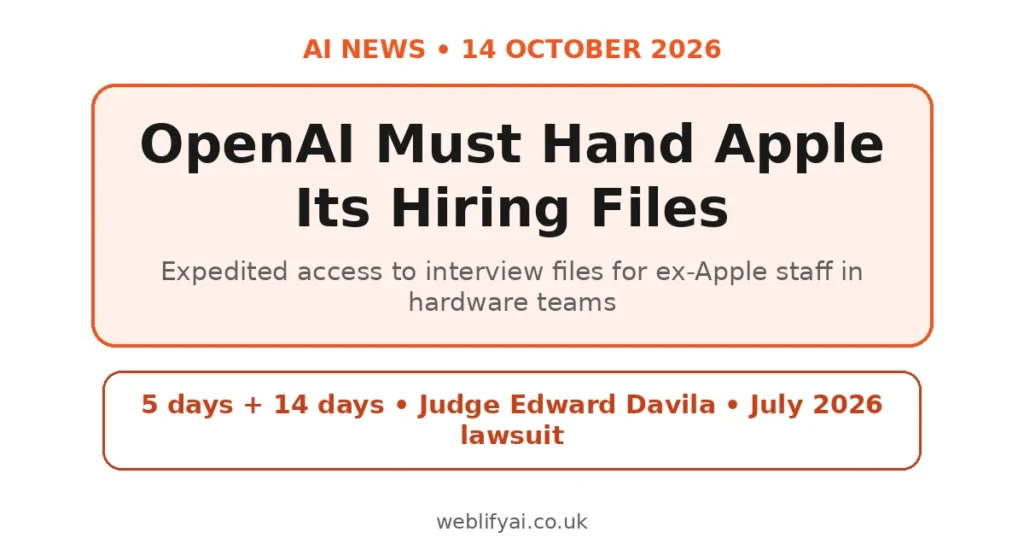
Direct answer: On 13 October 2026, US District Judge Edward Davila ordered OpenAI to turn over hiring records to Apple in the iPhone maker’s trade-secrets lawsuit — specifically interview materials for former Apple employees recruited into OpenAI’s hardware and robotics teams. Apple gets the files within days. For small businesses, the case is a blunt reminder that your biggest IP risk often walks out the door with departing staff.
What happened
Apple sued OpenAI in July 2026, alleging what TechCrunch’s reporting describes as a pattern of trade-secret theft. Apple’s claims are concrete: former employees allegedly used Apple laptops to download confidential material — technical specifications, engineering presentations, proprietary project data on unannounced technologies — and then coached others considering the jump on what information to bring to their OpenAI interviews.
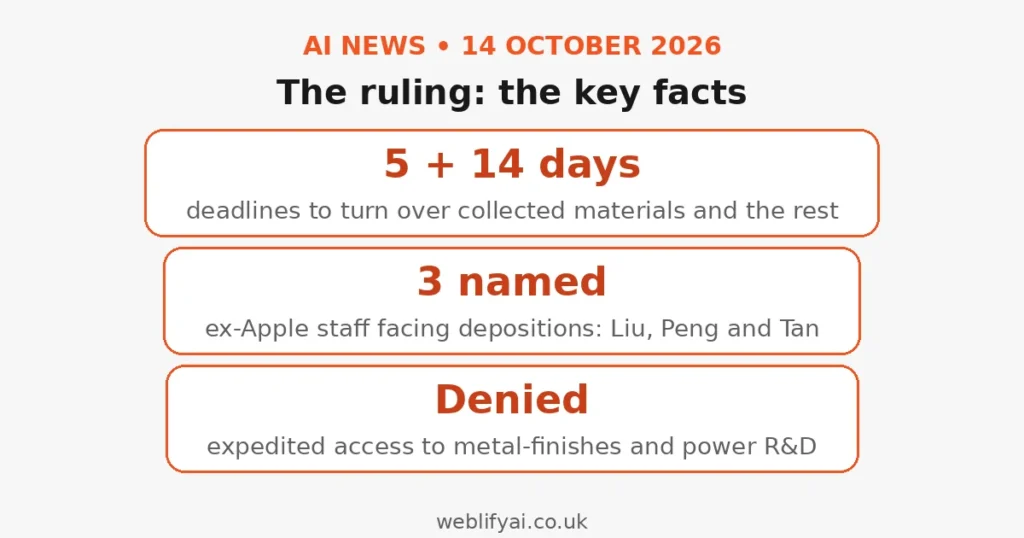
Judge Davila’s ruling on 13 October gives Apple expedited access to the interview trail. The documents OpenAI must produce include interview checklists, guides, instructions, manuals and scripts, plus technical presentations and any records showing Apple technology or components came up in discussion. Timelines are tight: five days for materials OpenAI has already collected, 14 days for everything else covered by the request.
The order reaches beyond HR files. The judge also let Apple view private LINE messages between individuals named in the case — OpenAI employees Chang Liu and Alyssa Peng — and approved depositions for Liu, Peng, and OpenAI’s chief hardware officer Tang Yew Tan. All three previously worked at Apple.
Not everything went Apple’s way. Davila denied expedited access to OpenAI’s research and development in specific areas like metal finishes and power management, and rejected broader discovery into OpenAI’s hardware research or what former employees created after joining. That denial isn’t final — Apple can narrow its requests and return.
The backdrop is OpenAI’s rumoured first hardware device, a project Apple appears to believe could one day rival the iPhone. The employees at issue were hired into OpenAI’s consumer hardware and robotics groups — the teams building it.
What it means for UK small businesses
1. Offboarding is where IP leaks — and most small firms wing it. Apple’s case hinges on what happened when employees left: what they downloaded, what they carried to interviews, who coached whom. A small business with a client database, pricing models, or proprietary processes faces the same risk at smaller scale. Revoke access promptly, audit downloads in the final weeks, and collect company devices before the goodbye lunch, not after.
2. Interview hygiene cuts both ways. If you’re hiring from a competitor, Apple’s allegations show how quickly “tell us what you know” becomes a lawsuit. Keep interviews focused on skills and hypothetical problems, never on proprietary details of a former employer. Document that you did.
3. NDAs are necessary but not sufficient. Apple’s fight shows that even giants with sophisticated legal machinery end up in court. For a small firm, the practical layer matters more: limit who can access what, watermark sensitive documents, and keep a record of who saw what and when. Our AI statistics roundup shows how fast AI adoption is spreading — and with it, the tools that make exfiltration easier.
4. The AI hardware race is accelerating. OpenAI building consumer hardware — alongside devices like the Ambi ambient-listening assistant — signals that AI is moving from the screen into physical products. Small businesses should watch this space: the next customer touchpoint might be a device, not a phone screen.
Honest limits / what to watch
- These are allegations, not findings. Apple claims a pattern of theft; OpenAI disputes it, and the case is far from over. The judge’s discovery order doesn’t say Apple’s claims are true — it says Apple gets to look for evidence.
- Discovery can be weaponised. Expedited access to a rival’s hiring playbook is a competitive intelligence win for Apple regardless of the outcome. Expect OpenAI to fight the scope hard, and expect the final judgment to land somewhere messier than either side’s telling.
- Five and 14 days are the deadlines, not the verdict. The documents Apple gets now become the ammunition for the next phase — depositions, narrowed requests, and likely a long fight over what OpenAI’s hardware teams actually built.
- Your contracts matter more than headlines. The lesson for a small firm isn’t the $20-billion-scale drama; it’s that most IP disputes never make the news. A clear, enforceable confidentiality agreement signed at hiring time is worth more than a lawsuit after the fact.
FAQs
What is the Apple vs OpenAI case about?
Apple sued OpenAI in July 2026, alleging a pattern of trade-secret theft tied to hiring. Apple claims former employees downloaded confidential material onto Apple laptops before leaving and coached others on what information to bring to OpenAI interviews. The case comes as OpenAI develops a rumoured consumer hardware device.
What exactly did the judge order OpenAI to hand over?
US District Judge Edward Davila granted Apple expedited access to OpenAI’s interview materials for former Apple employees who applied for consumer hardware and robotics roles — interview checklists, guides, instructions, scripts, technical presentations, and any records showing Apple technology was discussed. OpenAI has five days to produce materials already collected and 14 days for the rest.
What did the judge refuse?
He denied Apple’s request for expedited access to OpenAI’s R&D in specific areas such as metal finishes and power management, plus broader requests covering OpenAI’s hardware research and what former employees built at OpenAI. The door is open for Apple to narrow those requests and try again.
Who are the people named in the ruling?
OpenAI employees Chang Liu and Alyssa Peng, plus OpenAI’s chief hardware officer Tang Yew Tan — all former Apple employees. The judge approved depositions for all three and allowed Apple to view private LINE messages between named individuals.
What should UK small businesses take from this?
Treat trade-secret protection as an ongoing process, not a one-off NDA. Control how staff access sensitive files before they leave, audit downloads and permissions when someone resigns, and make sure your contracts cover post-employment confidentiality clearly. Big cases like this show how expensive it gets when offboarding is lax.