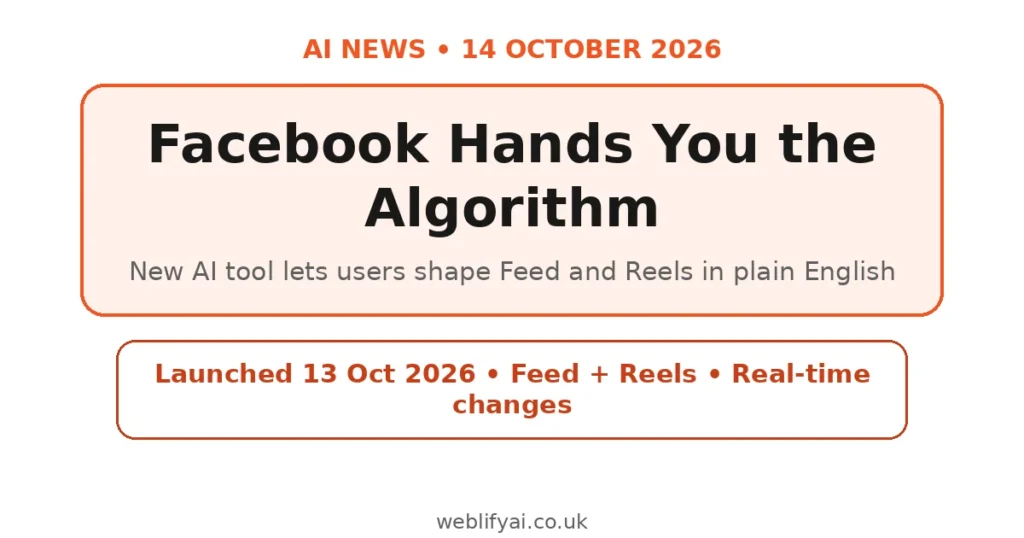
Direct answer: Meta has launched “Your Algorithm” on Facebook — an AI-powered tool that lets users shape their Feed and Reels by describing what they want to see in plain English. The platform may ask follow-up questions, and changes apply in real time. For small businesses, it means organic reach is now filtered through customers’ stated preferences, not just their past behaviour.
What happened
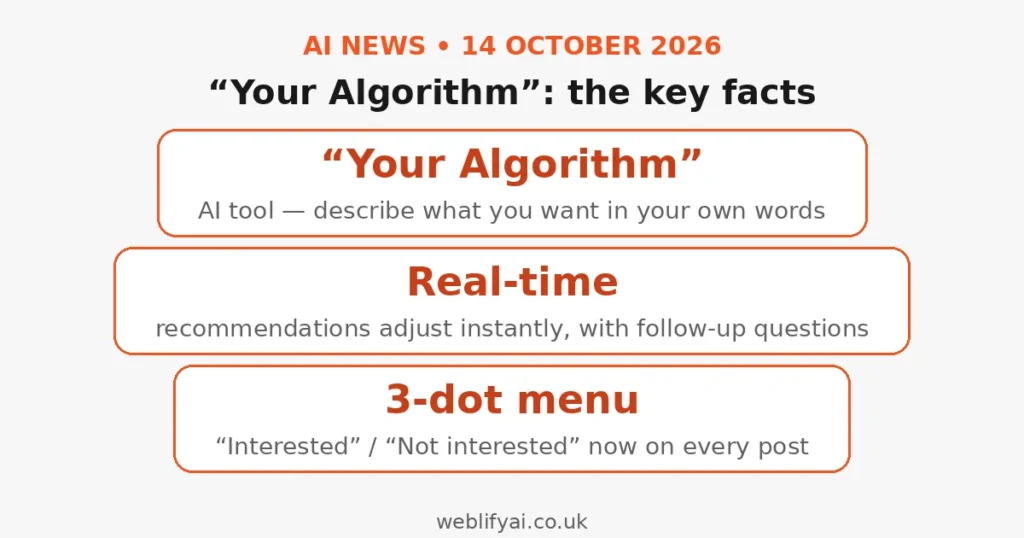
Meta announced the new feature on Tuesday 13 October 2026 (source: TechCrunch — announced). Instead of the feed quietly deciding for you, Facebook users can now talk to the ranking system directly: type what you want more or less of, in your own words, and the recommendations shift immediately.
A few of the practical details:
- It covers Feed and Reels, the two surfaces where most discovery happens.
- Meta can ask follow-up questions to pin down what a user liked or disliked about a post, so feedback gets more specific over time.
- The three-dot menu got an upgrade. On any post, users can open the menu and find “Your Algorithm” alongside the simpler “Interested” / “Not interested” toggles — making preference-setting part of everyday scrolling.
- This isn’t Meta’s first attempt. Instagram launched its version for Reels in December 2025 and extended it to Feed and Explore in June 2026; Threads users get a sibling feature called “Dear Algo.”
The bigger picture is a shift away from purely behavioural recommendation — “you watched this, so here’s more” — toward stated preference, closer to how streaming services handle personalisation. Meta’s framing is user control; the engineering reality is that the algorithm now has a much richer signal to optimise against.
What it means for UK small businesses
1. Your customers are now actively curating you out — or in. Until now, feed ranking was mostly a passive process: people scrolled, and the system guessed. A user who explicitly tells Facebook “less promotional content” or “fewer local business posts” is making a deliberate choice that’s harder to reverse than a skipped video. Businesses that post generic, low-effort updates are the first casualties.
2. Relevance beats volume, decisively. The businesses that benefit are the ones producing content tied to specific, nameable interests — the kind of thing a customer would actually type into the preference box. A bakery posting “behind the scenes of sourdough” is describing an interest; a bakery posting “come visit us today” is not. Our guide to using AI for marketing covers how to build content around what your audience actually cares about.
3. Watch what Meta tells advertisers. The feature is user-facing for now, but if Meta starts surfacing aggregated preference signals to page owners or advertisers — “X% of your audience asked for less of this” — that data becomes gold dust for content strategy. Keep an eye on Meta Business updates in the coming months.
4. Diversification is no longer optional. If Facebook drives a meaningful share of your leads, a platform where users can mute entire categories of content on demand is a fragile foundation. Own an email list, keep your lead-generation chatbot on your own site, and treat rented audiences as a bonus, not the business.
5. It may actually help the good stuff get seen. There’s a genuine upside: a feed tuned to stated interests punishes clickbait and rewards consistency. Niche businesses with a clear voice — the exact kind that struggle against viral junk in a behavioural feed — could find their audience more reliably.
Honest limits / what to watch
- We don’t know how aggressively it filters. “More or less of this topic” is a blunt instrument; Meta hasn’t said how strongly these preferences weigh against other ranking signals like engagement or recency. The real impact on reach could range from mild to severe.
- Most users won’t bother. Instagram’s version has been live for months, and preference tools historically get used by a motivated minority. The businesses affected most will be those whose audiences skew toward the kind of users who tinker — younger, tech-comfortable customers.
- Follow-up questions are a data play too. Meta gets richer preference data out of every interaction, which improves its ad targeting whether or not your organic posts benefit. The asymmetry is worth remembering: users get control, Meta gets data, businesses get neither directly.
- Expect copycats. If preference-based feeds become the norm across platforms, the era of “post and pray” organic social is over everywhere, not just on Facebook. Businesses building audience strategies around any single platform’s algorithm are building on sand.
FAQs
What is Facebook’s ‘Your Algorithm’ feature?
It’s an AI-powered preference tool Meta launched on 13 October 2026. Instead of passively receiving recommendations, users can now describe in their own words what they want to see more or less of in Feed and Reels, and the platform adjusts recommendations in real time. It may ask follow-up questions to refine its understanding.
How do users access it?
Through an updated three-dot menu on individual posts, which now includes a “Your Algorithm” option alongside “Interested” and “Not interested” controls. Users can also manage their preferences through the feature’s own interface, explaining their content tastes in natural language.
Did Instagram already have this?
Yes. Instagram introduced “Your Algorithm” for Reels in December 2025, then extended it to Feed and Explore in June 2026. Threads has a similar feature called “Dear Algo”. Facebook is the latest Meta platform to get it.
Will this hurt organic reach for small businesses?
It could make reach less predictable: users actively pruning topics may see fewer business posts they didn’t ask for. But it also rewards relevance — content that genuinely matches a user’s stated interests stands a better chance of surviving than bland, broad-appeal posts. Quality and specificity matter more than volume now.
Should my business change its Facebook strategy?
Don’t abandon the platform, but stop relying on generic posting. Lean into content tied to clear, specific interests your customers would actually name — and watch whether Meta offers advertisers or page owners any visibility into these preference signals. If you depend on Facebook for leads, diversify now.