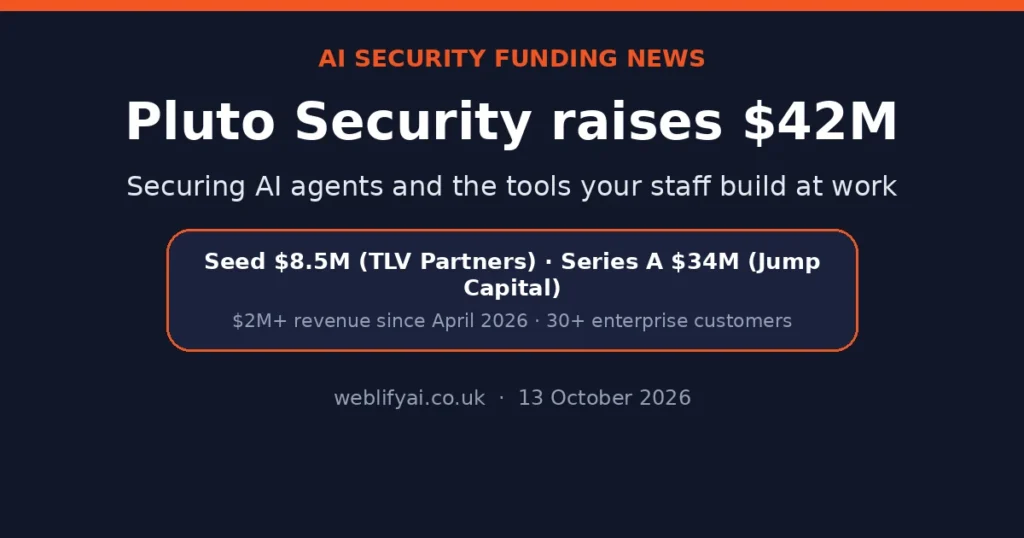
Direct answer: Pluto Security, an Israeli cybersecurity startup, has come out of stealth with $42 million in total funding to tackle a growing problem — employees using and building AI tools faster than security teams can keep up. The company says it has already crossed $2 million in annual revenue since it started selling in April 2026, and it’s betting that watching what AI agents do in real time is the next big frontier in security.
What happened
On 13 October 2026, Pluto Security announced it had raised $42 million across two rounds: an $8.5 million seed led by TLV Partners (with the founders of cybersecurity firm Armis investing), and a $34 million Series A led by Jump Capital, with participation from Skinos — the venture firm of Check Point co-founder Shlomo Kramer — plus Ansa Capital and angel investors (TechCrunch).
The startup, co-founded by CEO Shahar Bahat, is joining a fast-growing crowd of security companies convinced that traditional monitoring tools can’t handle AI. Their argument: existing software was built to watch people, not to watch what autonomous AI agents get up to.
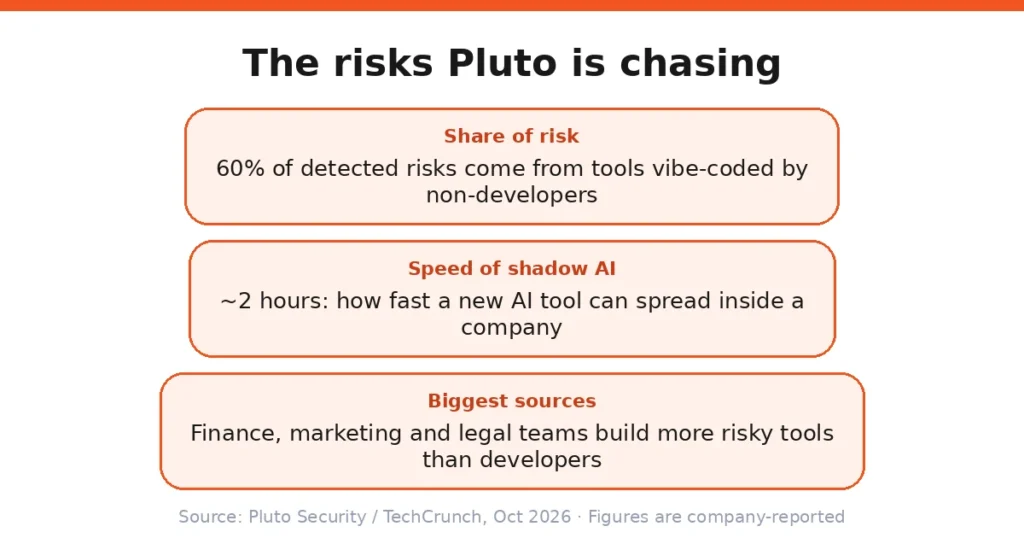
The numbers tell a striking story about the problem. Bahat told TechCrunch that a newly released AI tool can appear inside a company’s systems within roughly two hours of launch — leaving security teams almost no time to vet it. And about 60% of the risks Pluto detects across its customer base come from tools “vibe-coded” by people who aren’t developers at all. Finance departments are the biggest source, followed by marketing and legal teams. Developers rank only fourth. In one case, Pluto found an app built by a finance employee at a Fortune 500 company to manage customer information and churn — left exposed to the internet.
The product itself connects to a company’s endpoint security and device management systems, gathering prompts, commands, permissions and activity, then uses lightweight models on the endpoint to assess what an AI agent is trying to do. Its standout feature is real-time intervention: if an agent tries to grab permissions beyond what the user intended, Pluto can stop the action or inject context into the session so the agent asks for confirmation. As Bahat put it: “We’re moving from user behavior to agent behavior.”
Pluto is also trying an unusual route to win customers. In April it launched Plutonium, a free platform where anyone can check risks tied to public AI skills, connectors and add-ons, plus an MCP scanner and a catalogue of verified components. The company claims thousands of security professionals use it, and says 70% of its sales pipeline now comes from inbound interest.
What it means for UK small businesses
You probably won’t be buying Pluto’s enterprise platform any time soon. But the problem it exists to solve is not an enterprise-only problem — it’s a people problem, and it shows up in small firms too.
Think about your own team. Staff are almost certainly pasting things into AI chatbots, installing browser extensions and connectors, and maybe even building small internal tools with AI app builders. Every one of those is a door into your business’s data. The uncomfortable finding from Pluto’s work — that non-developers create the majority of these risks, and that it can happen within hours — applies just as well to a 10-person firm as to a Fortune 500.
The good news is that the response doesn’t require a $42-million-backed platform. Three practical steps cover most of the risk:
- Know what’s in use. Ask your team what AI tools, extensions and connectors they’re actually using. Most small firms have never done this — and the answers usually surprise.
- Check permissions and data access. A browser extension that can read every page, or an AI app with access to your customer database, deserves a second look. Treat GDPR and AI data rules seriously — customer data in the wrong AI tool is a compliance problem, not just a technical one.
- Set simple ground rules. A short policy on what company data can go into AI tools, and who approves new ones, costs nothing to write and prevents most accidents. The direction of travel is clear — AI adoption across UK businesses keeps climbing (see the latest AI statistics for UK small businesses) — so this is about getting ahead of a risk that’s only growing.
Honest limits / what to watch
A funding announcement is a pitch, not a verdict. Some caveats worth keeping in mind:
- The traction figures are company-reported. $2 million-plus in ARR, 30-plus enterprise customers, thousands of Plutonium users — none of this has been independently verified, and startups pick the numbers that flatter.
- It’s a crowded race. Pluto is one of a new crop of AI-security startups raising big money (names like Zenity and LayerX are in the same fight), and established vendors are adding AI-agent features too. Which approach wins is far from decided.
- The “intervene mid-task” feature is untested at scale. Interrupting an AI agent in real time without breaking legitimate work is genuinely hard — this is the claim to watch as real customers put it through its paces.
- Fortune 500 anecdotes ≠ small-business reality. The vivid examples (a finance-built app exposed to the internet) come from large enterprises. For smaller firms, the bigger day-to-day risks are simpler: staff sharing logins, pasting client data into free chatbots, or installing shady extensions. The basics still matter most.
That said, the signal underneath the hype is real: investors are putting serious money behind the idea that AI agents need watching in real time. Whether Pluto or someone else wins, “agent behaviour” security is becoming a category — and small businesses should start paying attention now.
FAQs
How much funding has Pluto Security raised?
Pluto Security has raised $42 million in total across two rounds: an $8.5 million seed round led by TLV Partners, and a $34 million Series A led by Jump Capital. Other backers include Skinos (the venture firm of Check Point co-founder Shlomo Kramer), Ansa Capital, and the founders of cybersecurity firm Armis.
What does Pluto Security actually do?
Pluto monitors how employees use AI tools — including the skills, extensions, MCP servers and AI agents those tools rely on — and flags risky components or dangerous agent behaviour. Unusually, it can intervene while an AI agent is mid-task, blocking an overreaching action or prompting the agent to ask for confirmation, without stopping staff from using AI altogether.
Why is AI such a security problem for businesses right now?
AI tools spread through companies astonishingly fast — Pluto’s CEO says a newly released tool can show up inside a company’s environment within two hours. Around 60% of the risks the company detects come from apps “vibe-coded” by people who aren’t developers, with finance, marketing and legal teams producing more risky tools than developers themselves. In every proof-of-concept the company has run, it found something malicious.
Does this matter for UK small businesses?
Yes. Small firms may not buy enterprise security platforms, but the underlying problem — staff pasting company data into AI tools, installing risky browser extensions, or building unvetted apps — applies at any size. The practical response is simple: know what AI tools your team uses, check what permissions and data access they have, and set basic ground rules before something goes wrong.
What is Plutonium?
Plutonium is Pluto Security’s free platform, launched in April 2026, that lets anyone check risks tied to public AI skills, connectors and add-ons, plus an MCP scanner and a catalogue of verified components. The company says thousands of security professionals use it, and says 70% of its sales pipeline now comes from inbound interest.
Who are Pluto Security’s customers?
Pluto started selling in April 2026 and says it already has more than 30 enterprise customers, including Oscar Health, Workato, Sixt and AlphaSense. It also claims to have crossed $2 million in annual recurring revenue. These are company-reported figures that have not been independently verified.