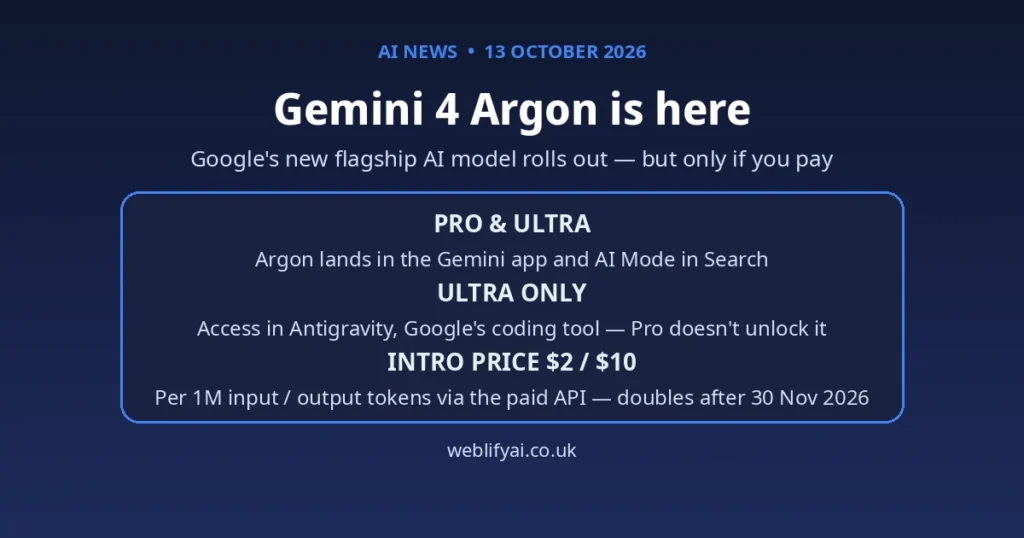
Direct answer: Google began rolling out Gemini 4 Argon — its newest flagship AI model — on 13 October 2026, but only to paying users. Pro and Ultra subscribers get it in the Gemini app and AI Mode in Search, Ultra subscribers get it in Google’s Antigravity coding tool, and developers can reach it through the paid tier of the Gemini API. Free-tier users are left out.
What happened
Google CEO Sundar Pichai announced the global rollout on X on 13 October 2026, two weeks after Argon debuted in a restricted release on 30 September limited to vetted cybersecurity defenders in Google’s Fairwind programme.
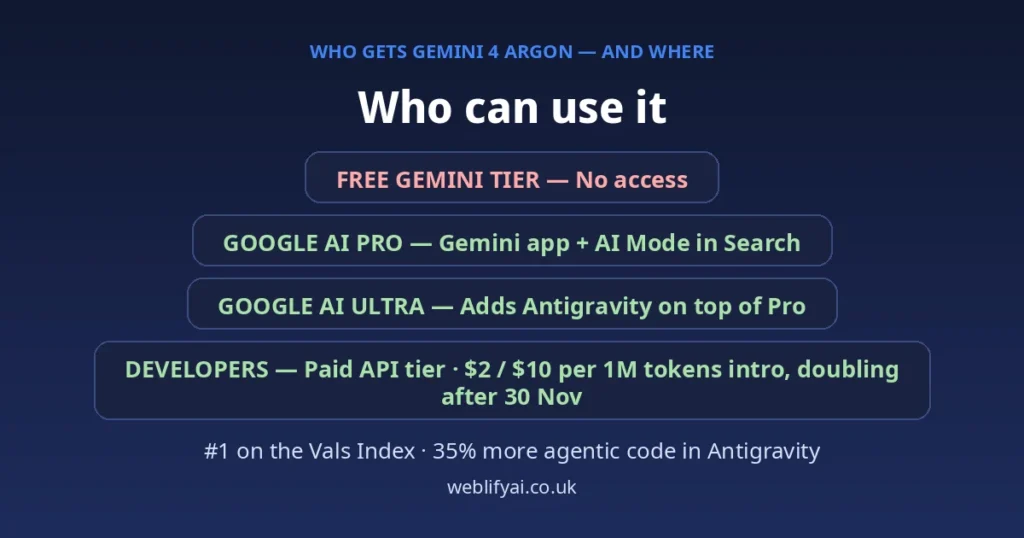
The access tiers break down like this, per Google’s own announcement:
- Gemini app and AI Mode in Search: Google AI Pro and Ultra subscribers
- Antigravity (Google’s coding environment): Ultra subscribers only — a Pro plan doesn’t unlock it there
- Gemini API and Google AI Studio: developers and enterprises on the paid tier
API pricing starts at an introductory rate of $2 per million input tokens and $10 per million output tokens (cached input at 95% off). That intro rate expires on 30 November 2026, after which the price doubles to $4/$20 — Reuters reports.
Google is talking up Argon’s benchmarks hard: it claims the model ranks first on the Vals Index (68.90%, tested on finance, coding, legal and tax tasks), and says internal teams using it in Antigravity submitted over 35% more agentic code while rollbacks fell by nearly a third. It also points to real-world engineering wins — including a Chrome refactor spanning hundreds of files that Google says was compressed from months into weeks.
For context, this release follows a rough patch for Google’s AI division. Reuters notes the company recently scrapped plans for Gemini 3.5 Pro and shook up DeepMind’s leadership after co-founder Demis Hassabis stepped aside. Alongside the rollout, Google said it will expand its Fairwind programme to hundreds more cybersecurity partners and give 10,000 scientists six months of free access to Antigravity’s highest usage tier.
What it means for UK small businesses
1. The best AI models are now subscription-gated. This is the direction of travel: frontier models are getting reserved for paying customers. If your business relies on free AI tools for day-to-day work, expect the performance gap between free and paid tiers to widen. Budget a few pounds a month for a Pro-level plan the way you’d budget for any other software.
2. AI Mode in Search is changing how customers find you. Argon arriving in AI Mode matters because Google’s AI-powered search answers are increasingly the first — and sometimes only — thing searchers see. That makes AI-search visibility part of your marketing, not a side project. Our generative AI SEO guide walks through how to stay visible as search answers get written by models like these.
3. Coding assistance is getting noticeably stronger — even for non-developers. The 35% jump in agentic code submissions is a developer metric, but the spill-over effect is real: the no-code and low-code tools your business uses (chatbots, automation, simple apps) all get better when the underlying models do. This fits a wider pattern of AI upgrades landing this month — the tooling floor keeps rising.
4. Pricing windows matter. The intro API rate doubling on 30 November is a reminder: AI pricing is promotional and temporary. If you’re building anything on top of the Gemini API, lock in testing and cost modelling before the end of November, not after.
Honest limits / what to watch
- Independent benchmarks tell a less flattering story. Google claims Argon tops the Vals Index, but as AI Stock Wire notes, on the Artificial Analysis Intelligence Index Argon merely tied OpenAI’s GPT-6 Astra and trailed two Anthropic models. Vendor-reported wins deserve scepticism — wait for independent testing before treating Argon as the market leader.
- Rollouts are phased, not instant. Google began the broader rollout on 13 October, but availability in the app has been appearing gradually. Don’t panic if your Pro subscription doesn’t show the model on day one.
- Ultra is a lot to pay for most small firms. Unless your team is actively building software in Antigravity, Ultra’s premium buys you little that Pro doesn’t. This is a developer-targeted tier, not a small-business one.
- The price doubles on 1 December. Budget forecasts built on today’s $2/$10 rates will be wrong within six weeks. If an agency or tool vendor is quoting you “powered by Gemini 4 Argon” services, ask whether their pricing survives the December increase.
FAQs
Who can use Gemini 4 Argon right now?
Paid users only. Google AI Pro and Ultra subscribers get Argon in the Gemini app and AI Mode in Search; Ultra subscribers also get it in Google’s Antigravity coding tool. Developers can use it through the paid tier of the Gemini API. The free Gemini tier does not get access.
How much does Gemini 4 Argon cost via the API?
The introductory price is $2 per million input tokens and $10 per million output tokens, with cached input tokens discounted by 95%. That intro rate expires on 30 November 2026, after which pricing doubles to $4 per million input and $20 per million output.
Is Gemini 4 Argon available in the UK?
Google says the rollout is global, and Sundar Pichai confirmed on X that Argon is available worldwide. UK users on Google AI Pro or Ultra subscriptions should see it appear in the Gemini app and AI Mode in Search as the rollout progresses.
Why did Google limit Gemini 4 Argon to paid users?
Argon debuted on 30 September 2026 restricted to vetted cybersecurity defenders in Google’s Fairwind programme. Google then phased access wider but kept it behind paid tiers — a pattern consistent with keeping its most expensive frontier model aligned to subscription revenue while it tests safeguards at scale.
Should my small business switch to Google AI Ultra?
Probably not on the basis of this announcement alone. Pro covers the Gemini app and AI Mode in Search; Ultra is only required if you specifically need Argon inside Antigravity, Google’s coding tool. For most non-technical firms, the cost of Ultra is hard to justify without a clear use case.