Direct answer: American Express is getting ahead of a problem most shoppers haven’t hit yet: AI agents buying the wrong thing. Its new "Intent Intelligence Framework" captures what you actually asked an AI agent to buy — and authenticates that intent — before the transaction completes, so a nondeterministic chatbot can’t complete a purchase you never approved. Amex wants it to become the industry standard for agentic commerce, and it’s backing the idea with purchase protection for customers whose registered agents make mistakes.
What happened
Personal AI agents are increasingly buying things on people’s behalf — booking travel, ordering groceries, comparing prices. The trouble, as TechCrunch reports, is that large language models are nondeterministic by design: an agent can occasionally go off script and buy something nobody approved. Amex’s answer is the Intent Intelligence Framework, which keeps the customer’s original purchase instructions attached to the transaction from purchase through everything that follows.
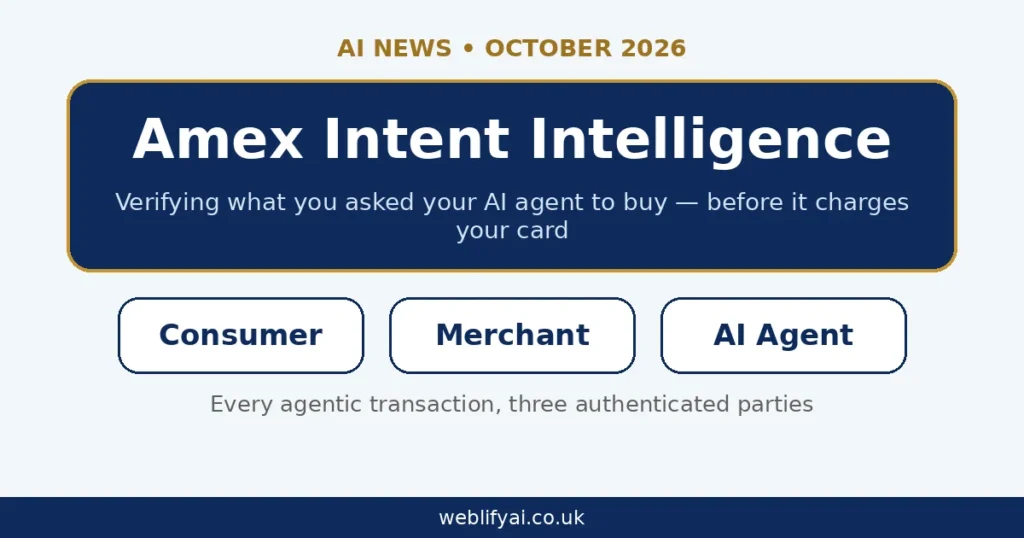
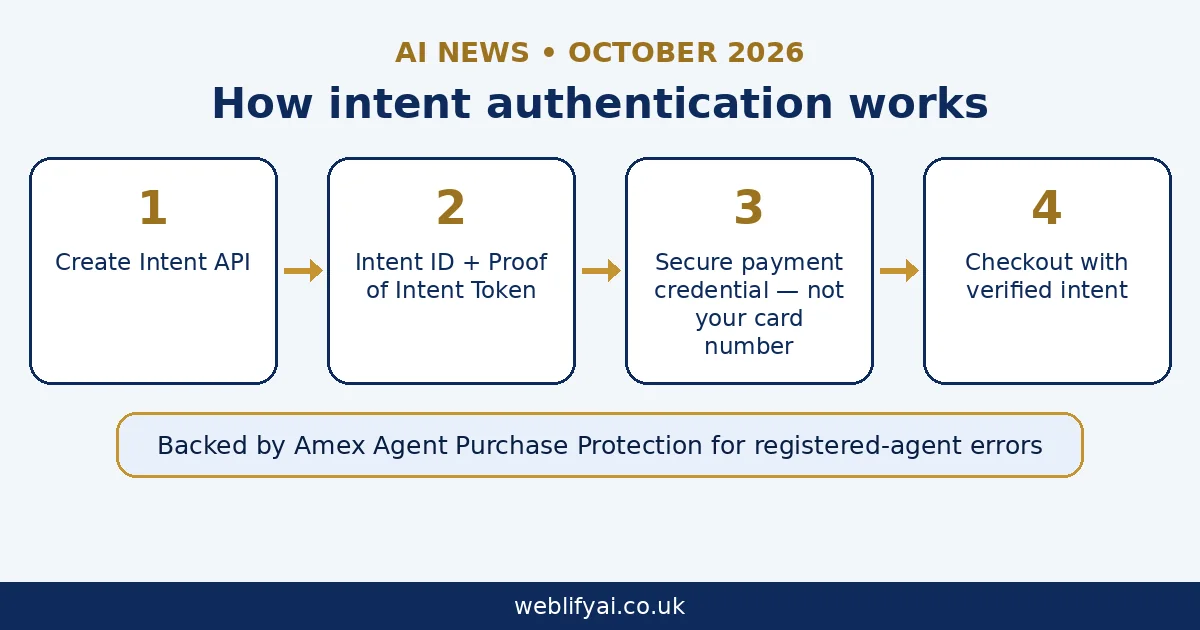
How it works: it starts with a Create Intent API. When a purchase is initiated, an Intent ID is created along with a Proof of Intent Token containing the customer’s high-level constraints (what, where, how much). That token is used to obtain a secure digital payment credential the agent uses at checkout — the agent never touches the real card number. Every agentic transaction becomes a three-party affair: consumer, merchant, and agent, with an auditable record of who authorized what.
The framework sits inside Amex’s Agentic Commerce Experiences (ACE) Developer Toolkit, launched in April, which already covers agent registration, account enablement, payment credentials and cart context. And Amex is putting money behind the trust story: its Amex Agent Purchase Protection shields eligible cardholders from charges arising from an authorized agent’s error — wrong item, wrong merchant, duplicate order, over the user’s limits — provided the agent was registered and authenticated intent was transmitted, as detailed in FStech’s coverage of the launch.
Notably, Amex says it hasn’t seen a dispute spike yet — this is deliberately proactive. But its own Trendex survey suggests the wave is coming: 66% of US consumers say they’re likely to use AI agents to research the best price in the next 12 months, and 61% for product or service recommendations.
What it means for UK small businesses
If you sell anything online, agentic commerce is about to knock on your door — and this framework is the clearest signal yet of how the rails will work:
- Disputes are the hidden cost. A customer whose AI agent orders the wrong product will dispute the charge — with you, not the agent. Frameworks like this create a clear authorization trail showing what was approved versus what the agent bought, which protects merchants from chargeback chaos. Businesses with clean, documented checkout records will fare best; those without may eat the losses.
- Prepare your checkout for agents, not just humans. Amex’s model — registered agents, intent tokens, auditable consent — points to a future where your store needs to distinguish agent traffic from human traffic and log it differently. If you’re planning agentic commerce features, build authorization and record-keeping in from day one.
- Trust is the product. Consumers will only let agents spend money if someone credible guarantees the guardrails. Amex’s closed-loop network (issuer, network and acquirer in one) gives it end-to-end visibility — and whichever card networks your customers use will need equivalent protections. Expect Visa and Mastercard to follow with their own versions soon.
Honest limits / what to watch
The biggest caveat: this is Amex’s framework, on Amex’s rails. It only protects transactions where everyone plays by its rules — registered agents, authenticated intent, Amex cards. The real question is whether it becomes an industry standard or one of several competing ones, and what happens to the long tail of merchants and payment providers who aren’t in Amex’s closed loop.
Also note the protection covers agent error, not every problem — eligibility depends on using a registered agent, meeting account and transaction conditions, and reporting issues in time. And while 66%/61% are striking survey figures, they’re US consumers’ stated intentions, not UK behaviour — intentions routinely overstate actual adoption. The framework is genuinely thoughtful infrastructure, but treat it as a first draft of the rules, not the finished rulebook.
FAQs
What is Amex’s Intent Intelligence Framework?
A framework that captures and authenticates a customer’s purchase intent before an AI agent completes a transaction. The original instructions stay attached to the transaction through its whole lifecycle, so the agent can’t complete a purchase that differs from what was approved.
How does it stop unauthorized purchases technically?
It starts with a Create Intent API that generates an Intent ID and a Proof of Intent Token containing the customer’s constraints. The token is exchanged for a secure digital payment credential the agent uses at checkout instead of the real card number.
Why is this needed — can’t agents just follow instructions?
Large language models are nondeterministic, so an agent told to book a flight or order groceries can occasionally misfire and buy something unapproved. The framework gives merchants and networks cryptographic-grade proof of what was actually authorized.
Does Amex protect me if my AI agent buys the wrong thing?
Under Amex Agent Purchase Protection, eligible cardholders are shielded from charges arising from an authorized, registered agent’s error — wrong item, wrong merchant, duplicates, over-limit purchases — subject to terms and timely reporting.
Has agentic commerce caused many disputes so far?
Amex says it has not seen an increase in disputes yet — the framework is proactive. But with two-thirds of surveyed US consumers saying they’ll likely use AI agents for price research within a year, the volume is expected to grow fast.