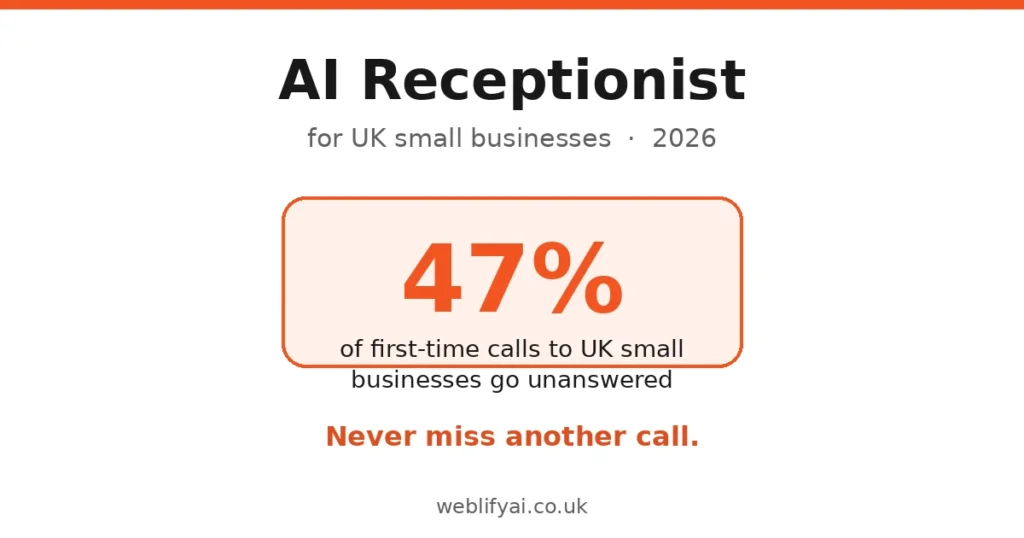
Direct answer: An AI receptionist answers your business calls with a natural AI voice — greeting callers, answering FAQs, booking appointments and taking messages, around the clock. UK small businesses typically pay £25–£500 per month depending on features. And here’s the number that matters: UK research found 47% of first-time calls to small businesses go unanswered, with 85% of those callers never calling back. If that’s you, an AI receptionist usually pays for itself within the first month. If you already answer nearly every call, save your money.
Search interest is climbing — “ai receptionist for small business” is a top rising UK query right now. Most of what’s written about it is either vendor marketing or US-centric. This is the UK small-business version: real prices, what the tech actually does, and when it’s not worth it.
What an AI Receptionist Actually Does
Forget the sci-fi framing. A modern AI receptionist does five jobs:
- Answers instantly, 24/7 — no ringing out, no voicemail black hole, no “we’re experiencing high call volumes”.
- Greets and qualifies — “Thanks for calling [Business], how can I help?” then works out what the caller wants.
- Answers common questions — opening hours, prices, service area, “do you cover my postcode?” — from a script you write.
- Books appointments — checks your calendar and books, reschedules or confirms while on the call.
- Takes messages and escalates — texts or emails you the details seconds after the call, and patches urgent callers straight through to you.
The callers most businesses lose are the ones who ring at 7pm, during the school run, or while you’re up a ladder. That’s exactly who this serves.
What It Really Costs in the UK (2026)
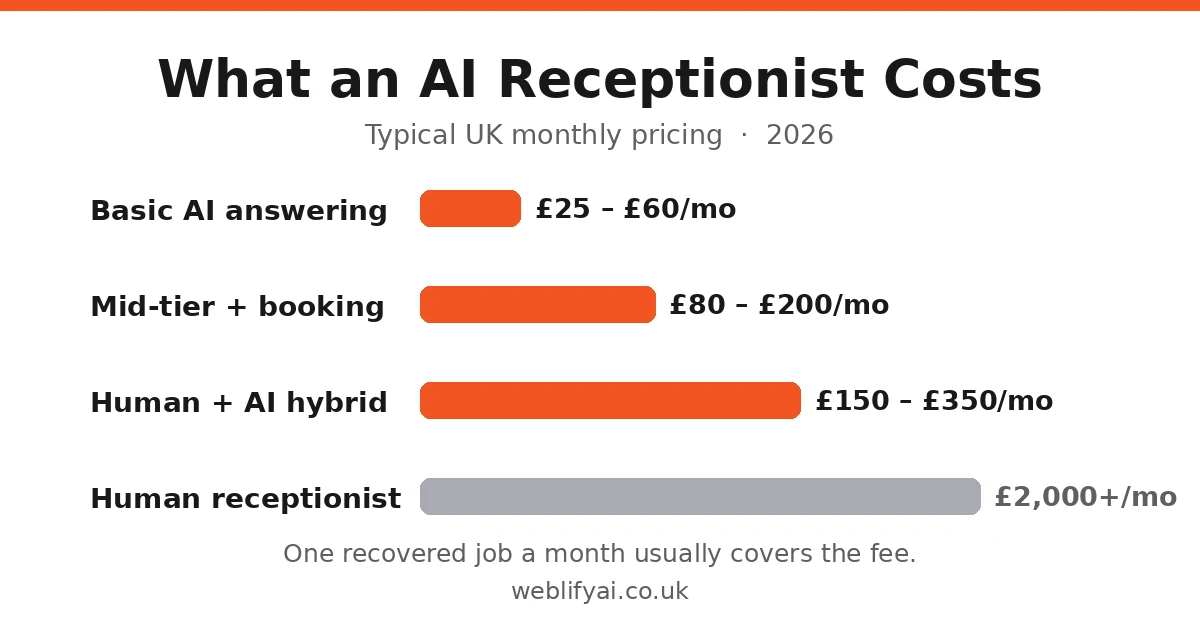
Prices vary a lot by pricing model — flat subscription, per-call, or per-minute — so here’s the honest market picture:
| Tier | Typical UK cost | What you get |
|---|---|---|
| Basic AI answering | £25–£60/month | Answers calls, takes messages; usually capped at 50–200 minutes |
| Mid-tier with booking | £80–£200/month | Calendar booking, CRM sync, more minutes |
| Flat-rate unlimited | From ~£49/month | Unlimited calls, one predictable bill |
| Human + AI hybrid | £150–£350/month | AI handles routine, humans take the tricky calls |
| Phone-system add-ons | ~£20–£35/month + line | AI features bolted onto a VoIP plan (e.g. bOnline at £19.95) |
Two things the headline prices hide. First, per-minute overage (typically 10–25p/min) can sting exactly when business is booming. Second, the setup work is yours: budget 3–6 hours to write the call script, feed in your FAQs, prices and service area, and test it with realistic scenarios. An AI receptionist with a bad script is worse than voicemail — it confidently gives wrong answers.
Compare against the alternative: a full-time human receptionist costs £24,000–£32,000 a year in the UK. The AI doesn’t need to be as good as a human. It needs to be better than a missed call.
The Maths: When Does It Pay for Itself?
Work it backwards from your numbers:
- Missed calls per month × your conversion rate × average job value = revenue leaking out of unanswered calls.
A plumber missing 10 calls a month, converting 3 at £300 a job, leaks £900. A £99/month AI receptionist that captures even half of those pays for itself nine times over. The TelePA study of 142 UK SMEs found nearly half of initial calls unanswered — if you’re a tradesperson, salon or clinic owner doing the work yourself, you’re almost certainly in that half.
But flip it: if you already answer 90% of calls within three rings, an AI receptionist adds cost without adding revenue. Run the numbers honestly before you buy. The tech is exciting; the maths is what matters.
AI Receptionist vs Human Receptionist vs Doing Nothing
| AI receptionist | Human receptionist | Missed calls | |
|---|---|---|---|
| Monthly cost | £25–£500 | £2,000–£2,700 | £0 |
| Availability | 24/7 | Working hours | — |
| Handles complexity | Routine only | Excellent | — |
| Knows your regulars | No | Yes | — |
| Scales at busy times | Infinitely | One call at a time | — |
| Cost of failure | Wrong answers | Sick days | Lost jobs |
The hybrid services (£150–£350/month) exist because the middle ground is real: AI for the routine 80%, a human for the 20% that needs judgement. For many businesses that’s the sweet spot.
UK-Specific Things to Get Right
Disclosure. Tell callers it’s an AI assistant. A quick “I’m the AI assistant for…” at the start is honest, and Ofcom’s direction of travel is toward transparency on automated calls anyway.
Data protection. Call recordings and transcripts are personal data under UK GDPR. Use a provider that stores data in the UK/EU, and update your privacy notice. This is a five-minute job — don’t skip it.
The accent test. Test the voice with your actual customers’ accents and vocabulary. “Postcode”, “boiler service”, “MOT” — if it stumbles on your industry’s everyday words, retrain the script before it goes live.
Escalation rules. Decide in advance what counts as urgent (a burst pipe, a medical concern, an angry customer) and make sure those calls reach a human immediately. This is the difference between a tool and a liability.
Who Should (and Shouldn’t) Get One
Should: tradespeople, salons, clinics, estate agents, solicitors — any business where the owner does the work and the phone rings while they’re busy. Also anyone with meaningful after-hours demand.
Shouldn’t: businesses that already answer promptly, ultra-high-trust services where the personal relationship IS the product (though hybrids can work), and anyone unwilling to spend the setup hours writing a proper call script.
If your needs are lighter — appointment booking over chat rather than full phone answering — our Dola AI WhatsApp Assistant guide covers a WhatsApp-based alternative that’s free in beta. And for the bigger picture on AI handling customer contact, see our AI agents for small business UK guide.
FAQs
What is an AI receptionist?
Software that answers your business phone calls with a natural-sounding AI voice. It greets callers, answers common questions, books appointments, takes messages and routes urgent calls to you — 24/7, without a human receptionist.
How much does an AI receptionist cost in the UK?
Most UK small businesses pay £25–£500 per month. Basic AI answering starts around £25–£60/month, mid-tier with calendar booking runs £80–£200/month, and human-plus-AI hybrid services cost £150–£350/month. Flat-rate plans with unlimited calls start near £49/month.
Can an AI receptionist book appointments?
Yes — mid-tier and above integrate with calendars like Google Calendar to book, reschedule and confirm appointments during the call. For a lighter chat-based option, our Dola AI WhatsApp Assistant guide covers booking over WhatsApp.
Is an AI receptionist worth it for a small business?
If you’re missing calls, usually yes. UK research found 47% of initial calls to small businesses go unanswered, and 85% of those callers don’t call back. One recovered job a month typically covers the fee. If you already answer 90%+ of calls, it’s an unnecessary cost.
Will callers know it’s an AI?
Most likely, yes — and that’s fine. The best practice is a brief disclosure (‘I’m the AI assistant for…’). Callers care that their problem gets handled, not whether the voice is human.
What can’t an AI receptionist do?
Handle genuinely complex or emotional situations, exercise judgement on unusual requests, take payments securely in most setups, or replace the relationship value of a human who knows your regulars. Human-plus-AI hybrid services exist for exactly this gap.
Do I need new phone hardware for an AI receptionist?
No. Most services work with your existing business number via call forwarding or a VoIP line. Setup is software configuration — writing the call script, FAQs and booking rules — typically a few hours of your time.