

Direct answer:
Direct answer: The UK government is creating a new AI Biosecurity Lab, backed by £100 million of public money and up to £200 million in model credits and support from OpenAI and Anthropic. Described by ministers as the world’s first dedicated AI biosecurity organisation, the lab will use frontier AI to spot biological threats earlier and to speed up vaccines, treatments and other medical countermeasures. It is a serious, long-term institution in the making — not a grant scheme, not an overnight fix, and not yet open for business.
What happened
The announcement landed on 23 October 2026, ahead of the Budget, as part of a wider AI security spending package. The Cabinet Office announcement, reported by the BBC and multiple outlets, sets out a simple but striking idea: the same AI capabilities that are accelerating biological research could also make biological harm easier, cheaper or faster to attempt, and the UK should build a dedicated institution to work on that problem rather than treating it as an afterthought of either AI policy or health policy.
The numbers, as reported, break down like this. The government itself is putting £100 million into the lab. On top of that, OpenAI will provide £100 million in compute and model credits, plus trusted access to its most capable relevant models through its Rosalind Biodefense programme. Anthropic will provide up to £100 million in model credits, trusted model access and dedicated technical support. That gives the project up to £300 million in total backing — but it is important to be precise about what kind of backing that is. The company contributions are credits, compute and access, not £200 million in cash landing in a government bank account. That distinction matters, because credits buy model usage, and model usage is only useful if the lab has the people, data, infrastructure and legal permissions to use it well.
Two further partners are named in reports of the announcement: Google DeepMind and the UK company Basecamp Research, which will provide its AI-biology models and work with the lab as research partners. That matters because it means the lab is not solely dependent on two American frontier labs. DeepMind brings deep UK-based AI research capacity, and Basecamp Research brings specialist AI-biology work from a British company. A lab that can compare, combine and challenge models from several providers is a stronger lab than one locked into a single supplier’s view of the world.
The lab’s mission, in the government’s words as reported, is to strengthen biosecurity by harnessing frontier AI. It will bring together frontier AI talent and biological science talent to develop practical technical capabilities that improve the UK’s ability to understand, prevent, detect and respond to biological threats. The research is intended to strengthen UK and global resilience to a wide range of biological risks, including those enabled by advances in AI. In plain English: hire people who understand both AI systems and biology, build tools that work in real outbreak and laboratory conditions, and make the UK faster at noticing trouble and faster at responding to it.
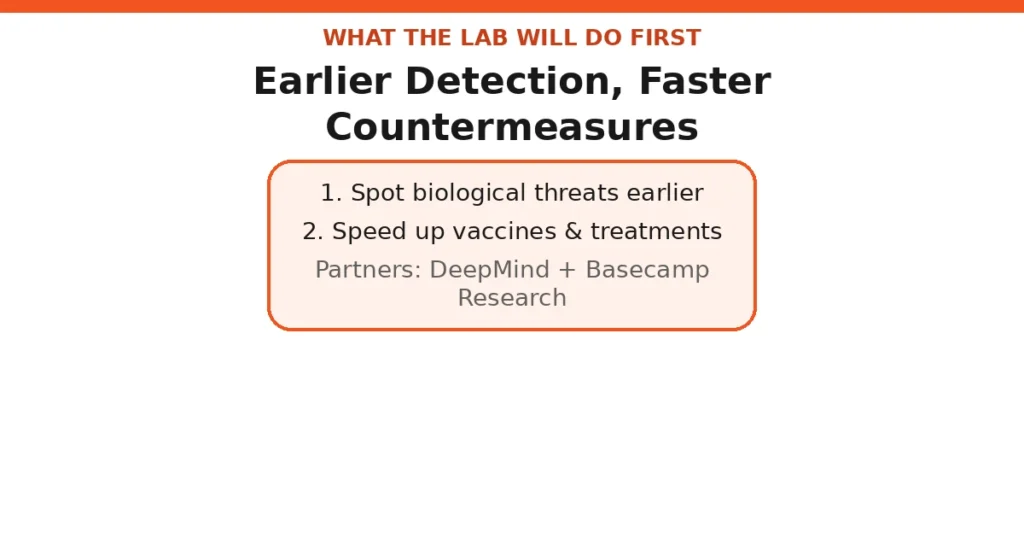
Initial delivery will focus on two priorities. The first is earlier detection of emerging biological threats. The second is faster development of vaccines, treatments and other medical countermeasures. The government says the lab will harness frontier AI to support partners including the UK’s national biosecurity centres and the country’s life sciences industry, enabling the UK and the world to respond faster to disease outbreaks and strengthening resilience against future biological risks. Those two priorities are deliberately practical. Detection and countermeasures are the places where days or weeks of delay translate directly into lives, hospital capacity and economic disruption, as the Covid-19 pandemic demonstrated in brutal detail.
The announcement sits inside a larger package, and the wider numbers are worth reporting carefully because different outlets have framed them slightly differently. Alongside the lab itself, the government separately announced £65 million for developing countermeasures against pathogens. The UK’s AI Security Institute — the body set up in 2023 to evaluate the risks of the most powerful AI models — is set to receive an additional £120 million to keep its testing work going. Other reported elements of the wider AI security package include £130 million for cyber defence programmes, £60 million for a fund backing British companies applying AI to robotics, autonomous systems and manufacturing, £60 million for AI research and procurement contracts, £23 million to study AI’s economic impact, £18 million for a chip design academy, and £15 million for a prize rewarding AI solutions to public policy problems, starting with healthcare. Some outlets have totalled the wider package at roughly £600 million. Treat that total as a reported package figure, not as money for the lab itself: the lab’s own headline figure is £100 million of government funding plus up to £200 million of company support.
The politics of the announcement are also part of the story. AI Minister Kanishka Narayan said the lab would become a major global institution bringing together world-leading scientific expertise to protect people from emerging biological threats, and framed it as staying ahead of threats ranging from cyber attacks to biological risks while building more of the critical technology national security depends on. Chancellor John Healey framed the package as a distinctively British approach to AI: one that protects working people, defends the national interest and spreads the benefits of AI-enabled growth across the country, while backing British science, advanced chips and home-grown AI companies to strengthen security, rebuild industrial strength and create skilled jobs. You do not have to agree with that framing to recognise what it signals: the government wants AI safety and AI growth to be presented as one programme, not two opposing camps, and biosecurity is now one of the places where that argument will be tested.
Why biosecurity, and why now
To understand why a government would create a dedicated AI biosecurity lab in 2026, it helps to separate three different claims that are often blurred together in public debate.
The first claim is that AI is genuinely useful for biology. That part is now well established. Machine learning models help researchers predict protein structures, analyse genomic data, design experiments, sift through scientific literature at a scale no human team can match, and model how a pathogen might spread. Drug discovery, vaccine design and diagnostics have all been accelerated by AI tools in recent years. OpenAI’s own move into biotech — including its acquisition of the startup Orchestra Bio, which we covered earlier — is one sign of how seriously frontier labs now take the biology opportunity. When the government says AI can accelerate research, improve understanding of diseases and support the discovery of new medical countermeasures, it is describing work that is already happening, not a speculative future.
The second claim is that AI could lower barriers to harmful biological activity. This is the risk side, and it is more contested, but it is the reason a biosecurity lab exists at all. The concern, as stated by governments and safety researchers, is that increasingly capable AI systems — systems that can write code, operate software tools, plan multi-step tasks, summarise specialist literature and reason about complex systems — could help a bad actor identify weaknesses, design experiments, troubleshoot laboratory work or automate parts of an attack that previously required rare expertise, expensive equipment or a team of specialists. Nobody serious claims that a chatbot alone creates a bioweapon. The claim is subtler: AI compresses the distance between intention and capability, and that compression deserves a dedicated institutional response.
The third claim is that this risk is growing fast enough to justify a new institution now, rather than leaving the work scattered across health agencies, defence bodies and AI safety teams. That is a judgement call, and reasonable people disagree about the timeline. What is not in doubt is that the same week as the lab announcement, the tension was visible in industry itself: Moonshot AI, announcing its new Kimi K3.1 Pro model, said it had deliberately curbed the model’s cyber-offensive capabilities by removing cyber-related data from training and reinforcement learning, precisely because of fears that increasingly autonomous AI could turbocharge hacking. Reuters reported the move on 24 October 2026, and Moonshot said it aimed “not to release open weights that would extend the absolute frontier of cyber capability.” Biosecurity and cybersecurity are different domains, but the underlying governance question is the same: when a model becomes more capable, who decides which capabilities are safe to release, and who checks that decision?
A dedicated lab is one answer to that question. Instead of relying entirely on companies to police their own releases, or entirely on regulators to write rules from the outside, a lab creates a third place: a public-interest institution with its own technical talent, its own access to frontier models, and a mandate to build defensive capabilities. Its work can inform regulation, support industry, and — crucially — be tested against real biological data and real outbreak scenarios rather than remaining theoretical.
There is also a straightforward national-interest argument. The UK has world-class life sciences, a strong AI research base, and national biosecurity centres that already do this work. The lab is, in part, an attempt to connect those strengths: give the biosecurity centres frontier AI tools, give the AI labs real biological problems, and give British companies a reason to build biosecurity-relevant technology at home rather than watching the field consolidate overseas. Whether £100 million plus credits is enough to do that at scale is a fair question, and we return to it in the limits section. But the strategic logic — connect AI talent to biology talent under one roof — is coherent.
How the lab is supposed to work
Because the lab is still being set up, there is no published organisational chart, no director announcement in the reports we have seen, and no detailed research programme to analyse. What we can do is explain, from the announcement itself, how the pieces are meant to fit together, and what questions the lab will have to answer as it takes shape.
First, talent. The lab’s core bet is interdisciplinary: AI researchers and biologists working together, not in parallel. That sounds obvious, but in practice the two fields have different languages, different publication cultures, different safety norms and different ideas about what counts as evidence. A biologist worries about wet-lab validation, sample integrity and clinical relevance. An AI researcher worries about benchmarks, generalisation and failure modes. A lab that genuinely merges them needs shared projects with shared accountability — for example, a detection tool that is judged not on a benchmark score but on whether it flags a real outbreak signal earlier than existing surveillance, without drowning public health teams in false alarms.
Second, access. The OpenAI and Anthropic contributions give the lab trusted access to frontier models, including OpenAI’s most capable relevant models through the Rosalind Biodefense programme. “Trusted access” is doing a lot of work in that phrase. It presumably means access beyond a standard public API: deeper model capabilities, perhaps earlier access to new models, and technical support to adapt them for biosecurity work. The value of that access depends on the terms, which have not been published in detail. Does the lab get to inspect model behaviour independently? Can it publish evaluations that are critical of a provider’s model? Can it share its tools with other public bodies? Those governance details will determine whether the lab is an independent institution or a showcase for its sponsors.
Third, partners. The lab is meant to support the UK’s national biosecurity centres and the life sciences industry. That suggests a hub-and-spoke model: the lab develops capabilities, and the centres and companies deploy them. For that to work, the lab needs data-sharing agreements, clear rules about who owns what, and a route from prototype to operational use. A detection model that works in a research paper but cannot legally or practically access NHS, veterinary, agricultural or environmental surveillance data is not a detection capability. Data access, privacy law and cross-agency coordination are therefore just as important as model quality, and they are typically where public-sector technology projects succeed or stall.
Fourth, countermeasures. The £65 million for pathogen countermeasures, reported alongside the lab, points to the other end of the pipeline: once a threat is detected, how fast can the UK develop, test, manufacture and distribute a response? AI can help prioritise candidates, design trials and model manufacturing, but it cannot shortcut clinical safety testing or regulatory approval. A realistic lab will therefore measure itself on time-to-decision and time-to-deployable-prototype, not on promises of instant cures.
Finally, standards and evaluation. The additional £120 million for the AI Security Institute suggests the government sees evaluation as a continuing public function, not a one-off exercise. A biosecurity lab that publishes rigorous evaluations — of models, of detection tools, of its own performance — will build the credibility it needs to influence both industry and international partners. A lab that only publishes success stories will not.
What it means for UK small businesses
It is tempting to read a £100 million lab announcement and ask, “What does this mean for my business?” The honest answer is: less directly than a tax change or a grant scheme, but more than it first appears, because biosecurity, AI safety and public-sector procurement all shape the environment small businesses operate in. Here is a detailed breakdown by type of business.
For life sciences, biotech and health technology small businesses, the lab is a signal about where public money and attention are heading. If you supply laboratories, diagnostics, sequencing, data analysis, cold-chain logistics, or specialist software to the health or life sciences sector, a new national lab means a new potential customer, collaborator or competitor over the next few years. It does not mean a procurement portal opens tomorrow. But it does mean it is worth tracking the lab’s formation: who leads it, where it is based, what its procurement and partnership routes are, and whether it runs open calls, challenges or pilot programmes. Businesses that already work with national biosecurity centres, universities or NHS-linked research bodies are best placed to hear about those opportunities early, because the lab is described as supporting those existing centres rather than replacing them.
For the much larger group of small businesses that are not in life sciences at all — retailers, professional services, trades, hospitality, manufacturers, agencies — the direct effect is indirect but real, and it runs through three channels: resilience, regulation and reputation.
Resilience first. The pandemic taught every small business that biological disruption is a business continuity risk, not just a health story. Faster detection and faster countermeasures mean shorter, less severe disruptions if a future outbreak occurs. That is a public good, and small businesses benefit from it whether or not they ever deal with the lab directly. The practical takeaway is not to build a biosecurity plan around the lab, but to keep the business continuity lessons of the pandemic alive: remote working options, supplier diversification, cash buffers, and clear communication plans for staff and customers. A lab that shortens the next disruption by weeks is worth more to a small business than any single grant.
Regulation second. A dedicated biosecurity institution tends, over time, to produce standards, guidance and expectations that filter down through supply chains. If you handle biological materials, work in food production, agriculture, veterinary services, waste management, or laboratory supply, expect biosecurity and data governance to feature more prominently in customer due diligence and public procurement over the coming years. The smart move is to get your house in order early: document your handling procedures, know where your biological or chemical inputs come from, keep records that would survive an audit, and be able to explain your AI use — if you use AI tools for research, diagnostics or customer data — in plain language. None of that requires waiting for the lab to publish guidance. It is good practice now, and it becomes a competitive advantage when customers start asking.
Reputation and trust third. For AI-focused small businesses, the lab announcement is part of a wider shift: AI safety is becoming a mainstream business consideration, not a niche concern for frontier labs. Clients increasingly ask how AI tools handle sensitive data, what safeguards exist, and whether a vendor has thought about misuse. A small agency, software firm or consultancy that can answer those questions clearly — what data you use, what you do not use, how you test outputs, where human review sits — will win work over a competitor that waves the question away. You do not need a biosecurity policy to do that. You need a short, honest AI use statement, a human-in-the-loop for consequential decisions, and a willingness to say no to a use case that looks risky.
There are also specific opportunities to watch. The wider package’s £60 million fund for British companies applying AI to robotics, autonomous systems and manufacturing, and its £60 million for AI research and procurement contracts, are closer to small-business relevance than the lab itself, because they suggest procurement and innovation funding routes that small technology firms can actually bid for. Details have not been published yet, so do not budget around them. But do watch for calls from the relevant departments, and be ready with a one-page description of what your company does, who it serves, and what evidence you have that it works. Public innovation funding rewards readiness, not last-minute applications.
A word of caution for any small business tempted to rebrand itself overnight as a “biosecurity AI” company to chase this announcement: do not. The lab’s work is specialist, safety-critical and reputation-sensitive. Claiming expertise you do not have, or implying an endorsement from the lab, OpenAI or Anthropic that you do not hold, will damage trust far faster than it wins work. If your business genuinely touches biology, AI safety or public health, say so precisely, with evidence. If it does not, the right response to this announcement is to note it, keep your continuity and data practices strong, and move on.
For UK small businesses that sell AI tools or services, there is one more practical implication: model credits and frontier access are becoming a form of strategic currency. The lab’s deal — public money plus private model access — mirrors deals seen in other countries, where governments trade legitimacy, data or compute for privileged access to frontier systems. Small AI firms will not get Rosalind Biodefense access, but they should understand the direction of travel: the most capable models are increasingly accessed through partnerships, programmes and trusted tiers, not just open APIs. Building relationships with model providers, universities and public research bodies, and demonstrating safe, well-governed use, is becoming part of competing in AI, not an optional extra.
Key facts and timeline
The table below summarises what has been confirmed in reports of the announcement, and what remains unpublished. Treat the right-hand column as a checklist to revisit when the government publishes more detail.
| Item | What we know | What is not yet published |
|---|---|---|
| Name | AI Biosecurity Lab (AIBL) | Legal form, host institution, location |
| Announced | 23 October 2026, ahead of the Budget | Budget confirmation and any revised figures |
| Government funding | £100 million | Spending profile over how many years |
| OpenAI contribution | £100 million in compute and model credits, plus trusted access via Rosalind Biodefense | Detailed access terms, publication rights |
| Anthropic contribution | Up to £100 million in model credits, trusted access, technical support | Exact value, duration, conditions |
| Other partners | Google DeepMind, Basecamp Research named as research partners | Roles, funding, data-sharing terms |
| First priorities | Earlier detection; faster vaccines, treatments and countermeasures | Measurable targets, first capabilities, dates |
| Related funding | £65 million pathogen countermeasures; £120 million AI Security Institute | Programme details, application routes |
| Status | Announced, being set up | Opening date, leadership, staffing |
A note on dates: several outlets describe the lab as announced on 23 October 2026, with formal launch or Budget confirmation to follow. Some aggregator pages date their own coverage 24 October. That is a publication-date difference, not a disagreement about the announcement itself. When you cite this story, cite the 23 October announcement and note that Budget details were still to be confirmed at the time of reporting.
Honest limits / what to watch
A £100 million lab announcement deserves enthusiasm and scrutiny in equal measure. Here are the limits and open questions that matter most.
First, credits are not cash, and access is not independence. Up to £200 million in model credits sounds enormous, but its real value depends on how much the lab actually needs frontier model access, at what price, and on what terms. If credits expire, are restricted to particular models, or cannot be used for the lab’s most important work, their headline value overstates their practical value. More importantly, a lab funded partly by the companies it is meant to evaluate needs strong governance: independent leadership, transparent evaluation methods, and the freedom to publish critical findings. Watch for who leads the lab, who sits on its oversight board, and whether its evaluations are published in full. Those details will tell you more about its independence than any press release.
Second, the lab does not yet exist as an operating institution. Announcements are not capabilities. Hiring specialist AI-biology talent takes time, security clearances take time, data-sharing agreements take time, and building detection tools that work in real surveillance systems takes longer still. The risk is not that the lab fails outright, but that it becomes a well-funded research centre whose outputs never reach operational use. The test will be whether, in twelve to eighteen months, the lab can point to specific tools in use by biosecurity centres, specific evaluations published, or specific outbreak or exercise scenarios where it demonstrably improved detection or response times. Until then, treat its impact as prospective.
Third, the dual-use dilemma has no clean solution, and the lab will live inside it. The same AI tools that detect pathogens can, in principle, be misused to understand them better. The same models that accelerate vaccine design could accelerate harmful design. The lab’s answer — build defensive capabilities, publish carefully, control access — is reasonable, but it involves judgement calls about what to publish, what to share with partners, and what to withhold. Those calls will be contested, and the lab will sometimes be criticised from both directions: too open by safety advocates, too closed by open-science advocates. Expect that tension, and judge the lab on its reasoning and transparency, not on whether it pleases everyone.
Fourth, international context matters. Biosecurity is inherently global: pathogens do not respect borders, and neither do AI models. A UK lab operating alone can only do so much. Its value multiplies if it shares data, tools and evaluations with allies, and if its standards influence international norms. Watch for partnerships with equivalent bodies overseas, contributions to international evaluation standards, and any role in shaping how open-weight models handle biological capabilities. Conversely, if other countries race ahead with larger, better-funded programmes, the UK lab’s £100 million may look modest. Scale is not everything — focus and talent matter — but it is not nothing either.
Fifth, do not over-read the wider package. The roughly £600 million total that some outlets cite bundles together many different programmes: cyber defence, robotics funding, research contracts, economic research, chip design and a policy prize. Those are all legitimate, but they are not lab funding, and they will not all reach small businesses. When the Budget confirms the figures, read the line items, not just the headline total. The most useful question for any small business is not “how big is the package?” but “is there a specific programme I can apply to, with published criteria and a deadline?”
Finally, a media literacy note. This story has been covered by the BBC and reputable outlets, but also by a long tail of aggregator sites that repackage the same announcement with varying accuracy. Some conflate the lab’s £100 million with the wider package, some present model credits as cash, and some invent opening dates or grant schemes that do not exist. If you see a claim about AIBL grants, jobs or partnerships that does not trace back to a government announcement or a named outlet’s reporting, treat it as unverified. The sources for this article are listed below; the government’s own announcement and BBC reporting should be your first check for any new claim.
What to watch next
Three milestones will tell us whether the lab lives up to its announcement. The first is leadership and location: a named director with credible AI and biology credentials, and a clear institutional home, will signal that the lab is moving from announcement to organisation. The second is the Budget confirmation: final figures, spending profile and any new detail about governance, partners or data access. The third is the first published output: an evaluation, a detection tool, a partnership agreement or a research programme with measurable goals. Any one of those will be more informative than another round of announcement coverage.
For small businesses, the practical watchlist is simpler. Watch for procurement or partnership calls linked to the lab or the wider AI security package. Watch for guidance from your sector body about biosecurity, AI governance or data handling that cites the lab’s work. And watch for customer questions: if clients start asking about AI safety, data provenance or misuse safeguards, that is the market telling you that this announcement is part of a larger shift, not a one-day headline.
The UK has chosen to build a dedicated institution for a problem that sits at the intersection of two of the most powerful technologies of our time. That is a significant decision, and it deserves to be followed closely — with enthusiasm for the ambition, and with the scrutiny that public money and public safety both require.
FAQs
What is the UK AI Biosecurity Lab?
The AI Biosecurity Lab, known as AIBL, is a new UK government-backed organisation that will use frontier AI to understand, prevent, detect and respond to biological threats. The government describes it as the world’s first dedicated AI biosecurity organisation.
How much funding does the AI Biosecurity Lab get?
The government is committing £100 million, and OpenAI and Anthropic are providing up to £200 million in combined model credits, compute and technical support — giving the project up to £300 million in total backing, though the company contributions are credits and access rather than cash.
What will the lab actually do first?
Its initial work will focus on earlier detection of emerging biological threats and faster development of vaccines, treatments and other medical countermeasures, working with the UK’s national biosecurity centres and life sciences industry.
Are Google DeepMind and other firms involved?
Yes, according to reports of the announcement, Google DeepMind and the UK company Basecamp Research will work with the lab as research partners, bringing AI-biology expertise alongside OpenAI and Anthropic.
Is the lab open yet, and can small businesses apply for funding from it?
No. The lab was announced on 23 October 2026 and is still being set up; no opening date, grant scheme or application route for small businesses has been published yet. Treat any claim of AIBL grants as unverified until the government publishes details.
Does this mean AI itself is now treated as a biological threat?
Not exactly. The government’s case is two-sided: AI can accelerate biology research and countermeasure development, but increasingly capable AI systems could also lower the barriers to harmful biological activity. The lab exists to work on both sides of that equation.
Sources: Cabinet Office announcement as reported by the BBC; Unite.AI, “UK Establishes AI Biosecurity Lab Backed by OpenAI and Anthropic”; Thames Compass, “UK launches AI Biosecurity Lab with £100m of government funding to counter biological threats”; Crypto Briefing, “UK commits approximately £600 million to AI security, with a biosecurity lab at the center”; Reuters, “Moonshot curbs hacking ability in new Kimi model as fears grow over AI-powered cyberattacks” (24 October 2026). Related WeblifyAI reading: OpenAI’s biotech acquisition and Anthropic’s European AI consultancy.