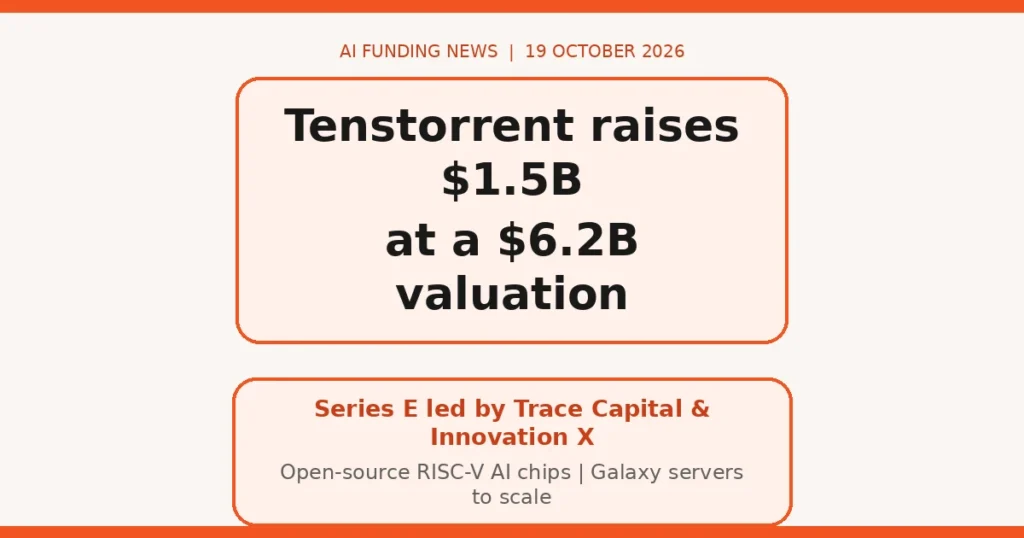
Direct answer: Tenstorrent, a Santa Clara-based AI chip startup led by veteran chip architect Jim Keller, has raised $1.5 billion in Series E funding at a $6.2 billion post-money valuation. The round, led by Trace Capital and Innovation X, will fund the scale-up of its Galaxy AI servers, and it’s the clearest sign yet that investors want an open-source alternative to the dominant proprietary chip stacks.
What happened
Tenstorrent announced the round on Monday, 19 October 2026, more than doubling its valuation from December 2024, when it raised over $693 million at a $2 billion pre-money valuation led by Samsung Securities and AFW Partners. This time the backers included Cathie Wood’s ARK Invest, Sandisk, Morgan Stanley, T. Rowe Price and Tether Investments, alongside existing investors.
The company’s bet is different from most AI chipmakers: its chips and software stack are built on RISC-V, an open-source chip architecture that lets companies design processors without paying licensing fees, reducing dependence on proprietary ecosystems such as Arm’s. Tenstorrent sells AI compute at every level — from a single card or workstation up to racks, superclusters and custom IP it licenses to customers designing their own silicon — with an open-source software stack meant to let developers run frontier models locally.
“We built one architecture and sell it at every size,” said Keller. “The future of compute is open, scalable, and owned by the people building on it.”
What it means for UK small businesses
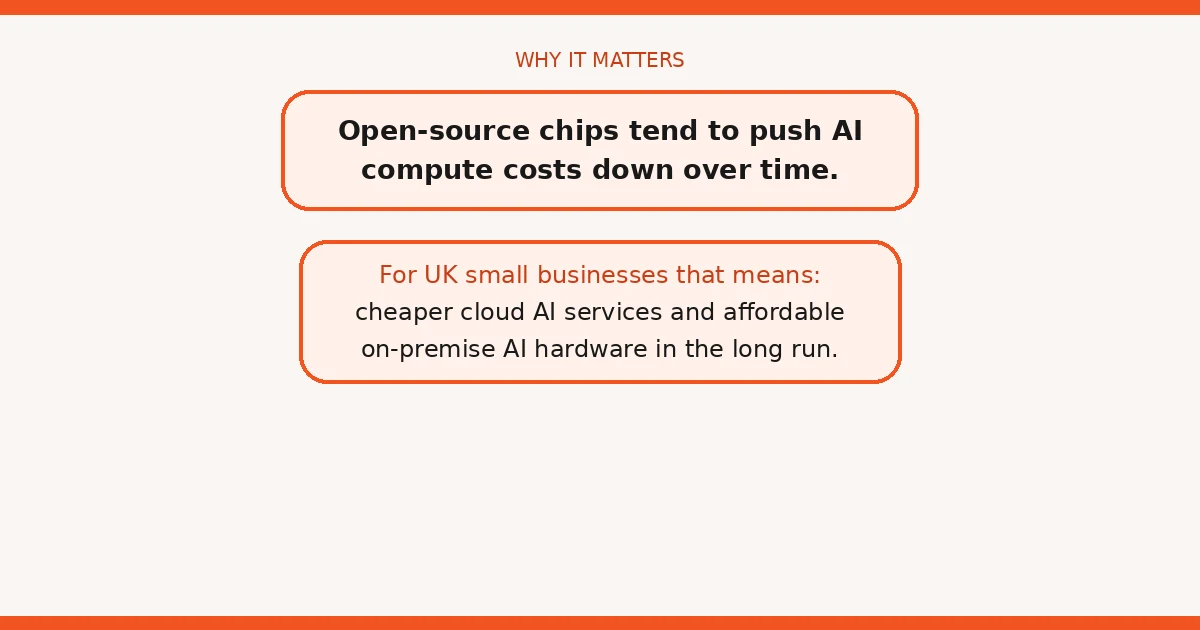
You won’t be buying a Tenstorrent chip for your office any time soon, but this matters to you indirectly. The reason AI tools are expensive to run — and why AI software keeps getting pricier — is the cost of the hardware underneath. An open-source architecture that anyone can build on tends, over time, to push prices down. Cheaper compute eventually flows through to cheaper cloud AI services, lower API costs for the tools you subscribe to, and on-premise AI hardware that smaller firms can actually afford.
There’s a second, subtler point: Tenstorrent explicitly targets open-weight models (openly available AI models anyone can run). That direction favours smaller businesses, because open-weight models can be deployed privately — keeping your customer data on your own machines rather than sending it to a big provider’s cloud.
Honest limits / what to watch
A $6.2 billion valuation is not a guarantee of success. Tenstorrent’s revenue, customer list and the economics of its Galaxy servers are all undisclosed, and it has a fraction of Nvidia’s scale with no widely published benchmark comparisons yet. Big rounds in AI hardware have a history of taking longer than expected to turn into shipping products.
For a small business, the practical takeaway is patience: this is infrastructure news, not a tool you can use tomorrow. The thing to watch is whether open-source AI hardware keeps attracting this level of investment — if it does, the price of running AI will fall steadily, and that’s good news for every firm currently paying premium rates for AI software. In the meantime, getting more out of the AI tools you already pay for is where the real savings live.
FAQs
How much did Tenstorrent raise and at what valuation?
Tenstorrent raised $1.5 billion in Series E funding at a $6.2 billion post-money valuation, announced on 19 October 2026. The round was led by Trace Capital and Innovation X.
What does Tenstorrent make?
Tenstorrent builds AI chips and AI software on the open-source RISC-V chip architecture, plus Galaxy servers that combine dozens of its chips to power chatbots, coding assistants and video generators.
Who runs Tenstorrent?
The company is led by CEO Jim Keller, a well-known chip architect who previously led Tesla’s self-driving chip effort and held key design roles at Apple and AMD.
Why is this funding round significant?
It more than doubles Tenstorrent’s valuation from its December 2024 round ($693 million+ at a $2 billion pre-money valuation), signalling strong investor appetite for an open-source alternative to proprietary AI chip ecosystems like Arm.
Does Tenstorrent’s raise affect small businesses?
Not directly in the short term, but open-source chip architectures like RISC-V tend to bring down the cost of AI compute over time, which eventually means cheaper AI tools and cloud services for small businesses.
Sources: Reuters via Channel News Asia (19 October 2026) channelnewsasia.com ; Tenstorrent announcement via ACN Newswire tradingview.com