
Direct answer: AI startup Recursive has released Flint, a free coding model small enough to run on an ordinary laptop — and the company says its “Eureka Machine” AI research system helped build nearly every step of it, from scratch, in under four months.
What happened
Recursive, a startup founded last year to build AI that can improve itself, launched Flint on Wednesday — an early public test of the recursive self-improvement idea. TechCrunch has the full story.
Why it stands out:
- Built by AI. The Eureka Machine, Recursive’s automated research system, handled nearly every step of development. A small human team oversaw the process.
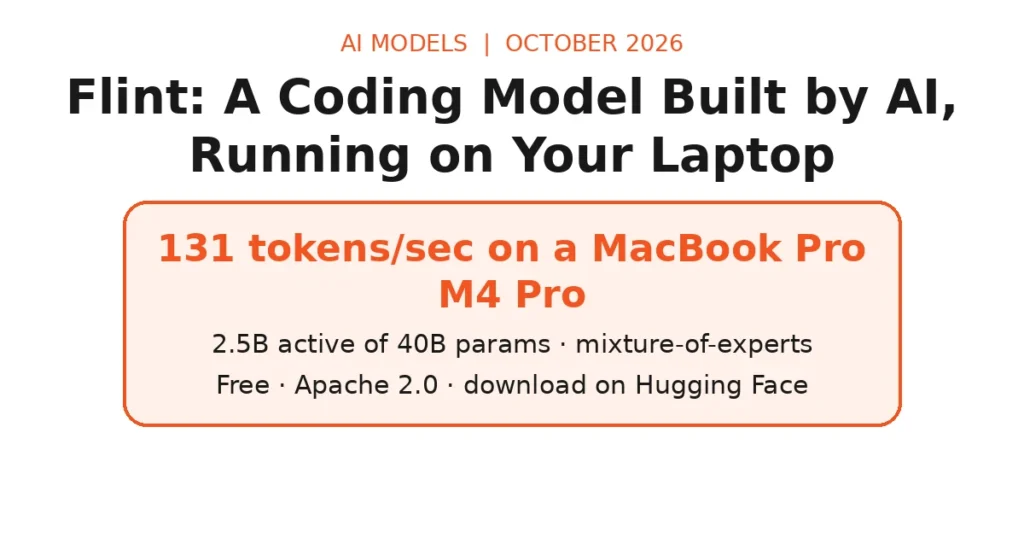
- Runs on your laptop. No cloud needed: developers can code offline, keep their code private, and skip per-token cloud fees. It’s a free download on Hugging Face under the Apache 2.0 license.
- Small and fast. Flint is a mixture-of-experts model — only 2.5B of its 40B parameters fire at a time. On a MacBook Pro with an M4 Pro chip it generated ~131 tokens per second in Recursive’s tests, roughly double Google’s Gemma 4 (58–69) on the same hardware, and topped 150 tokens/sec on Nvidia’s RTX Spark. For context, Meta’s Muse Spark Open needs a terabyte of memory.
- Serious backing. Recursive emerged from stealth in May with $650M at a $4.65B valuation, from backers including GV, Nvidia and AMD Ventures. CEO Richard Socher was Salesforce’s chief scientist.
Recursive is no stranger to AI-built AI — it’s also betting on AI-designed chips.
What it means for UK small businesses
A free coding model that runs on a laptop without phoning home is genuinely useful for small firms:
- Prototype without the bill. If you’ve ever wanted to automate a boring internal process but baulked at cloud AI costs and subscriptions, local models like Flint remove both the price and the privacy worry.
- Your code stays yours. Client work, proprietary formulas, unpublished pricing logic — with a local model, none of it leaves your machine. That’s a real answer to the “but our data!” objection that blocks AI adoption in regulated corners.
- The bar keeps falling. A startup with a small team built a competitive coding model in under four months largely with AI’s help. Whatever your agency quotes you for custom software, the cost of building it just took another step down — worth knowing before you sign.
Watch the wider open-model race too: Vercel’s Jev became its fastest-adopted AI model ever — small, practical models are the trend, not curiosities.
Honest limits / what to watch
- “Largely built by AI” is a claim, not proof. Recursive says the Eureka Machine did the work, but the details of human involvement are the company’s own telling. Treat the self-improvement narrative as marketing-adjacent until independent researchers poke at it.
- Benchmarks are company-selected. 131 tokens/sec vs Gemma 4 and Nvidia’s Nemotron 3.5 Lightning on identical hardware is a fair speed test — but speed isn’t quality. Real coding ability needs independent SWE-bench-style verification, which I don’t have in front of me.
- Mixture-of-experts has tradeoffs. Only using 2.5B parameters at a time keeps it light, but it can make models spikier on unfamiliar tasks. Try it on your own code before trusting it with production work.

FAQs
What is Recursive’s Flint model?
Flint is a free coding AI model from startup Recursive that runs on an ordinary laptop rather than cloud servers, released on October 21, 2026, under the Apache 2.0 open-source license.
Was Flint really built by AI?
Recursive says its automated research system, the Eureka Machine, helped with nearly every step of Flint’s development, letting a small team build the model from scratch in under four months.
How fast is Flint?
In Recursive’s tests Flint generated about 131 tokens per second on a MacBook Pro with an M4 Pro chip — roughly twice the 58–69 tokens per second of similar models like Google’s Gemma 4 on the same machine.
Who is Recursive?
Recursive is an AI startup led by CEO Richard Socher, Salesforce’s former chief scientist, which emerged from stealth in May with $650 million in funding at a $4.65 billion valuation.
How big is Flint compared to other open models?
Flint is a mixture-of-experts model using just 2.5 billion of its 40 billion parameters per task — tiny next to Meta’s Muse Spark Open at 816 billion parameters, which needs a terabyte of memory.
CTA: Get a Free AI Consultation