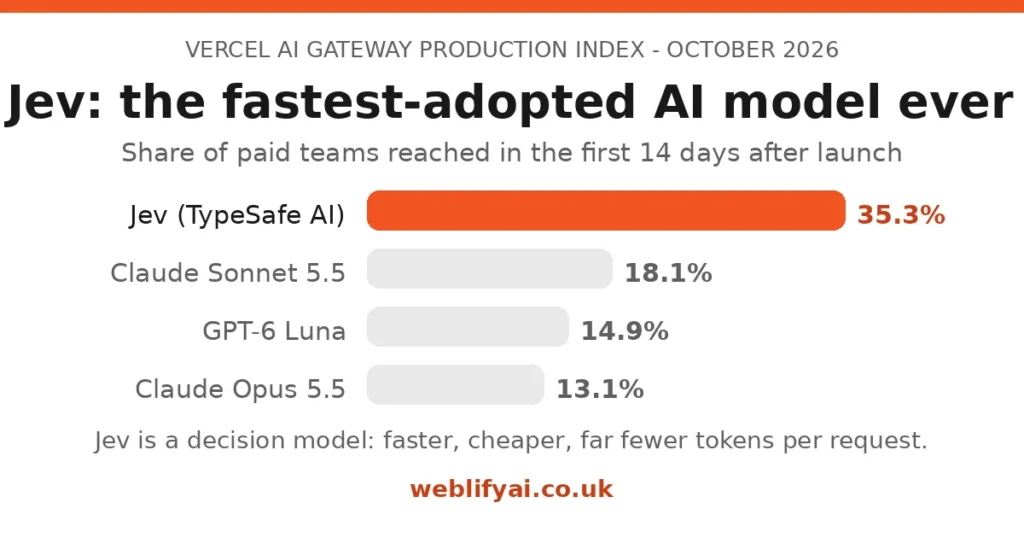
Direct answer: TypeSafe AI’s decision model Jev has become the fastest-adopted AI model ever recorded on Vercel’s AI Gateway, reaching 35% of paid teams within two weeks of launch — nearly double the reach of runner-up Claude Sonnet 5.5. For UK firms, the takeaway is practical: cheap, task-specific models can now handle jobs like classification and routing at a fraction of frontier-model cost.
What happened
Vercel publishes a monthly AI Gateway Production Index based on the traffic routed between production applications and AI labs through its AI Gateway — a unified API service used by thousands of teams. The October 2026 edition includes a scorecard of every September model launch with at least two weeks of data, and one model stood out.
Jev, launched in limited release in mid-September by a small lab called TypeSafe AI, reached 35.3% of paid teams in its first 14 days — the fastest adoption of any model in AI Gateway history. It also received the most requests of any September model, despite launching halfway through the month. The second-place model, Anthropic’s Claude Sonnet 5.5, managed 18.1% reach.
Jev is a decision model — a different breed from the general-purpose chat models most people know. Instead of generating free-form text, it’s built to choose between a few predetermined outputs. That narrow design lets it run cheaper and faster than models like Sonnet, using a fraction of the tokens — which is why it’s well suited to classifying large quantities of data quickly. As TechCrunch reported, the buzz around Jev has already inspired competing offerings from OpenAI and Amazon, and Vercel itself has used Jev to replace GPT-6 Luna for classifying harmful commands.
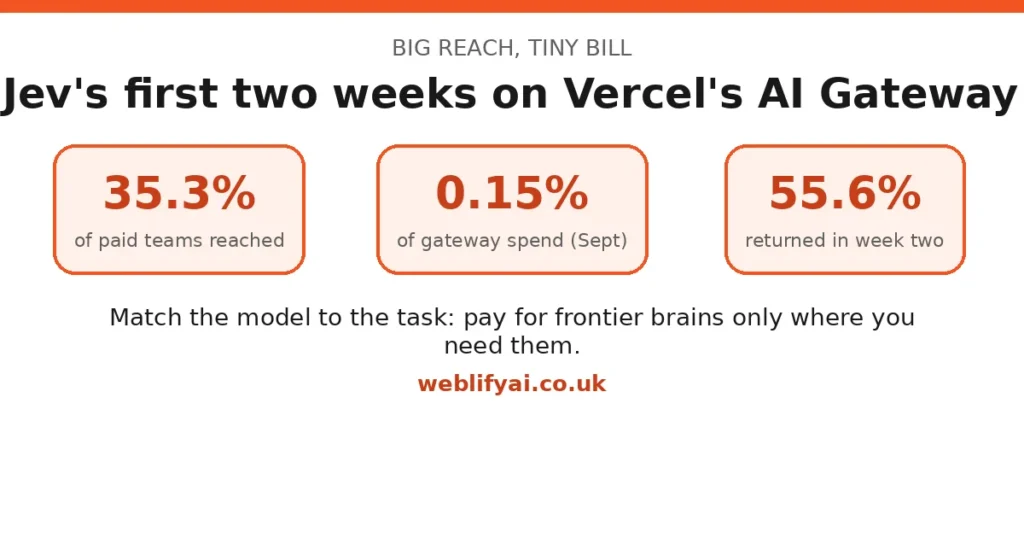
The headline adoption figure comes with an important twist: Jev’s requests are so cheap that despite its huge reach, it accounted for just 1% of September’s tokens and 0.15% of spend. Big adoption, tiny bill — that’s exactly the point.
The rest of Vercel’s index tells the same story at scale. Open-weight models now process 71.5% of gateway tokens and nearly one in four dollars of spend, with their spend share more than quadrupling since June. Total AI spend in September was roughly 13 times December’s, while the average price per token fell 47%. Teams are spending more on AI but paying less per token — and they’re switching constantly: almost one in three teams changed their most-used lab in September, a record, and model switching has risen for five straight months. Vercel’s own conclusion: the model is becoming a replaceable part of a much larger investment.
This echoes the pattern behind Microsoft’s Decision-1 model — purpose-built, smaller models doing specific jobs well rather than one giant model doing everything.
What it means for UK small businesses
Most small firms reach for the biggest, best-known model by default — and pay for it on every single request. Jev’s rise is hard evidence that this is often the wrong call. A huge share of real business AI work is decisions, not conversations: classifying support tickets, flagging harmful content, routing enquiries, tagging products, sorting invoices. Those jobs don’t need a frontier model’s reasoning power; they need a fast, cheap classifier.
The practical playbook for a UK SME:
- Audit your AI bill by task type. Separate creative and complex work (keep the frontier model) from repetitive classification and routing work (move to a cheap model).
- Stay model-agnostic. Build through a gateway or API layer so you can swap models in days, not months — the teams winning right now are the ones switching, with one in three changing their most-used lab last month alone.
- Test small first. A decision-style model costs pennies per thousand requests. Run it on one workflow — say, triaging incoming email or tagging inventory — and measure the saving before committing.
If you’re weighing up model choices more broadly, our comparison of Claude Opus 5.5 vs Sonnet 5.5 shows how much cost and capability can vary between models even from the same lab.
Honest limits / what to watch
A few caveats before anyone gets carried away:
- The data has a limited view. Vercel’s gateway necessarily undercounts the big labs that sell their own APIs (OpenAI, Anthropic), so the scorecard favours models distributed through gateways. Jev’s numbers are real, but they’re a slice of the market, not the whole pie.
- Adoption is not loyalty. Jev’s week-two return rate was 55.6% — fifth among September launches. OpenAI’s GPT-6 Luna had the highest return rate at 64.8% despite reaching fewer teams. Fast to try doesn’t always mean fast to keep.
- Decision models have a ceiling. Jev is brilliant at picking between fixed options; it won’t draft your proposal, debug your code, or reason through an edge case. Matching the model to the task is the whole game.
- Open weight isn’t automatically right for your data. Cheap models and open models mean thinking harder about where your data goes. If you handle customer or financial data, check provider data policies before chasing the lowest price per token — the UK GDPR angle still applies to every API call.
None of this dents the core lesson: the era of “one big model for everything” is fading. The smartest AI setups — from Vercel’s own moderation pipeline down to a one-person firm — mix and match models by task, and swap them when something cheaper appears.
FAQs
What is Jev?
Jev is a decision model built by TypeSafe AI. Instead of generating open-ended text, it is designed to choose between a few predetermined outputs, which makes it faster, cheaper and far less token-hungry than general models like Claude Sonnet. It launched in limited release in mid-September 2026.
What did Vercel’s data show about Jev’s adoption?
In its first 14 days, Jev reached 35.3% of paid teams on Vercel’s AI Gateway — nearly double the reach of Claude Sonnet 5.5 (18.1%), and the fastest adoption of any model in the gateway’s history. Just over half of the teams that tried it in week one came back in week two.
What is a decision model, and why is it cheaper?
A decision model specialises in one job: picking the best answer from a fixed set of options, such as classifying content or routing a request. Because it does far less work per request than a full language model, it runs faster, costs less and uses a fraction of the tokens.
Why should UK small businesses care about Jev?
Most small firms don’t need a frontier model for every AI task. Cheap, task-specific models like Jev can handle classification, moderation and routing at a tiny fraction of the cost — leaving the expensive models for work that genuinely needs them. Jev accounted for just 0.15% of gateway spend in September despite its huge adoption.
Is the shift to open-weight and smaller models real?
According to the same Vercel index, open-weight models now process 71.5% of gateway tokens and nearly a quarter of spend, with their spend share quadrupling since June. Overall AI spend in September was about 13 times December’s, while the average price per token fell 47%.