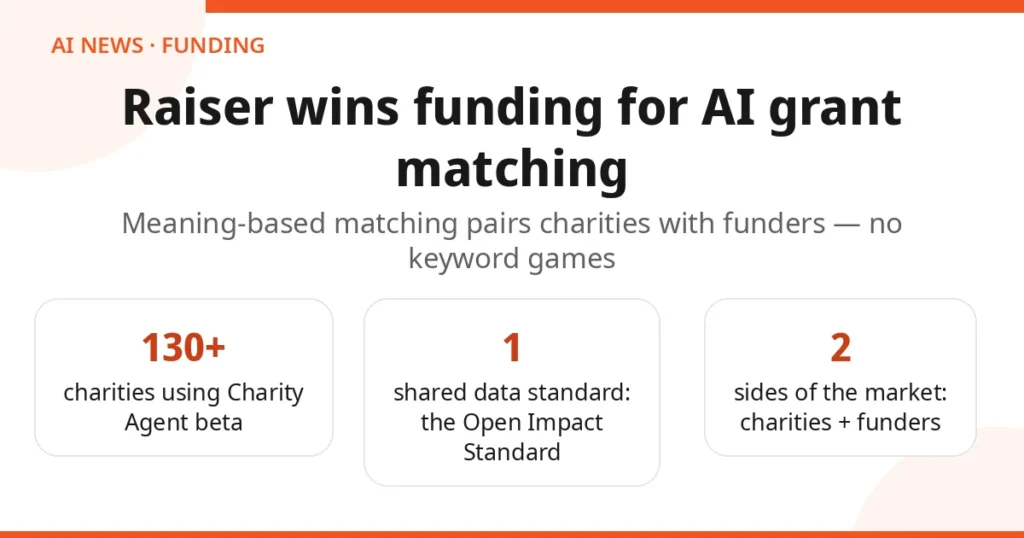
Direct answer: Manchester startup Raiser has secured innovation funding from the Greater Manchester Business Growth Hub to build an AI-enabled grant-matching engine — software that pairs charities with the right funders using structured impact data instead of keyword searches. Its Charity Agent product is already in beta with more than 130 charities on board, and it has also drawn backing from Daryl Upsall and other charity-sector figures.
What happened
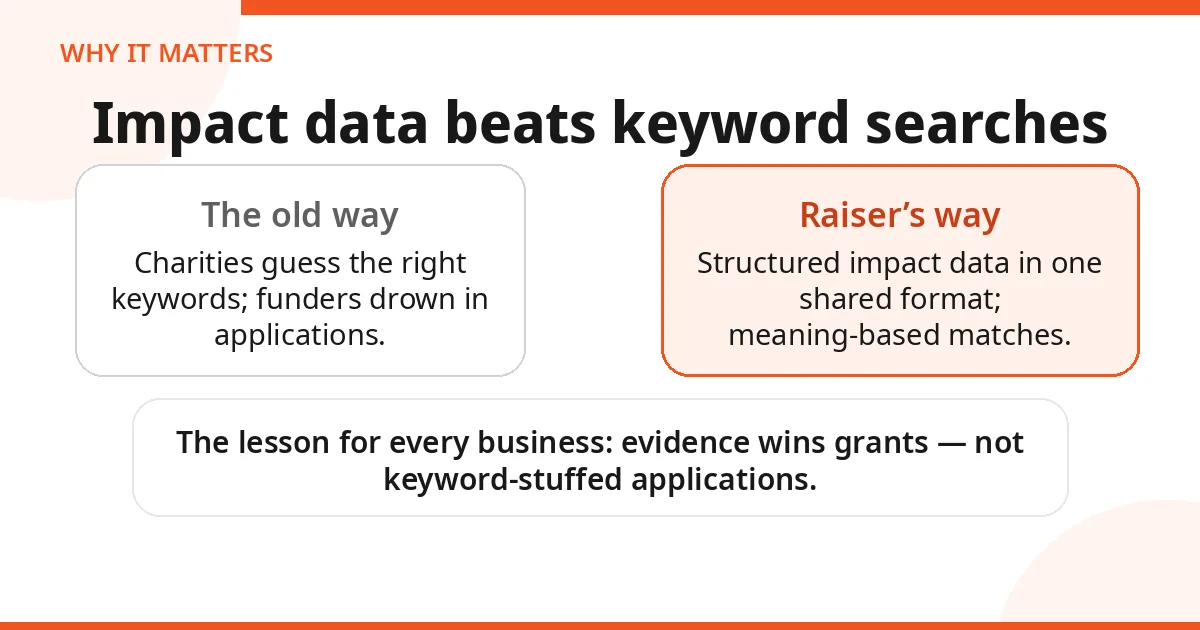
Raiser is taking on a longstanding, unglamorous problem in the charity world: smaller organisations struggle to surface in funder searches, or to describe their work in terms that fit a funder's criteria. The result is a double waste — charities drowning in applications, funders missing organisations doing exactly the work they want to pay for.
The new funding, awarded by the Greater Manchester Business Growth Hub, will develop the company's core technology: a meaning-based matching engine that identifies organisations whose activities and outcomes align with a funder's priorities. The engine rests on a shared data framework Raiser calls the Open Impact Standard — a common format for recording charitable activities, outputs and outcomes, intended to give charities and funders a shared language for describing work and results.
What makes Raiser's positioning interesting is what it's choosing not to build. There's a growing market for AI tools that help charities draft more applications, or help funders process ever-larger piles of submissions. Raiser is going the other way: software for both sides of the funding process, with tools for charities to capture evidence of impact and tools for funders to discover organisations, assess their work and manage funding relationships.
The backing is a credibility signal in its own right. Alongside the Growth Hub funding, Raiser has brought in support from Daryl Upsall — a well-known figure in the fundraising consultancy world — and other charity sector figures. And the product has traction already: Raiser's existing Charity Agent is live in beta, with more than 130 charities using the platform to manage funding opportunities, assemble evidence and support applications.
Source: IT Brief UK
What it means for UK small businesses
Most of our readers aren't charities — but the pattern here is worth stealing. Grant funding, innovation loans and public contracts all run on the same machinery: you need to show evidence that matches the funder's criteria, in the funder's language. The businesses that win UK innovation grants (Innovate UK, for example) tend to share one habit: they keep structured evidence of what they've done and what changed as a result, long before an application deadline appears. Raiser's whole thesis is that this evidence — not the writing of the application — is the scarce resource. That's true well beyond charities.
The other signal is Manchester. Northern tech keeps producing real AI startups with actual customers — 130 charities in beta is more traction than most AI launches can claim. If you're a UK small business weighing AI consulting or automation work, the Manchester ecosystem is worth watching closely; it's where a lot of practical, non-hype AI is being built right now.
And there's a broader point for anyone using AI tools in their business: the most valuable AI products emerging this year aren't the ones that generate more — more applications, more content, more noise. They're the ones that match and filter better. The AI landscape is shifting from generation to curation, and it's worth asking of every AI tool you consider: does this reduce my workload, or just increase my output? Our roundup of AI statistics for UK small businesses shows which tools are actually being adopted — and which are just being tried.
Honest limits / what to watch
The matching is only as good as the data. A meaning-based matching engine is an attractive idea, but it depends on hundreds of charities diligently recording activities, outputs and outcomes in the Open Impact Standard format. Data standards in the charity sector have a long history of noble launches and patchy adoption. Raiser's 130 beta charities are a promising start, not proof the standard will stick.
Keyword search isn't actually the enemy. Structured impact data sounds obviously better than keyword searches — but keywords work well for simple queries, and they're cheap. The real question for Raiser is whether funders change their discovery behaviour, not whether the matching is technically better. Adoption by funders, not charities, is the metric to watch.
The funding amount is undisclosed. Innovation funding from a Growth Hub is a vote of confidence, not a war chest — it's a different scale from a venture round. That's fine; it just means the matching engine's timeline will be measured in steady development, not blitzscaling. Set expectations accordingly.
FAQs
What is Raiser's AI grant-matching engine?
It's software designed to match charities with funders based on structured impact data rather than keyword searches. The engine reads what an organisation actually does and what outcomes it produces, then identifies funders whose priorities align — a meaning-based match instead of a keyword match.
Who is funding Raiser?
Raiser has secured innovation funding from the Greater Manchester Business Growth Hub, plus backing from Daryl Upsall and other charity-sector figures. The amount hasn't been disclosed.
What is the Open Impact Standard?
It's Raiser's proposed shared data framework for recording charitable activities, outputs and outcomes in a common format. The idea is to give charities and funders a shared language for describing work and results, so matching software can compare like with like instead of relying on how each side happens to describe itself.
Is Raiser's product available yet?
Its existing Charity Agent product is live in beta, with more than 130 charities already using it to manage funding opportunities, assemble evidence and support applications. The AI grant-matching engine itself is what the new funding will develop.
How is Raiser's approach different from other AI fundraising tools?
Most AI fundraising tools focus on writing more applications or helping funders process larger volumes of submissions. Raiser is deliberately doing something different: software for both sides of the funding process — tools for charities to capture evidence of impact, and tools for funders to discover organisations, assess their work and manage relationships.
Can for-profit UK businesses use Raiser's technology?
Raiser is built for the charity-funder world, but the pattern matters for any small business chasing public contracts or innovation grants: match your evidence to the funder's stated criteria, and use structured data about your work rather than keyword-stuffed applications.