
Direct answer: Most small businesses lose leads because they reply too slowly — by hours, not minutes. An AI agent can acknowledge every new enquiry within seconds and run a polite follow-up sequence over days without you touching it. You set up a trigger on each enquiry form, define a cadence (instant, day 1, day 3, day 7), pick channels like WhatsApp and email, and write the scripts the agent follows. In the UK you must keep it legal: marketing messages need consent under PECR, and all personal data handling must meet UK GDPR.
The speed-to-lead problem most UK businesses ignore
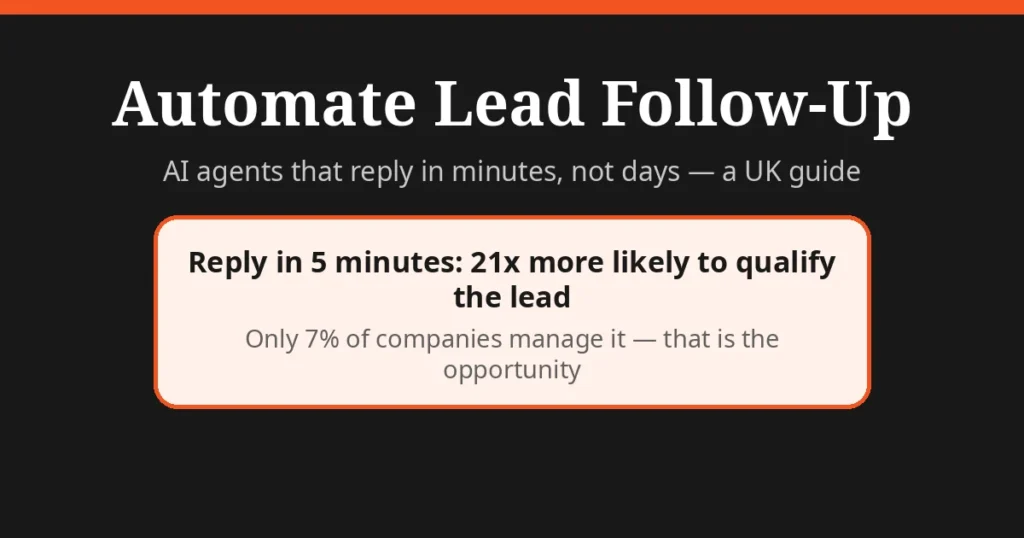
Here's the uncomfortable number: salespeople responding to a lead within 5 minutes are 21 times more likely to qualify that lead than if they wait 30 minutes. That comes from the Lead Response Management study of over 15,000 leads. A Harvard Business Review audit found firms that responded within an hour were nearly 7 times more likely to qualify a lead than those that waited an hour longer, and over 60 times more likely than those waiting a full day. And a Drift audit of 433 companies found only 7% responded within 5 minutes. Most of your competitors are failing at this. That's the opportunity.
The problem is structural, not motivational. You're on a job, in a viewing, with a patient. Nobody sits by the inbox at 9pm. An AI agent does.
What an AI follow-up agent actually does
Strip away the jargon: an AI follow-up agent is a workflow that watches for new enquiries and sends sensible, personalised messages at defined intervals — while holding a real conversation if the prospect replies. It answers basic questions, books appointments, and logs everything to your CRM. It's not magic. It's a tireless, slightly polite receptionist who never sleeps.
The pieces you'll connect:
1. A trigger — a new website form submission, a missed call, a Google Business message, a Facebook lead ad.
2. A conversation engine — an AI agent platform (see costs below) that reads the enquiry and replies in natural language.
3. A channel — WhatsApp, SMS, email, or a website chat widget.
4. A CRM or spreadsheet — so conversations land somewhere and nothing falls through cracks.
If you already run a chatbot on your website to capture leads, adding automated follow-up is the natural next step — capture and follow-up become one system instead of two gaps.
The follow-up cadence that actually works
A follow-up sequence has two jobs: strike while the enquiry is hot, then stay present without becoming a nuisance. Four touches over a week is the sweet spot for most UK service businesses. Here's a template:
| Step | Timing | Channel | What the AI agent does | What you do |
|---|---|---|---|---|
| 1 | 0–2 minutes | WhatsApp or SMS | Acknowledges the enquiry by name, confirms what they asked about, promises a personal reply shortly | Nothing — but be available if the reply needs you |
| 2 | Same day (2–4 hrs) | Sends the detailed info they asked for (price guide, brochure, booking link) and asks 2–3 qualifying questions | Review any hot replies before end of day | |
| 3 | Day 3 | WhatsApp or SMS | Short check-in: "Still looking? Happy to answer anything." Shares one useful thing (a new listing, a tip) | Personally message anyone who clicked but didn't reply |
| 4 | Day 7 | Final nudge with a clear call to action (book a viewing, get a quote), and a polite opt-out | Personally call the warmest leftovers |
After day 7, stop the automation. Either the lead is warm — in which case you handle it personally — or it's dead, and more messages just annoy people. The "just checking in" fifth message is where good businesses become spam.
What the AI says vs what stays human
This line matters. Get it wrong and the agent either annoys people or gives away things it shouldn't. A practical split:
AI handles: instant acknowledgement ("Thanks for getting in touch — I've got your details"), qualifying questions (budget, timeline, postcode), appointment booking, opening hours and service FAQs, chasing for missing info, reminders.
Humans handle: anything involving price negotiation, bespoke quotes, complaints, sensitive situations (medical, legal, financial advice), and any reply the AI can't confidently answer. Also: anyone who asks for a person. "Can I speak to someone?" must always work, immediately, with no argument.
Tell people upfront they're chatting with an automated assistant. It's honest, and it actually reduces frustration — people adjust their expectations. (The EU AI Act's transparency rules, in force from August 2026, push in this direction anyway.)
Choosing channels: WhatsApp, SMS, email
Open rates decide this fight. In the UK, WhatsApp and SMS get read far more reliably than email, so use messaging for the fast touches and email for the detailed ones. But each channel has rules:
- WhatsApp — For proper automation you need the WhatsApp Business API (the free app's auto-replies are too basic). Meta requires documented opt-in naming your business and WhatsApp as the channel. You can reply freely within 24 hours of the customer's last message; outside that window you must use pre-approved template messages. Since October 2026 Meta also charges per message for service replies after the first 1,000 free per number per month. Misclassifying promotional content as "utility" is a common violation — keep marketing messages honest about what they are.
- SMS — Works on every phone, no app needed. Under PECR, marketing texts need consent or the soft opt-in, and every message must identify your business and offer an easy opt-out (the standard is "Reply STOP"). UK practice is to keep texts between 8am and 9pm; nothing overnight.
- Email — Best for quotes, brochures, and anything with attachments. Same PECR consent rules as SMS. Always include a working unsubscribe.
A deeper walkthrough of the WhatsApp side lives in our WhatsApp automation guide for UK small businesses.
The UK law you can't skip: PECR and GDPR
This is the part most "how to" guides wave past, and it's the part that can cost you real money. The ICO has fined businesses six figures for PECR breaches — HelloFresh was fined £140,000 partly because its opt-in covered email but not SMS. Channel-specific consent matters.
PECR (the marketing message rules):
- You must not send marketing emails or texts to individuals without their prior consent — unless the soft opt-in applies.
- Soft opt-in only works when all four conditions hold: you got their details during a sale or negotiation of a sale, you're marketing your own *similar* products or services, you gave them a clear opt-out when you collected their details, and every message includes an opt-out. A website enquiry alone is not a sale — so for brand-new leads, the safest basis for the first messages is that you're answering their enquiry, not marketing to them.
- Consent must be a clear, positive action — an unticked tick box, not a pre-ticked one or consent buried in terms. And it must name the channel: email consent isn't SMS consent.
- Sole traders and most partnerships count as individuals under PECR — only limited companies, LLPs and similar bodies get the lighter corporate rules. If you're unsure, treat the contact as an individual.
UK GDPR (the data rules): you need a lawful basis for storing and processing lead data, you must tell people what you're doing with their data (privacy notice), keep it secure, and delete it when it's no longer needed. The AI agent is a data processor in your chain — your contract with the tool provider needs to cover that. We cover the detail in our GDPR guide for AI in UK small businesses.
None of this is legal advice — for a tricky case, ask a solicitor. But getting the basics right is cheaper than an ICO investigation.
What it costs, realistically
Honest numbers from vendors' own published pricing (2026):
- Wati (WhatsApp-focused): Growth plan from about $59/month billed annually (~£45), plus Meta's per-message fees. Good entry point if WhatsApp is your main channel.
- Respond.io (omnichannel + AI agents): Growth plan from $159/month billed annually (~£120), which is the tier that unlocks AI agents and workflow automation. Meta message fees pass through at cost.
- DIY route: self-hosted tools plus AI API costs can run $10–$70/month, but you need someone technical to build and maintain it — one published 2026 breakdown put professional setup at $1,000–$4,000 one-off plus $30–$125/month running costs.
For most UK small businesses, the sensible middle is a managed platform at £45–£120/month, or an agency build if you'd rather not configure anything yourself. If one converted lead is worth a few hundred pounds to you, the maths usually works within the first month.
Worked example: an estate agent's sequence
Say you run a two-office estate agency in Leeds. A buyer, Priya, submits a website enquiry on a £285,000 semi at 10:40pm. Here's what the AI agent does:
Minute 0 (WhatsApp): "Hi Priya, thanks for your interest in the 3-bed semi on Oakwood Lane — this is the automated assistant at [Agency]. Our team will be in touch in the morning, but can I ask — are you looking to move within the next 3 months?" (Acknowledgement + one qualifying question. Not marketing — it's answering her enquiry.)
Morning, 8:30am (email): The full listing details, floorplan, EPC, and a booking link for viewings. The agent has already passed Priya's answers to your CRM, flagged her as high intent, and your negotiator sees her in the morning pipeline.
Day 3 (WhatsApp): "Hi Priya — just checking in. Two similar properties came up this week nearby; shall I send the details?" She replies yes; the agent sends them.
Day 7 (email): "The Oakwood Lane property is still available. If you'd like a second viewing or want to talk numbers, reply here or call us on [number]. If the timing's not right, just let me know and I'll pause the updates." Clear value, clear exit.
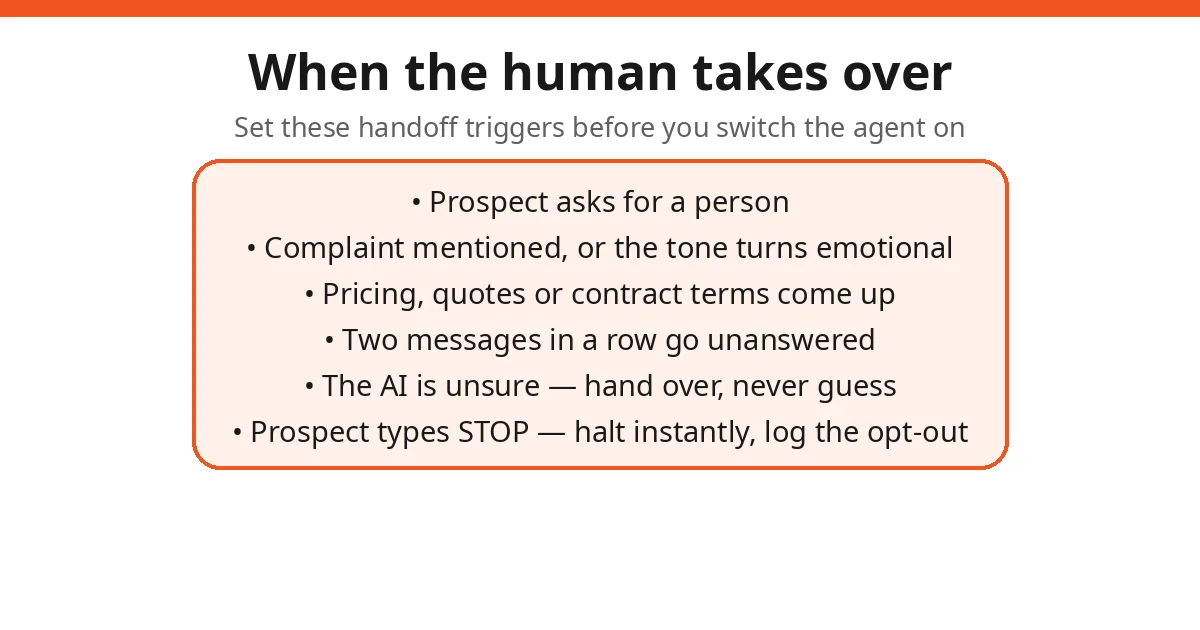
Human handoff triggers you set in advance: Priya asks to book a viewing → the agent offers times and confirms, then notifies your negotiator. She asks "what's your lowest offer?" → straight to a human. She goes quiet for two messages → the sequence stops and flags her for a personal call. She types "stop" → everything halts immediately, opt-out logged.
Honest limits
AI follow-up is powerful and easy to abuse. Here's where it goes wrong:
- It annoys prospects. Four touches in a week is fine; fourteen is harassment. Set the sequence, then actually read the replies for a week and tune it. If your block rate climbs, you're messaging too much or too generically.
- It hallucinates. Left unsupervised, an AI agent can invent prices, availability, or offers that don't exist. Feed it only from your real price list and availability data, and bar it from quoting anything not in its knowledge base. One wrong quote undoes months of trust.
- The compliance traps are real. An enquiry reply is not the same as marketing consent — don't slide a promotional blast into a service conversation. On WhatsApp, don't mix marketing content into utility templates. And honour STOP requests instantly; continuing to message after an opt-out is a clear PECR breach.
- Some moments need a human, full stop. Complaints, bad news, anything emotional, anything where the prospect is clearly frustrated. Your handoff triggers should be aggressive, not optimistic. The cost of a needless handoff is one conversation; the cost of a missed one is a review that stays on Google for years.
- It won't fix a bad offer. If your response time is instant but your quote takes a week and your reviews are 2 stars, automation just delivers the bad news faster. Sort the basics first.
Getting started this week
Don't try to automate everything at once. Start with one trigger (your main enquiry form), one channel (WhatsApp or SMS), and the instant acknowledgement plus one follow-up. Run it for two weeks, read every reply, then extend the sequence. Most businesses see the difference from step one alone — the 5-minute acknowledgement is where almost all the value lives, because only 7% of companies manage it.
And keep the consent paperwork tidy from day one: record what each person agreed to, when, and on which channel. It's ten minutes of setup that makes every future message defensible.
FAQs
Is it legal to use AI agents for lead follow-up in the UK?
Yes, provided you follow PECR and UK GDPR. You may follow up on a specific enquiry (that's customer service, not marketing). But marketing texts or emails need prior consent, or the soft opt-in for existing customers — with a clear opt-out every time. WhatsApp also requires opt-in and Meta-approved templates outside the 24-hour reply window.
How fast should I respond to a new lead?
Within 5 minutes if you can. The Lead Response Management study found salespeople were 21 times more likely to qualify a lead when responding within 5 minutes rather than 30. The Harvard Business Review found firms responding within an hour were nearly 7 times more likely to qualify a lead than those waiting an hour longer. A Drift audit found only 7% of companies manage the 5-minute mark — so the bar is low.
Which channels work best for automated follow-up in the UK?
WhatsApp and SMS get the highest read rates; email is fine for detail but slower. Use WhatsApp Business API (with templates and opt-in) for instant replies, SMS for simple reminders, and email for quotes and longer documents. Never add a channel the customer didn't consent to.
What should the AI agent say vs what stays human?
The AI handles acknowledgement, qualifying questions, appointment booking and factual answers about services. Humans take over at pricing negotiation, complaints, complex advice, anything emotionally charged — and whenever the AI is unsure. Every sequence needs a clear "speak to a human" escape.
How much does AI lead follow-up cost a UK small business?
Budget options start around £50–£60 a month for WhatsApp API tools like Wati's Growth plan, rising to £120+ a month for full AI-agent platforms like Respond.io's Growth tier, plus Meta's per-message fees. A done-for-you build by an agency typically runs into the low thousands as a one-off, then a modest monthly running cost.
What is the soft opt-in for follow-up messages?
Under PECR Regulation 22, you can email or text an existing customer about your own similar products or services without fresh consent — but only if you collected their details during a sale or its negotiation, gave them a clear opt-out at collection, and include an opt-out in every message. It never covers prospective customers or bought lists. When in doubt, ask for explicit consent instead.
When must a human take over from the AI agent?
Set hard handoff triggers: the prospect asks for a person, mentions a complaint, discusses pricing or contract terms, goes silent for two messages in a row, or the AI's confidence drops. The agent should hand over with a full summary of the conversation so the human doesn't make them repeat everything.