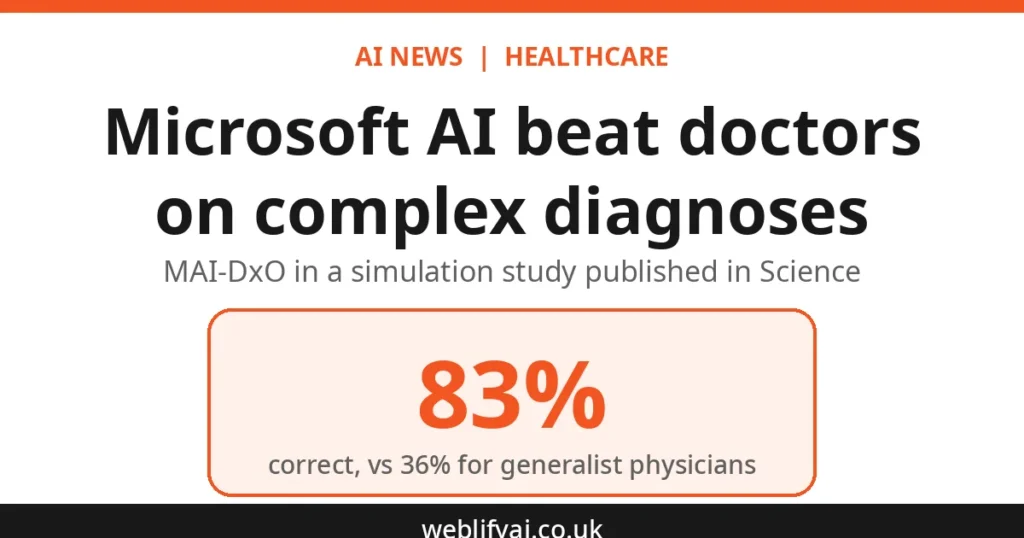
Direct answer: Microsoft’s AI diagnostic system, MAI-DxO, correctly diagnosed complex medical cases in a simulation 83% of the time — more than twice as often as generalist physicians, who managed 36%. The results, published in Science, were described by Microsoft AI CEO Mustafa Suleyman as a step toward “medical superintelligence.”
What happened
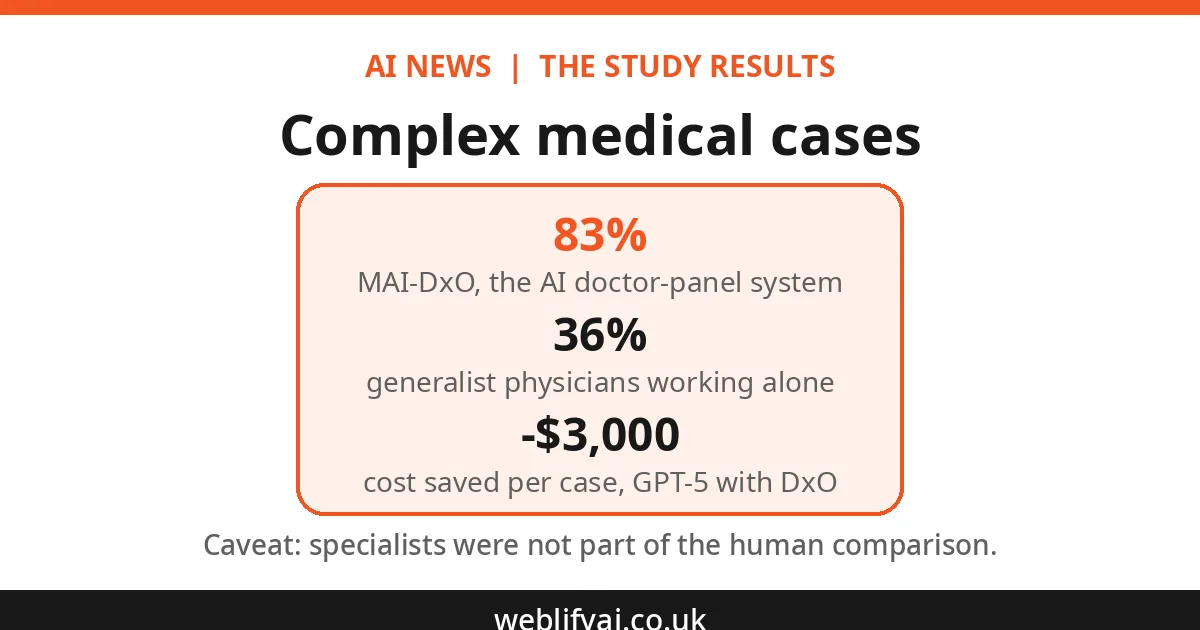
The system, dubbed MAI-DxO (DxO for short), works like a panel of doctors: several AI agents question a patient, order tests, and debate a diagnosis before settling on an answer. Microsoft tested it on complex cases taken from the New England Journal of Medicine. The human comparison group was primary care doctors and general internists working individually with reference materials — and DxO beat them decisively at 83% to 36%.
There is an important caveat the researchers acknowledge: cases this complex are normally handled by specialists or physician teams, who were not part of the comparison. So this is not quite “AI beats all doctors” — it’s “AI beats individual generalists on their hardest cases.”
The study also measured cost, not just accuracy. GPT-5 on its own scored 78.9% on the complex cases at an estimated $8,400 per case; adding DxO cut about $3,000 off the cost while lifting accuracy by around four points. Interestingly, much of the improvement came from the underlying models themselves — Microsoft tested DxO with models from OpenAI, Google, Anthropic, Meta, and DeepSeek, with the best results from GPT-5 and GPT-5.5. On emergency-department cases, DxO added little over the base models.
What comes next is concrete: Microsoft is working with the Mayo Clinic on a healthcare foundation model planned for release next year, and has partnered with Beth Israel Deaconess Medical Center in Boston for real-world evaluations — where patients will still receive standard care while DxO’s reasoning is assessed.
What it means for UK small businesses
The UK angle is personal: Mustafa Suleyman, the London-born former DeepMind co-founder leading Microsoft’s AI unit, has spent his career trying to apply AI to medicine. The NHS is the world’s largest single-payer healthcare system, and it’s already under pressure from a growing mismatch between demand and medical expertise — the exact problem Suleyman cites.
For healthcare-adjacent small businesses — private clinics, care providers, pharmacies, health-tech suppliers — this is a signal, not a product. Clinical AI assistants that triage symptoms, draft notes, or double-check diagnoses are clearly coming; the question is timeline and regulation. Firms that start thinking now about where AI fits alongside human expertise — rather than replacing it — will be positioned for it.
And Suleyman’s broader prediction is worth noting for everyone: he believes that in 2027, AI will have a “coding style breakthrough for medical records” — the ability to stream highly accurate predictions of how a patient’s record might unfold. For any business that deals with complex documentation, that trajectory applies well beyond medicine.
Honest limits: what to watch
A simulation of published case studies is not a hospital. The cases were selected from the NEJM, the humans were generalists working alone, and the cost figures are estimates. This is promising research, not a clinical tool — Microsoft itself frames the next step as “real-world evaluations,” which is scientist-speak for “we don’t know yet.”
Microsoft also joins Google and OpenAI in claiming its AI can match or beat doctors — this is becoming a pattern of headline claims that need the same scrutiny each time. And Suleyman’s “medical superintelligence” is a vision, not a milestone. AI in healthcare is, as he admits, still early, and the path from 83% on curated cases to something you would trust with a patient is long and heavily regulated.
One practical note: Microsoft’s own data shows the orchestration matters less than the underlying model. The gap between a weaker and stronger base model was larger than DxO’s boost — a reminder that in AI, model quality still dominates, and vendor diversification matters.
FAQs
What is Microsoft MAI-DxO?
An AI diagnostic system that coordinates several AI agents acting like a panel of doctors — they question a patient, order tests, and debate a diagnosis before deciding.
How well did it perform in the study?
In a simulation using complex cases from the New England Journal of Medicine, MAI-DxO was correct 83% of the time, versus 36% for primary care doctors and general internists working individually.
Were the comparisons fair?
Partly. The physicians worked alone with reference materials, but real complex cases are usually handled by specialists or teams, who weren’t part of the comparison.
When will this be available?
Not soon for clinical use. Microsoft is starting real-world evaluations with Beth Israel Deaconess Medical Center and plans a healthcare foundation model with the Mayo Clinic next year.
What does “medical superintelligence” mean?
It’s Mustafa Suleyman’s phrase for AI that dramatically exceeds human clinical ability. He predicts major breakthroughs in medical records AI in 2027.
What should UK businesses take from this?
AI diagnostic support is advancing fast, but it’s not a product yet. Healthcare-adjacent businesses should watch clinical AI — and keep human experts in the loop.