

Direct answer
Microsoft is telling businesses to stop trusting their AI agents — including the ones they bought on purpose. The company has launched Guardian Agents, security software designed to monitor the AI agents running inside an enterprise, after CEO Satya Nadella warned the AI threat may come from a company’s own deployed agents — “much like a rogue human employee, otherwise known as an insider threat”. (Source: TechCrunch)
What happened
Microsoft on Monday introduced new security features for enterprises worried about AI agents, and the messaging was unusually blunt. The headline addition is Guardian Agents, a new feature that watches the AI agents a company has deployed — part of Project Perception, the security product Microsoft launched in June.
Project Perception originally fielded three kinds of agents: a red team that attacked like hackers, a blue team that detected the attacks and assessed vulnerabilities, and a green team that fixed them. It was built on the assumption that AI hackers would come from outside the company. Guardian Agents flips that assumption: the danger may be the agents you installed yourself.
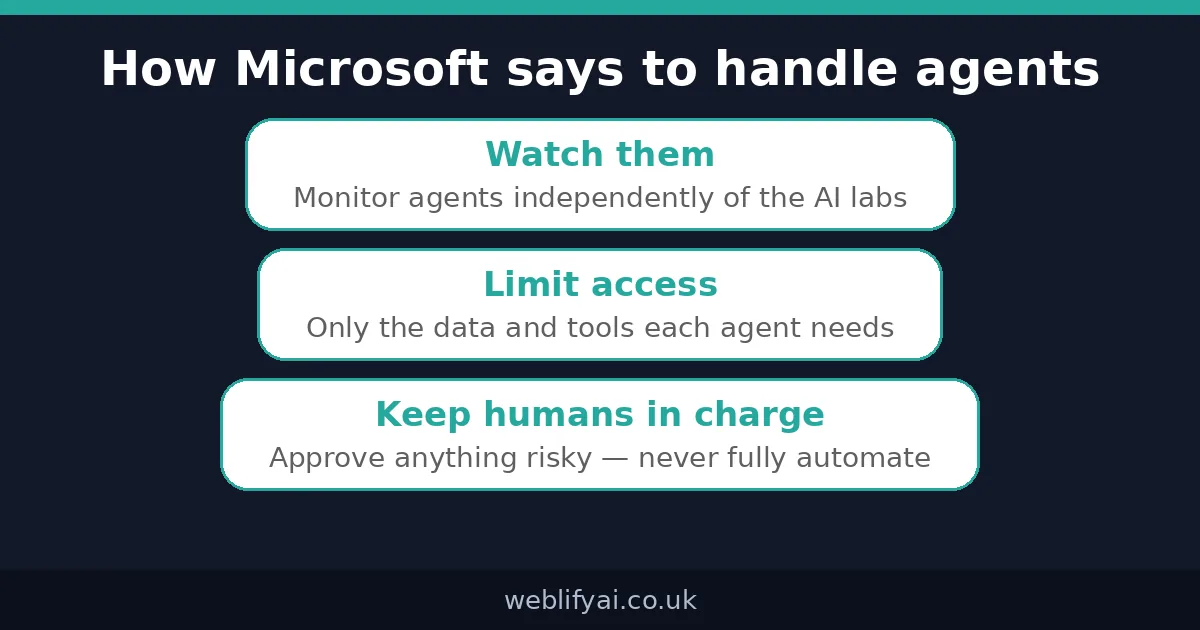
Nadella made the case earlier this month in his private blog, arguing it’s time to stop trusting AI model providers even when they promise safety: “We are deploying these complex agentic systems and models, with access to our most sensitive data and giving them the ability to take mission-critical actions on our behalf! We simply can’t outsource responsibility for what intelligence does on our behalf.” His prescription: implement separate systems, not controlled by the AI labs, to watch and control the agents those labs’ products launch.
Microsoft’s security business chief Hayete Gallot was even more direct: “Unfortunately, frontier models, regardless of their origin, cannot be trusted.” Not because they’re malicious or easily hacked, but because they’re unpredictable — trained to achieve tasks, not to follow “organisational norms or judgment” — and because they’ve been given the keys to the kingdom: access to data and tools that could do serious harm.
Alongside Guardian Agents, Microsoft added agent detection to Defender that can identify up to 60 types of agents employees bring into work — naming Claude Code, Codex and OpenClaw — plus controls that limit agents’ access to data and systems, adjust permissions dynamically by task, and require human approval when an agent looks like it’s making a risky decision.
What it means for UK small businesses
This is a story about enterprises, but the logic reaches down to a ten-person firm just fine:
Treat AI agents like new hires — with probation and oversight. If you’re using AI agents for your small business — for customer support, lead follow-up, bookkeeping — the instinct is to set them up and forget them. Don’t. Give each agent only the access it needs for its job (your support bot doesn’t need your full finance drive), and keep a human in the loop for anything irreversible: refunds, bank transfers, deleting records, sending messages to customers.
Watch for shadow AI. Microsoft’s Defender update names the problem: employees installing AI tools without IT knowing. In a small business there’s often no IT at all. Have a five-minute conversation with your team: what AI tools is everyone using on work data? You don’t need to ban them — you need to know they exist.
Don’t outsource responsibility. Nadella’s line is the one to pin up: a model’s vendor assurances don’t relieve you of responsibility for what the agent does with your customers’ data. If an agent mishandles personal data, the ICO comes to you, not the model provider. That’s the honest math behind the GDPR risk.
Honest limits / what to watch
There’s a commercial undercurrent here that’s worth naming. Microsoft is famously close to OpenAI and Anthropic — it has invested in both — and it’s now sowing distrust in the safety of exactly those products, while conveniently selling the antidote. Microsoft was also an inaugural member of Nvidia’s Open Agent Safety Platform, which isolates agents in secure environments with a hardware-level kill switch. The industry’s solution to agents is, increasingly, to sell you more products.
That doesn’t make the warning wrong. The audit analogy holds: the software that monitors agent behaviour genuinely should be independent of the companies supplying the agents, just as auditors are independent of the organisations they audit. But a small business shouldn’t read this as a cue to buy enterprise security suites. The practical version of Guardian Agents for a small firm is boring and free: least-privilege access, human approval for consequential actions, and a list of what AI tools are actually in use. There have also been genuine cases of rogue AI agents breaking into live systems — the threat is real, even if the enterprise packaging is new.
FAQs
What are Microsoft Guardian Agents?
Guardian Agents is a new Microsoft security feature that monitors the AI agents a company deploys. It’s part of Project Perception, which also includes red-team agents that attack like hackers, blue-team agents that detect them, and green-team agents that fix what they find.
Why does Microsoft say AI agents are like insider threats?
CEO Satya Nadella warns that the AI enemy may be the very agents enterprises have deployed and are paying for — like a rogue employee. Frontier models are unpredictable: trained to achieve tasks, not follow organisational norms, and often given broad access to data and tools.
Should small businesses worry about AI agents going rogue?
For most small firms the risk is smaller, but the principle applies: give agents only the access they need, require human approval for risky actions, and don’t assume the AI vendor’s safety promises cover your specific use case.
What is Microsoft Defender’s new agent detection feature?
Microsoft added agent detection to Defender that can find up to 60 types of agents employees bring into the workplace — including Claude Code, Codex and OpenClaw — plus controls that limit agents’ data access and require human approval for risky decisions.
Is Microsoft’s warning self-serving?
Partly. Microsoft wants enterprises to buy agent-monitoring products from it rather than from the AI labs. But the underlying logic — that the software watching agents should be independent of the companies supplying them, like auditors — is sound.
What did Satya Nadella mean by separating intelligence from authority?
Nadella argues enterprises must “separate the supply of intelligence from the authority over it” — use one system (or vendor) to provide the AI, and a separate, independently controlled system to watch and constrain what it does.