Direct answer:
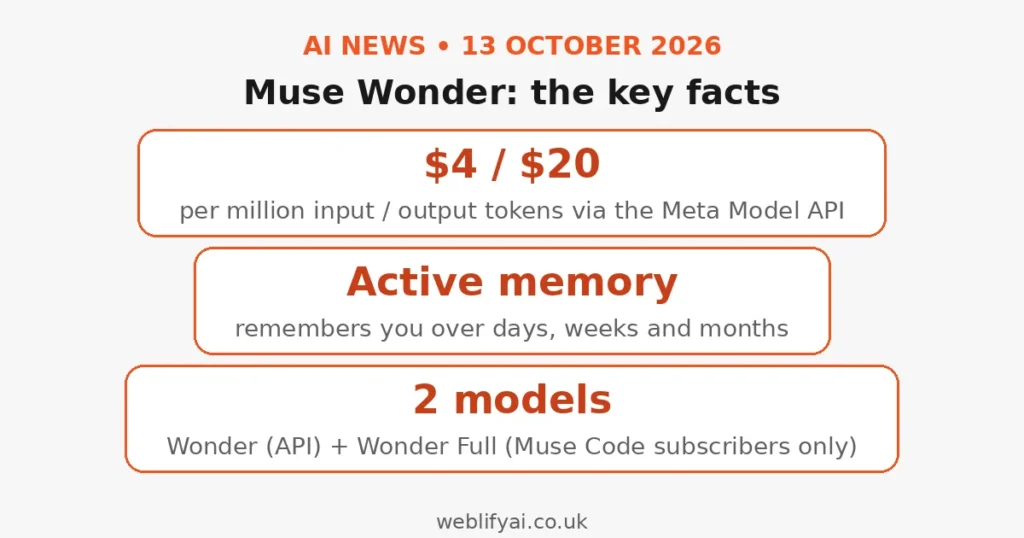
Meta has launched Muse Wonder and a larger sibling, Wonder Full — its first frontier AI models. Meta says they match Fable 5.1 and GPT-6 Astra on benchmarks, stand out at remembering users over long stretches of time, and will power a smarter Muse agent. Pricing lands squarely at the top end: $4/$20 per million input/output tokens, about the same as GPT-6 Sol or Opus 5.5.
What happened
Meta’s Superintelligence Lab released the pair on Monday, marking the company’s first attempt at a frontier model since Alexandr Wang restructured its AI efforts in August 2025. Until now Meta had kept to smaller releases — the lightweight Muse Spark and the Muse agent — while OpenAI and Anthropic shipped the headline-grabbing state-of-the-art models.
The Wonder models are bigger and, Meta says, more capable: better benchmark scores, stronger results on complex tasks like coding. According to the model card, Wonder and Wonder Full hit comparable scores to Fable 5.1 and GPT-6 Astra.
The centrepiece of the launch is what Meta calls “active memory” — the model’s ability to keep and use information a user has given it over days, weeks and months. On MemoryBench, a benchmark that tests continual learning and memory building, Meta claims Muse Wonder outscores Fable, Opus and Astra. “We put a tremendous amount of effort into making sure your model can remember what’s important to you over days, weeks, months, and beyond,” research scientist Kavya Kopparapu said in the launch video.
A few practical details from the launch reporting (TechCrunch):
- Wonder is available through the Meta Model API at $4 per million input tokens and $20 per million output tokens.
- Wonder Full is only available to Muse Code subscribers — it will not be served through the API.
- Both models power the Muse agent.
- They were trained at Meta’s Prometheus data centre in Ohio.
What it means for UK small businesses
Two things stand out for smaller firms. First, the pricing. At GPT-6 Sol / Opus 5.5 levels, Wonder is aimed at serious production use, not casual experimentation — this is a tool for businesses already spending real money on AI APIs, not a free upgrade for your chatbot.
Second, the memory angle. For any business using an AI assistant with customers or staff — support agents, quoting tools, knowledge bases — long-term memory is the feature that matters most and the one today’s models handle worst. If Meta’s “active memory” claims hold up in real use, assistants that genuinely remember your business context across weeks of conversation become much more practical. That’s directly relevant to anyone building AI agents for their small business.
More broadly, another frontier-class model on the market means more competition and more choice — and likely more pressure on prices over time. If you’re already using Muse AI in your business, this is the trajectory your tools are heading toward.
Honest limits / what to watch
- The benchmarks are Meta’s own. “Comparable to Fable 5.1 and GPT-6 Astra” comes from Meta’s testing, not independent evaluation. History suggests vendors pick the benchmarks that flatter them.
- Memory claims need real-world proof. Scoring well on MemoryBench is not the same as reliably remembering your client’s preferences across a month of conversations. Watch for independent testing before betting a customer-facing workflow on it.
- Wonder Full is fenced in. The bigger model is Muse Code subscribers only — no API. If you’re a developer weighing options, factor that lock-in into your plans.
- UK availability is unclear. Meta has said nothing specific about UK rollout or pricing in pounds. Don’t plan budgets around it yet.
Sources: TechCrunch, Bloomberg, CNBC, Wall Street Journal.
FAQs
What is Meta’s Muse Wonder?
Muse Wonder is Meta’s first frontier AI model, launched by its Superintelligence Lab alongside a larger variant called Wonder Full. Meta claims it reaches state-of-the-art performance, comparable to Fable 5.1 and GPT-6 Astra in its own benchmark testing.
How much does Muse Wonder cost?
Through the Meta Model API, Wonder costs $4 per million input tokens and $20 per million output tokens — roughly the same as GPT-6 Sol or Opus 5.5. Wonder Full is not available through the API at all; it is reserved for Muse Code subscribers.
What is “active memory” in Muse Wonder?
Meta describes active memory as the model’s ability to retain and synthesise information a user shares over days, weeks and months. On MemoryBench, a benchmark for continual learning and memory, Meta says Wonder scores higher than Fable, Opus and Astra.
Is Muse Wonder available in the UK?
Meta has not published UK-specific availability or pricing details at launch. Both models will power Meta’s Muse agent, and Wonder is offered through the Meta Model API, so developers can test it directly.
How does Muse Wonder compare to GPT-6 and Fable?
On Meta’s own testing, Wonder and Wonder Full achieve comparable benchmark scores to Fable 5.1 and GPT-6 Astra. These are Meta’s figures, not independent results — treat them as the company’s claim until third parties verify them.