
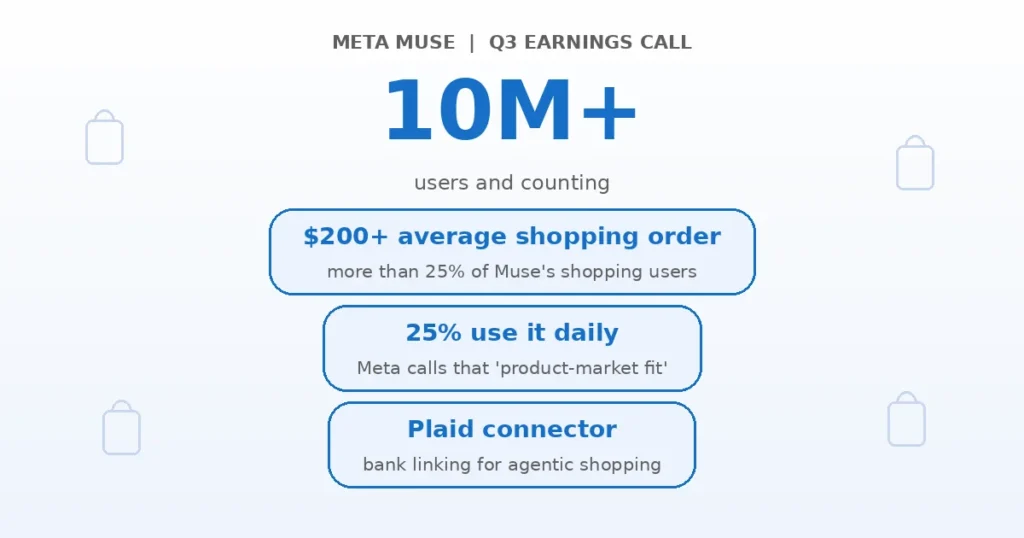
Direct answer: Meta’s AI agent Muse has passed 10 million users, with shopping emerging as a top activity — over a quarter of shopping users spent $200+ on average per order, CEO Mark Zuckerberg revealed on the company’s Q3 earnings call.
What happened
Meta disclosed the figure during its third-quarter earnings call on Wednesday, TechCrunch reported, confirming earlier estimates from market intelligence firm Sensor Tower. But the adoption number wasn’t the story — the behaviour was.
About 25% of people who set up Muse now use it daily, Zuckerberg said, calling the retention “product-market fit.” And among engaged users who shopped through the AI agent, more than a quarter had an average purchase size above $200. That’s real money moving through an AI agent — enough that Plaid, the fintech company whose connector lets Muse link bank accounts to complete purchases, told Meta it “hadn’t seen activity like they’re seeing with their connector on any other service before.”
Other popular uses include productivity tasks like connecting the agent to email and calendars. On trust, Zuckerberg pointed to the “Muse Secure VM” that protects user data, and said a forthcoming “Muse Confidential VM” will prevent even Meta itself from seeing users’ content.
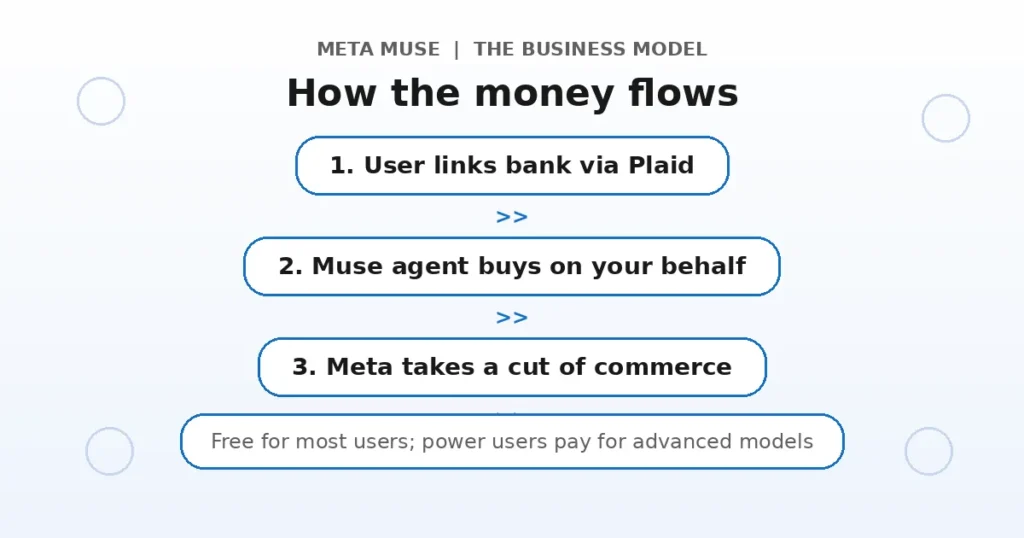
The business model is coming into focus: keep Muse free for most users, take a percentage of the commerce, and charge power users for advanced models and more tokens. Remarkably, Meta expects Muse to eventually generate more revenue per user than its family of apps (Facebook, Instagram, WhatsApp, Messenger), which currently bring in “several hundreds of dollars annually” each. Muse is compute-intensive today, but Zuckerberg expects 10x better cost efficiency within a year — and the agent sits at the centre of Meta’s smart glasses strategy too. He also teased a future “Muse network,” where your Muse can work together with your friends’ and family’s Muses.
What it means for UK small businesses
This is the clearest signal yet that agentic commerce is not a demo — it’s a sales channel:
- Customers are starting to buy through AI agents. $200+ average orders through an AI shopping assistant is a serious basket size. If you sell online, your products need to be discoverable and purchasable by agents, not just humans.
- The discovery layer is shifting. When an agent does the shopping, it compares options and picks — your product page’s structured data (price, availability, reviews) matters more than your hero banner. Make sure your Google Merchant Centre and product feeds are clean.
- Trust is the moat. People are linking bank accounts and calendars to an AI. Businesses that earn agent-mediated trust — clear returns policies, verified reviews, secure checkout — will win the agent’s recommendation.
Related reading: Meta’s Muse share links exposed business secrets in an earlier privacy stumble — worth knowing before handing an agent your company data — and see which brands are winning at agentic commerce.
Honest limits / what to watch
- 10 million is a start, not a wave. Meta’s family of apps serves billions; Muse’s user base is tiny by comparison, and scaling to a billion people will cost enormous compute.
- Spending figures are cherry-picked. “Over a quarter of engaged shopping users” averaging $200+ sounds impressive, but we don’t know the base: how many users actually shop, how often, or what Meta excluded.
- The privacy tension. A “Confidential VM” that blocks even Meta from seeing content sounds great — but regulators, advertisers and fraud investigators will all have questions about an agent that buys things on your behalf while nobody can see inside it.
FAQs
What is Meta Muse?
Muse is Meta’s standalone AI agent app. It can connect to services like email, calendars and bank accounts, and carry out tasks on the user’s behalf — including shopping.
How many users does Muse have?
Meta said on its Q3 2026 earnings call that Muse has been adopted by more than 10 million users, confirming earlier estimates from market intelligence firm Sensor Tower.
How much are people spending through Muse?
CEO Mark Zuckerberg said over a quarter of engaged Muse users who shopped through the AI agent had an average purchase size of over $200 — a figure that surprised even industry insiders.
How does Muse handle shopping payments?
Muse uses a connector from financial technology company Plaid to link users’ bank accounts and complete purchases as an agent. Plaid said it hadn’t seen connector activity like this on any other service.
How does Meta plan to make money from Muse?
Meta intends to keep Muse free for most users while taking a percentage of the commerce on the platform; power users wanting the most advanced models or more tokens will pay. Meta expects Muse to eventually earn more per user than its family of apps.
What is the Muse network?
A forthcoming concept Zuckerberg teased where one user’s Muse can work together with friends’ and family’s Muses — taking the AI agent from a “single-player game” to a shared one.