
Direct answer:
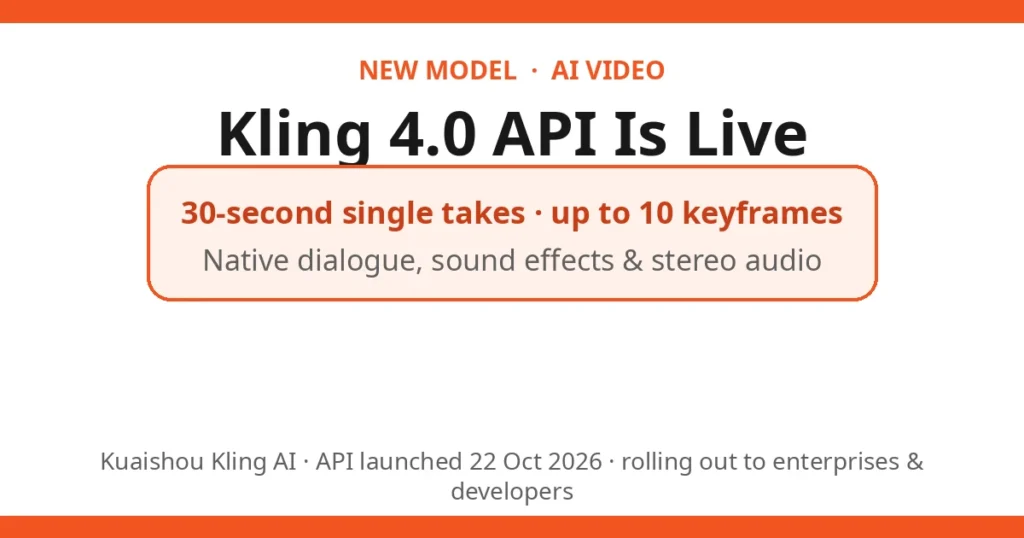
Kuaishou’s Kling AI has officially launched the Kling 4.0 API — and it’s a meaningful upgrade, not a version bump. Announced on 22 October 2026, the new model generates up to 30 seconds of continuous AI video in a single pass, gives directors up to 10 keyframes instead of two, and builds dialogue, sound effects and stereo audio into the generation itself. Platforms are already shipping it.
What happened
Kling 4.0, the newest AI video model from Kuaishou Technology’s Kling AI team, went live as a public API on 22 October 2026, and is gradually opening to enterprise customers and developers worldwide. The launch is backed by integrations that landed immediately: Perfect Corp announced that YouCam is one of the first platforms to integrate the model across its mobile and web lineup, and SelfyzAI confirmed it was in the model’s first-batch internal beta and has Kling 4.0 live in its workspace model picker alongside models like Seedance 2.5.
The capability list is where it gets interesting for anyone making video:
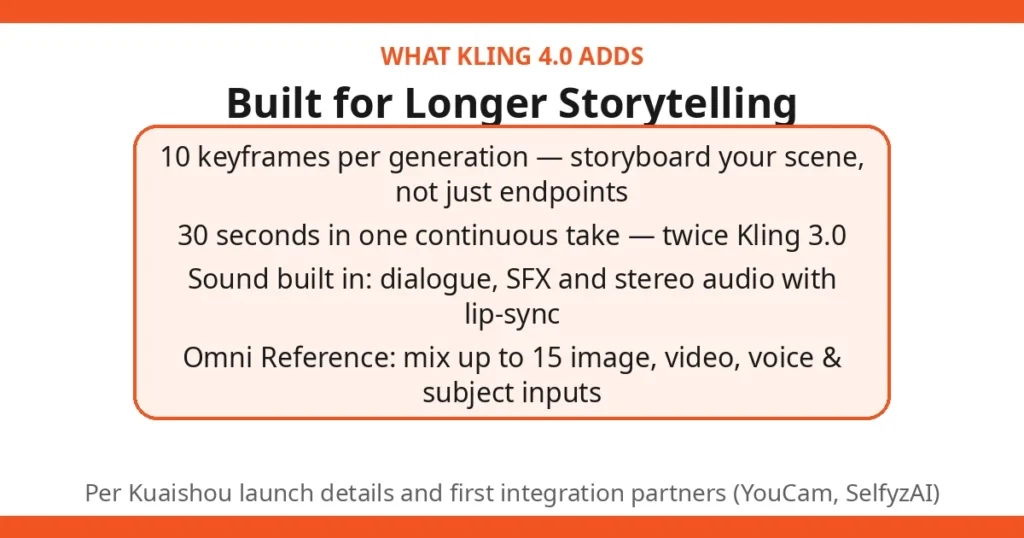
- 30-second single takes — one continuous generation, roughly double Kling 3.0’s length. Enough for a real product demo or a full social ad, not just a bumper.
- Up to 10 keyframes — set story beats like a storyboard (previous generations gave you a first and last frame). This is the control upgrade that makes brand work feasible.
- Native audio — dialogue, sound effects and two-channel stereo audio generated with the video, with tighter lip-sync. SelfyzAI’s beta notes describe “native single takes of up to 30 seconds… and native two-channel stereo audio.”
- Omni Reference — up to 15 combined reference inputs across images, video, voice and subjects, aimed at keeping characters and products consistent between shots.
- Multilingual speech — 9+ languages and several English accents with matching lip movement, per Perfect Corp’s integration details.
Kling isn’t a niche player here. Its parent company Kuaishou raised around $2.8 billion for Kling AI this summer at roughly a $15 billion valuation — part of the same AI video land grab that just saw Nvidia and TCV back Higgsfield.
What it means for UK small businesses
For marketing teams and freelancers, three practical takeaways:
- One-take product videos are now AI-feasible. 30 seconds covers most social ad formats. A small e-commerce brand can generate a product demo, a how-it-works clip and an ad variation without booking a videographer — then pick the best and polish in an editor.
- Keyframe control = brand control. The jump from 2 keyframes to 10 matters more than the length. You can now storyboard a short scene (wide shot → close-up → product detail → CTA frame) and keep visual continuity. Test character consistency across scenes before committing to a campaign look.
- Audio removes a post-production step. Built-in dialogue and stereo sound mean the generated clip lands closer to publishable. For multilingual markets, the speech support is worth testing against your actual audience accents — machine-generated lip-sync still benefits from a human ear.
If you’re weighing tools, Canva’s new image generation model covers stills; Kling 4.0 and the Higgsfield-style multi-model platforms are where video is heading. Try the free tiers of two platforms with the same prompt before spending.
Honest limits / what to watch
- API pricing and availability are still rolling out. “Gradually opening to enterprise customers and developers” means smaller users go through platforms like YouCam and SelfyzAI first — check credit pricing there before budgeting a campaign.
- AI claims need real-world testing. “Tighter lip-sync” and “character consistency” are launch-day claims from the vendor and its launch partners. Independent reviews haven’t caught up yet. Budget for regeneration time.
- Disclosure still applies. AI-generated spokespeople in ads need labelling under ASA guidance and platform policies. The more realistic the output gets, the more important this becomes — and the more scrutiny it will attract.
- Faces and rights. Keep consent and rights clearance tight for anything featuring recognisable people, and check each platform’s terms on commercial use before using generated video in paid ads.
FAQs
What is Kling 4.0?
Kling 4.0 is the newest AI video generation model from Kuaishou Technology’s Kling AI team. Its API officially launched on 22 October 2026 and is gradually opening to enterprise customers and developers worldwide. Headline features: up to 30-second single takes, up to 10 keyframes per generation, native stereo audio with lip-synced dialogue, and Omni Reference for mixing up to 15 reference inputs.
How is Kling 4.0 different from Kling 3.0?
Two big jumps: generation length and control. Kling 4.0 produces up to 30 seconds of continuous video in one pass — roughly double Kling 3.0 — and lets directors set up to 10 keyframes instead of only a first and last frame. Sound is now built in: dialogue, sound effects and stereo audio come with the video rather than being added afterwards.
Where can I try Kling 4.0?
The API is rolling out to enterprises and developers, but consumer access is already appearing through platforms: YouCam (Perfect Corp) has integrated Kling 4.0 across its mobile and web apps, and SelfyzAI was in the first beta batch and has it live in its workspace model picker.
Is Kling 4.0 good enough for business video?
For social clips, product teasers and ad creative, yes — with review. The 10-keyframe control and character consistency features make it far more usable for branded content than earlier models. For anything broadcast or client-facing at high stakes, treat it as a fast production tool, not a replacement for a videographer.
Does Kling 4.0 handle speech and lip-sync?
Yes — native two-channel stereo audio with tighter lip-sync is one of the launch’s headline features. It supports dialogue in 9 or more languages plus several English accents with matching lip movement, according to Perfect Corp’s integration details.