

Direct answer
Direct answer: Canva has launched Canva Craft, its first image generation model built in-house by its own research team. Instead of learning from photographs, Craft trained on Canva’s library of human-designed templates, so it produces images with legible text and clean layouts that can be converted into editable designs. It is available now to all users via the Dream Lab tab, the Canva API, and soon inside chatbots like ChatGPT and Gemini.
What happened
The design platform unveiled Canva Craft on 22 October, putting it head-to-head with image models from Google, OpenAI, ByteDance and Meta. This is a meaningful shift: until now, Canva has relied on third-party image models for generation inside its platform.
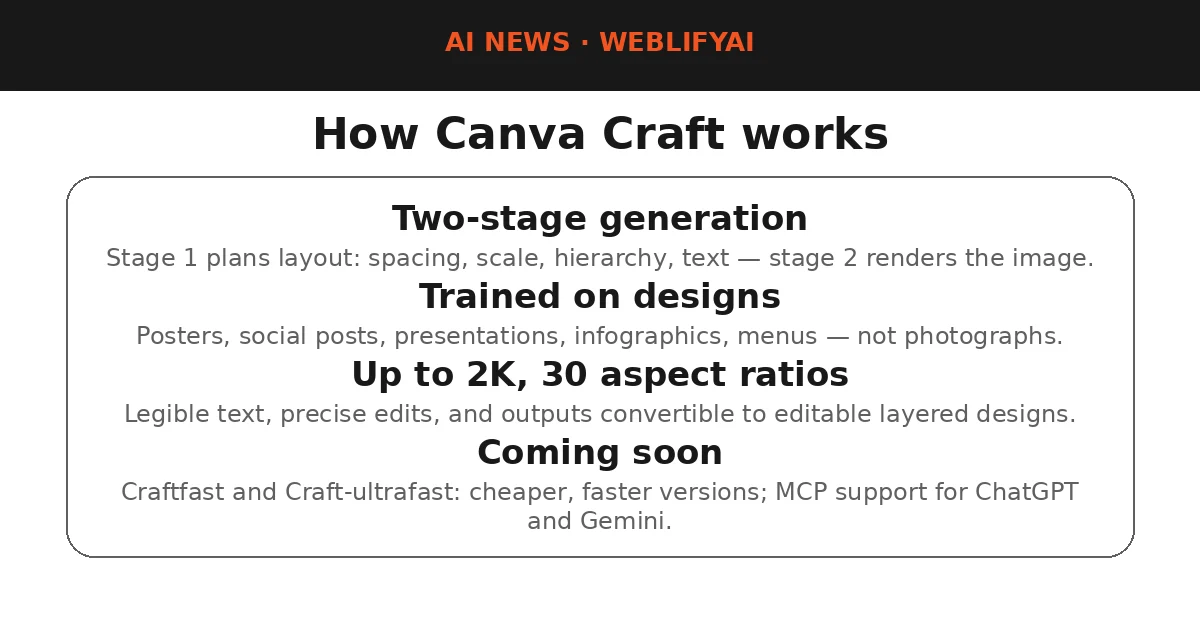
Craft works in two stages. First it interprets the user’s prompt and builds a plan — working out spatial relationships between elements, relative scale, visual hierarchy, and how text should be generated. Only then does it render the image, at up to 2K resolution across 30 different aspect ratios for different platforms.
Because it trained on designs — posters, social posts, presentations, infographics, menus and typography-heavy layouts — rather than photos, Canva says Craft produces images with accurate object detail and readable text, and supports precise edits without disturbing the rest of the image. Notably, generated images can be converted into layered, editable designs using Canva Magic, the company’s image-to-design transformer released last year.
The researchers behind the model come partly from Leonardo.ai, the media generation platform Canva acquired in 2024. Canva says running its own model gives it better control over quality and speed — and saves the API costs of calling external providers. Two leaner versions, Craftfast and Craft-ultrafast, are on the way.
What it means for UK small businesses
Most small firms already use Canva for marketing graphics. The practical difference:
- Readable text on AI-generated graphics. Garbled words have been the biggest giveaway of AI-made images — Craft is specifically built to fix that.
- Faster social and print output. Precise edits without regenerating the whole image means quicker turnaround on posters, menus and ads.
- Cheaper custom graphics. Better control of costs on Canva’s side may eventually mean more generous free-tier or Pro features.
- Design consistency. Images that convert into editable layers mean less hand-fixing in the editor afterwards.
If you publish AI-generated images on your site, remember Google cares about quality and usefulness, not how the image was made — but mislabelled AI photos in product listings remain a trust risk.
Honest limits / what to watch
- Canva has not shared independent benchmarks, so “legible text” is a company claim for now — test it yourself before trusting it on client work.
- Pricing details have not changed; there is no guarantee the cost savings reach users.
- As with all image generators, check copyright and likeness issues before using outputs commercially.
- Craftfast and Craft-ultrafast are announced but not yet released.
The move fits a wider pattern of design tools bringing models in-house, similar to Figma’s push into agentic design workflows covered in our look at Figma’s AI design agents. For small teams, the tooling keeps getting better — the differentiator remains your ideas, not the generator.
FAQs
What is Canva Craft?
Canva Craft is Canva’s first image generation model, built by its own research team (with input from the Leonardo.ai researchers Canva acquired in 2024). It competes with image models from Google, OpenAI, ByteDance and Meta, and is trained on human-designed templates rather than photographs.
How is Canva Craft different from other image generators?
Craft works in two stages: it first plans the layout (spatial relationships, scale, visual hierarchy, text placement), then generates the image. Because it was trained on posters, social posts, presentations, infographics, menus and typography-rich designs, it produces images with accurate object detail and legible text — and outputs can be converted into editable layered designs.
Where can I use Canva Craft?
It is available to all Canva users from the Dream Lab tab, through the Canva API, and Canva plans to support generation in third-party chatbots such as ChatGPT and Gemini via its MCP. Two faster, cheaper versions — Craftfast and Craft-ultrafast — are due soon.
Will Canva Craft be cheaper for users?
Canva has not announced pricing changes. It said building its own model gives it better quality and speed control and saves the API costs of using third-party models, which may feed through to users over time.
Does this affect UK small businesses?
Yes. Small businesses that rely on Canva for social posts, flyers, menus and presentations should get more accurate, on-brand graphics with readable text — and less need to fix garbled AI-generated words before publishing.