
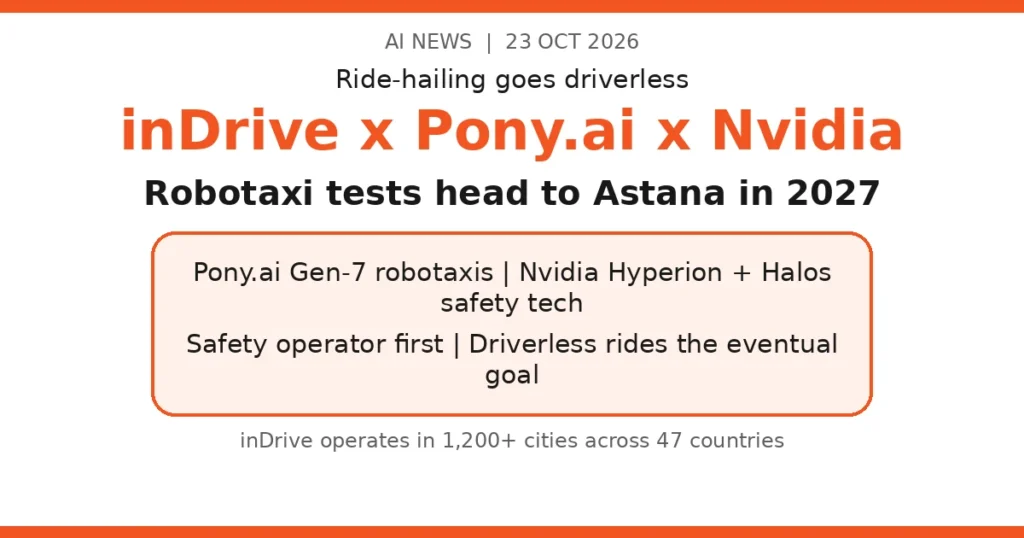
Direct answer: Ride-hailing firm inDrive has signed a memorandum of understanding with Chinese autonomous driving company Pony.ai and Nvidia to test robotaxis in Astana, Kazakhstan in 2027 — with safety operators at first and fully driverless rides as the eventual goal. It's the latest move in a race to take driverless ride-hailing beyond the US and China, and inDrive is pitching affordability as its edge.
What happened
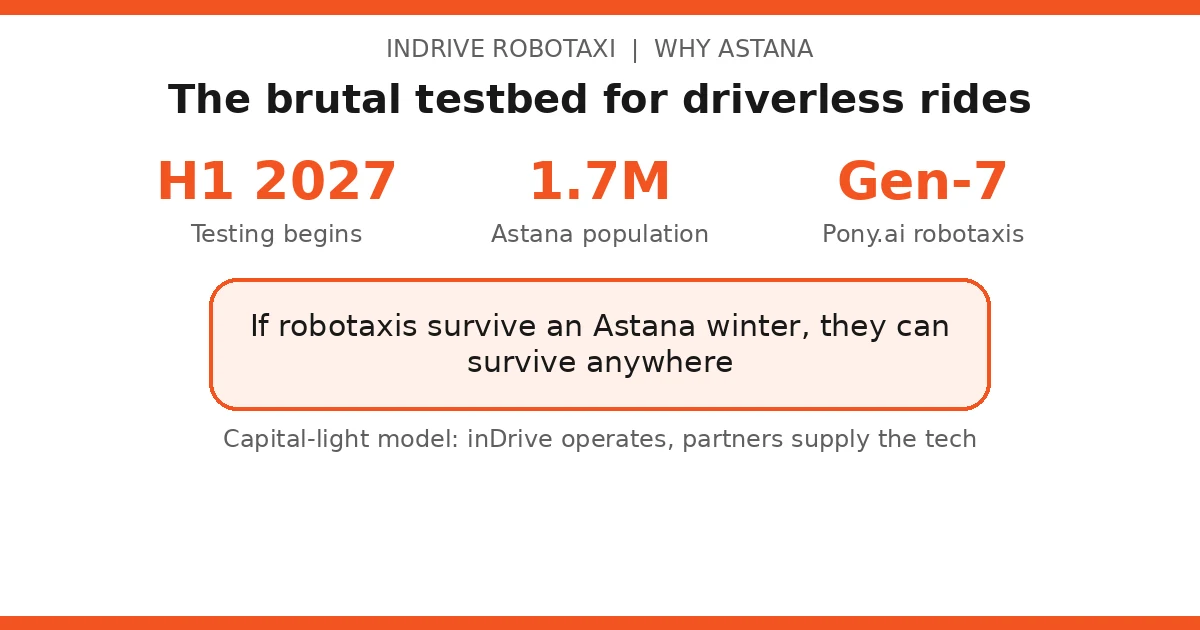
The three companies announced on Friday that they had signed an MoU to explore bringing Pony.ai's robotaxis onto inDrive's platform. Testing is set to begin in Kazakhstan's capital, Astana, in the first half of 2027, inDrive CTO Yuri Misnik told TechCrunch.
Under the proposed plan, Pony.ai supplies its Gen-7 robotaxis, which inDrive would operate through its ride-hailing app in Kazakhstan. Nvidia supplies the AI technology, including its Hyperion platform and Halos safety system.
The cost angle is central. Nvidia says its Hyperion platform could lower robotaxi development costs by giving companies a ready-made foundation of sensors and computing technology instead of building and integrating everything themselves — savings that matter most in emerging markets where rides are already cheap. "Our approach is capital-light by design," Misnik said, describing inDrive's model of partnering with technology providers in different markets.
The announcement coincides with Nvidia CEO Jensen Huang's first visit to Kazakhstan. And Astana itself is a deliberate choice: the city of around 1.7 million people endures months of snow and ice, making it a brutal testing ground for autonomous systems. Kazakhstan has also introduced rules allowing autonomous vehicles on certain public roads.
This isn't inDrive's first robotaxi experiment. In December it signed a separate agreement with Saudi Arabia's AI Driver to explore autonomous vehicles powered by China's WeRide, starting with Riyadh — though it remains unclear whether that testing has begun.
What it means for UK small businesses
Driverless taxis still sound futuristic in Manchester or Bristol, but this deal is part of a pattern worth watching. Uber — whose tech strategy has been in the news lately, including putting all 30,000 of its employees on ChatGPT Work — announced plans earlier this month to test Pony.ai robotaxis in London, alongside supervised autonomous rides with UK startup Wayve.
For small businesses, the real story is the cost trajectory. Autonomous ride-hailing that works in price-sensitive emerging markets will eventually be cheap enough to reshape transport costs everywhere — staff travel, last-mile delivery, and customer pickups all get re-priced when a vehicle doesn't need a driver. Businesses with transport-heavy operations (care providers, trades, hospitality) should track this the way they track fuel prices: as a future line item.
The winter-testing angle also matters. If autonomous systems can handle Astana's ice, the weather excuses for the UK market start to run out.
Honest limits / what to watch
This is a memorandum of understanding, not a contract — it commits the companies to explore, not to launch. The inDrive–WeRide pilot in Riyadh was supposed to start in the first half of 2026, and there's been no confirmation it did. Treat 2027 as a target, not a promise.
Regulation is the other variable. inDrive's CTO said a "favourable and collaborative regulatory environment" is one of the main requisites for a successful launch — and the UK's rules for fully driverless passenger services are still being worked out. The London Uber–Pony.ai tests will be a better signal for British businesses than Astana.
And the competitive picture is crowded: Pony.ai aims to have more than 3,500 robotaxis operating in over 20 cities worldwide by the end of 2026, up from 1,975 at the end of June. Many partnerships will be announced; only some will ship.
FAQs
When will inDrive start robotaxi testing?
Testing is planned for Astana, Kazakhstan in the first half of 2027. The first rides will have a safety operator on board, with fully driverless rides as the eventual goal.
Who is providing the technology?
Pony.ai will supply its Gen-7 robotaxis, Nvidia provides the AI technology including its Hyperion platform and Halos safety system, and inDrive will operate the service through its ride-hailing app.
Why Kazakhstan?
Astana's harsh winters — months of snow and ice — make it a demanding testbed for autonomous driving, and Kazakhstan has introduced rules allowing autonomous vehicles to be tested on certain public roads.
Is this inDrive's first robotaxi move?
No. In December inDrive signed a separate agreement with Saudi Arabia's AI Driver to explore autonomous vehicles powered by China's WeRide, starting with Riyadh, though it is unclear whether testing has begun.
How is this different from Uber's robotaxi plans?
inDrive is pitching a capital-light approach focused on affordable rides, partnering with technology providers rather than building its own vehicles. Uber announced plans earlier this month to test Pony.ai robotaxis in London.
Sources: TechCrunch