Direct answer:
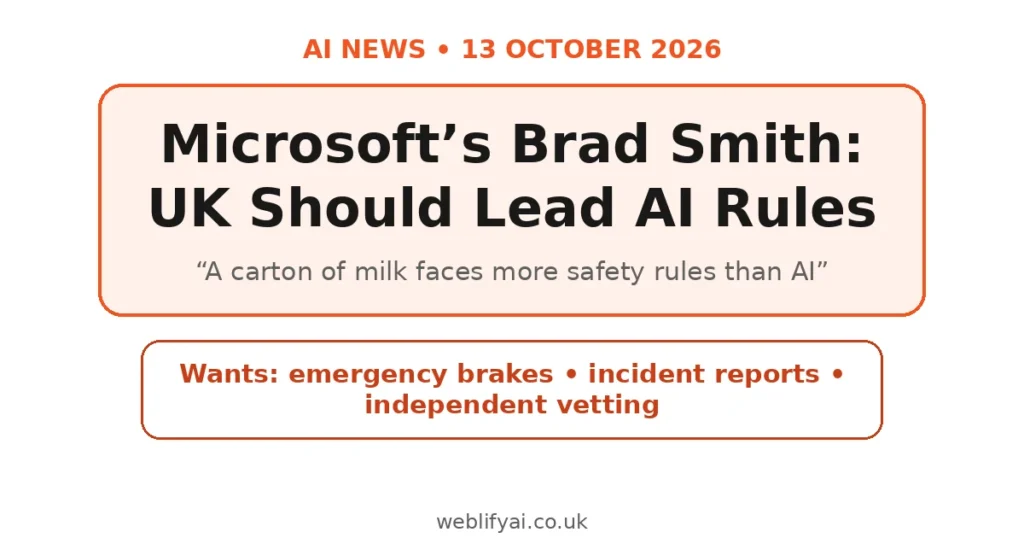
Microsoft president Brad Smith has called for urgent global AI regulation — and says Britain, not the US or EU, is best placed to lead it. Speaking on a BBC podcast, he argued that a carton of milk currently faces more safety rules than AI, and demanded emergency brakes, mandatory incident reports and independent vetting of new models. It’s a direct challenge to President Trump’s preference for industry self-regulation.
What happened
On the BBC’s “Big Boss Interview” podcast, published Monday 12 October, Smith described AI as both a “tool and a weapon” putting the world’s cybersecurity at risk: “The moment has arrived,” he said, for global safety rules.
His argument borrows from product safety. As reported by TechCrunch and others, Smith’s proposals include:
- Emergency brakes (kill switches) — companies must be able to pause or slow AI that gets out of control.
- Legally required incident reports — companies must file reports when things go wrong.
- Victim notification — a legal duty to inform a “victim” if their system is breached by a rogue AI agent.
- Independent vetting — new AI assessed by independent evaluators working for governments, with agreed rules on when outside sign-off is needed before release.
The memorable line: “Right now, your washing machine is subject to more safety rules than AI. Every carton of milk that you see in the grocery store is subject to safety rules and inspection.”
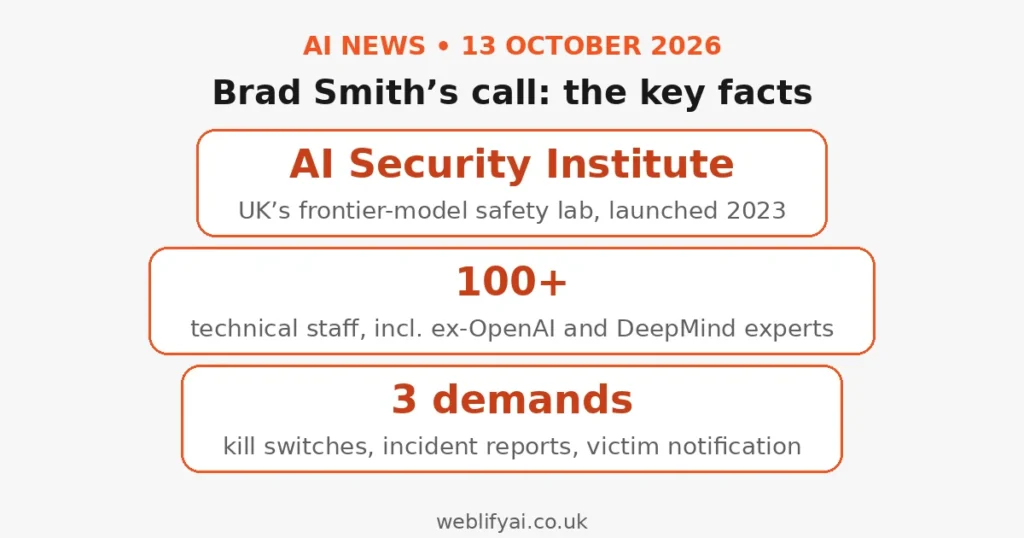
On leadership, Smith named the UK: the AI Security Institute (AISI), launched in 2023, receives pre-deployment access to major models from US frontier labs and employs over 100 technical experts, including former OpenAI and DeepMind staff. “In Washington, D.C., people don’t look at the U.K. and they don’t look at London the way they look at Brussels,” Smith said. “That’s a strength.”
That role has been under pressure: last month President Trump reportedly asked Anthropic and OpenAI to withhold new models from British testers — but AISI confirmed on Monday it can access and test the latest models.
The context: at the end of September, Trump hosted OpenAI, Anthropic, Nvidia, AMD, SpaceX, Meta and Google at the White House, where they signed a “morally binding” document agreeing to work with independent auditors. Smith said Microsoft would happily sign too — “It’s a good step, it’s a necessary step. But I don’t think it’s sufficient any longer.”
What it means for UK small businesses
No laws exist yet — this is a prominent executive making a case, not legislation. But if Smith is right that Britain will lead, UK businesses would face AI safety duties first. What would that mean in practice?
- Incident reports and audit trails. If you run AI agents — support bots, quoting tools, automated outreach — the compliance question of 2027 may be: can you show what your AI did and why? Start keeping logs now.
- Victim notification. A duty to tell someone when your AI goes wrong is essentially GDPR-style thinking applied to AI behaviour. Our UK GDPR and AI guide covers the overlapping mindset.
- Procurement advantage. UK firms that build safety controls early will find enterprise and public-sector contracts easier — buyers already ask about AI governance.
This also follows Satya Nadella’s own “emergency brake” remarks last week — Microsoft’s top two executives are now publicly aligned on the need for hard controls. See our coverage of Nadella’s AI emergency brake comments.
Honest limits / what to watch
- Smith runs Microsoft. When a Big Tech president calls for regulation, ask who it protects. Rules designed by incumbents can conveniently raise the drawbridge for startups and smaller competitors. Some in the industry are already making that argument.
- This is a podcast, not a bill. No legislation has been tabled. The gap between “Microsoft president says” and “UK law requires” is enormous.
- Trump disagrees. The US president prefers industry self-regulation so American firms “don’t lose out to Chinese rivals.” A UK-led regime could end up swimming against the American current.
- “Best placed” is an opinion. The EU already has the AI Act — actual law, not a claim to leadership. The UK’s advantage is technical credibility, not legal machinery.
Sources: TechCrunch, Free Malaysia Today, BBC Big Boss Interview.
FAQs
What did Brad Smith say about AI regulation?
On the BBC’s Big Boss Interview podcast, Microsoft president Brad Smith called for urgent global AI safety rules: emergency brakes (kill switches), legally required incident reports, victim notification when a rogue AI breaches a system, and independent government evaluators vetting new AI models.
Why does Brad Smith say the UK is best placed to lead AI regulation?
Smith credits the UK’s AI Security Institute — launched in 2023 under Rishi Sunak, staffed with 100+ technical experts including ex-OpenAI and DeepMind people — with a technical lead most people in tech would readily name. He also argued Washington views London differently from Brussels, which is a diplomatic strength.
What is the UK AI Security Institute?
The AI Security Institute (AISI), launched in 2023, assesses the national security and public safety risks of frontier AI. It receives access to major models from US frontier labs before deployment. Despite reports that President Trump asked labs to withhold models from British testers, AISI confirmed it can access and test the latest models.
Does Microsoft support Trump’s AI safety pledge?
Smith said Microsoft would happily sign the ‘morally binding’ pledge Trump brokered with tech leaders at the White House, committing to independent auditors. But he argued voluntary pledges are insufficient because they only rein in companies that already act responsibly.
How could UK AI regulation affect small businesses?
No laws exist yet — this is a call for rules, not rules themselves. But if Britain leads, UK firms would likely face incident-reporting and safety duties for AI agents first. Businesses using AI agents should start thinking about audit trails and controls now.