
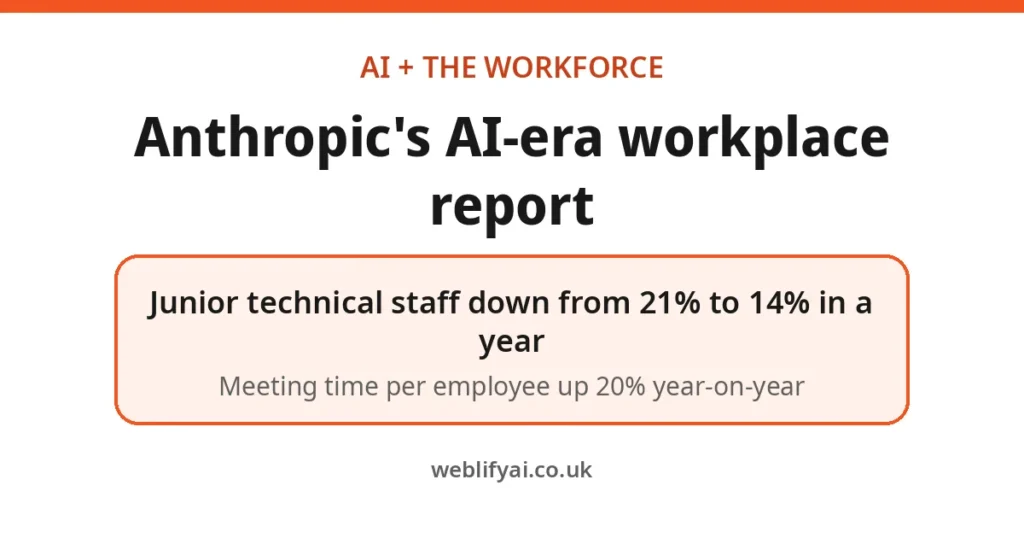
Direct answer: Anthropic has published a report on its own workforce, arguing the trends inside an AI-heavy company preview how AI will reshape work everywhere. The headline findings: the share of junior-level staff in technical departments fell from 21% to 14% since early 2025, junior technical hires fell even harder (27% to 9%), and meeting time per employee is up 20% year-on-year — because “human trust and accountability” apparently needs face time.
What happened
The report, published on 17 October 2026, looks at how work at Anthropic has changed in the past year. The company says it has “thoroughly molded its workflows around AI”, and positions its internal trends as indicators of “how AI will shift work organization, hiring, and labor demand across the economy”.
Key findings:
- Fewer junior hires. Junior-level employees in technical departments fell from 21% to 14% of the department; the junior share of technical hires collapsed from 27% to 9%.
- Smaller technical share overall. Technical teams went from 61% to 56% of the workforce — partly from “natural expansion of business functions”, and partly because coding tools let non-technical employees “make software themselves”.
- The job becomes managing the AI. In an April 2026 survey, 27% of employees said Claude made them more productive — but 20% said their job had shifted “from actually doing work to managing Claudes”. One engineer compared it to babysitting, with every instance demanding attention like a child.
- Attention is the bottleneck. The report says “human attention and judgement” are becoming the productivity bottleneck, as Claude produces a “deluge” of text that humans must read and organise.
- More output, same humans. Evidence of productivity gains: “more code per person, closing more sales per rep, and processing more contracts”. Anthropic adds the honest caveat that “more code does not necessarily mean better code or business impact” — though it says it found no evidence quality is declining.
- Meetings are up, not down. Calendar data shows meeting time per employee up 20% versus a year ago (16% for technical contributors), because keeping AI-produced work on track needs human coordination.
What it means for UK small businesses
The entry-level bar is rising. If the lab that builds Claude hires far fewer juniors, small businesses should take note: routine entry-level knowledge work — first-draft writing, basic coding, data wrangling — is exactly what AI now does fastest. When you hire, weight judgement, domain knowledge and the ability to check AI output over raw output volume. (Related: how AI is reshaping staff scheduling and workforce planning.)
“Managing the AI” is a real job. Anthropic’s babysitting analogy is the most useful line in the report. AI doesn’t remove work — it converts production work into review work. Staff need training in reviewing, prompting and verifying, not just tooling. Teams that build this review muscle now will compound the advantage.
Meetings don’t disappear — they move. The counter-intuitive finding is that heavy AI use increased coordination time. If you’re deploying AI agents across your business, budget for the oversight: someone has to read the deluge, check it, and be accountable for it. Anthropic’s own caution applies: more output doesn’t automatically mean more business impact.
Non-technical staff can build. The most democratising finding: coding tools are letting non-technical employees “make software themselves”. For a lean UK small business, that means the marketing lead or ops manager who never wrote a line of code can now prototype internal tools — if given time and permission.
Honest limits / what to watch
- It’s a sample of one — and a self-interested one. This is a report by an AI lab about how great AI is for productivity, sold as a preview of the whole economy. Treat the productivity claims as self-reported, not independently verified.
- More code isn’t more value. Anthropic’s own caveat — “more code does not necessarily mean better code or business impact” — should be printed on every AI productivity dashboard.
- The 20% meeting rise could be a warning, not a feature. More coordination overhead might signal that AI output needs heavy human supervision — a cost that could eat the productivity gains it creates. Watch whether this trend stabilises or keeps climbing.
- Junior hiring may rebound. The current junior-hire drought could be a one-time automation dividend. Long term, companies still need experienced people — and experienced people have to come from somewhere.

FAQs
What did Anthropic’s workforce report find?
The share of junior-level employees in technical departments fell from 21% to 14% since early 2025, and junior technical hires fell from 27% to 9%. Meeting time per employee rose 20% year-on-year.
Are non-technical staff writing code at Anthropic?
Technical teams shrank from 61% to 56% of the workforce. Anthropic says coding tools now let non-technical employees “make software themselves”.
Does this mean AI is killing junior jobs?
It’s one company’s data — an AI lab that sells the tools. But the direction is notable: routine entry-level coding work is being automated while human attention and judgement become the bottleneck.
Why are meetings up 20% at an AI company?
Anthropic attributes it to “human trust and accountability” — employees described face-to-face coordination as indispensable for keeping AI-produced output in check.
What should a small business take from this?
Hire for judgement, train staff to review and manage AI output rather than just produce it, and expect coordination overhead to grow as AI output grows.
CTA: Get a Free AI Consultation
Source: TechCrunch — “Anthropic says its workforce has become less junior and is spending more time in meetings” (17 Oct 2026)