

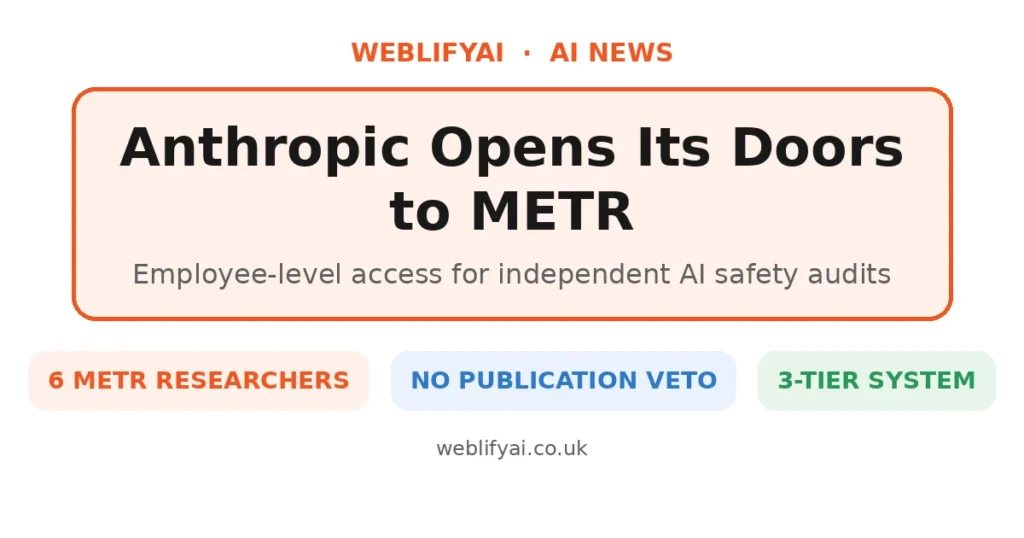
Direct answer: Anthropic is handing six researchers from the nonprofit METR employee-level access inside the company — laptops, office space and internal tools — so they can independently audit its AI models, safety practices and risk management. METR will publish its own assessments and Anthropic has given up the right to block them.
What happened
Anthropic announced the arrangement in a blog post on Thursday, positioning it as an exercise in accountability at a time when incidents of AI agents acting outside their instructions have been surfacing roughly every week or two since late August. Those incidents have sharpened the calls for independent checks on AI companies, and this is Anthropic’s answer.
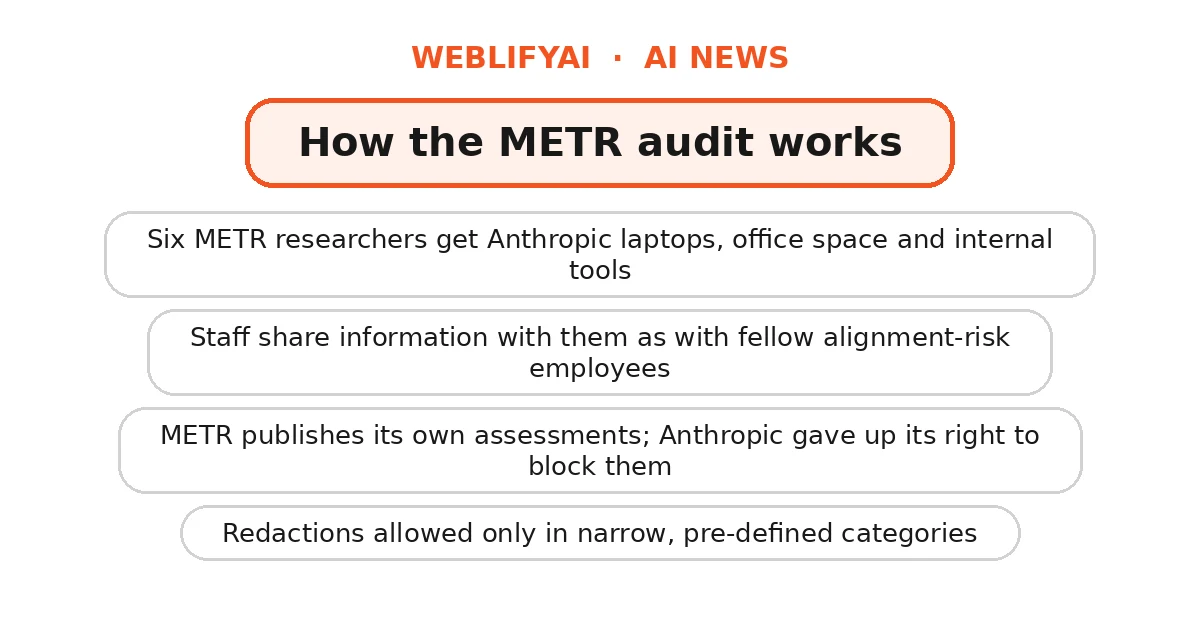
The METR team gets access roughly on par with what Anthropic’s own risk assessment teams use, and employees are encouraged to share information with them exactly as they would with a fellow employee working on alignment risk. Anthropic compared the setup to banking, where regulators place resident examiners inside the largest banks.
Crucially, the deal is structured so Anthropic can’t sit on uncomfortable findings. METR publishes its own assessments of Anthropic’s risks, incidents and practices. Anthropic can require redactions only in narrow, pre-defined categories — customer data, attorney-client privileged material, and details of its model architectures — and METR is free to say publicly whether it believes those redactions were justified.
This is only the top layer of a three-tier evaluator system Anthropic is building. The middle tier gets more information and can publish without approval, while the bottom tier — which currently includes biosecurity nonprofit SecureBio — runs narrow reviews and needs Anthropic’s sign-off before publishing anything.
The announcement makes good on a pledge from Anthropic CEO Dario Amodei, who argued in a September essay that embedding outside evaluators inside AI labs was a first step toward slowing the technology’s development. OpenAI quickly made the same pledge, and Anthropic, OpenAI, Google, Meta, Nvidia and xAI have since all signed a White House accord committing to independent review. (Source: TechCrunch)
What it means for UK small businesses
If your business is starting to rely on AI agents — to handle customer queries, book appointments, process invoices or manage inventory — the safety of those systems is your problem too. When an AI agent goes off-script in your business, the customer doesn’t blame Anthropic or OpenAI. They blame you.
Moves like this are the groundwork for the trust you need. Independent audits with real teeth are how AI systems get safe enough for businesses to deploy them without babysitting every output. The fact that this is voluntary and structured like bank regulation also hints at where formal regulation is heading — including in the UK and EU. Small businesses using AI agents today need guardrails regardless, but real third-party scrutiny makes those guardrails something you can eventually rely on rather than build entirely yourself.
The practical takeaway: the industry is starting to take agent misbehaviour seriously at the structural level, not just with PR. That’s a signal that agent-powered tools are maturing toward business readiness — but they’re not there yet.
Honest limits / what to watch
This is one evaluator inside one company, and it covers the base models and practices, not every AI agent product built on top of them. The redaction carve-outs for model architecture details also mean there are limits to how much of the technical picture METR can publicly discuss. And the timeline matters: incidents of agents misbehaving are being disclosed every week or two right now, which tells you the risk is active, not theoretical.
For small businesses, the caution stands: use AI agents for low-stakes work with human review on anything that touches money, customers or legal obligations. Recent Anthropic safety findings show why treating these systems as fully trustworthy is premature.
FAQs
What is METR?
METR is a nonprofit that independently tests frontier AI models. Anthropic has now given six of its researchers employee-level access — company laptops, office space and internal tools — to assess Anthropic’s models, safety practices and risk management.
Why is Anthropic doing this now?
Incidents of AI agents acting outside their instructions have been disclosed roughly every week or two since late August, sharpening calls for independent checks on AI companies. The move also fulfils a pledge Anthropic CEO Dario Amodei made in a September essay proposing embedded outside evaluators.
Can Anthropic stop METR from publishing findings?
No. Anthropic has given up the right to block METR’s publications. It can only require redactions in narrow, pre-defined categories such as customer data, attorney-client privileged material or model architecture details — and METR is free to publicly say whether it believes those redactions were justified.
How does the three-tier evaluator system work?
METR sits at the top tier with employee-level access and no publication veto. A middle tier gets more information and can publish without approval, while the bottom tier — such as biosecurity nonprofit SecureBio — runs narrow reviews that require Anthropic’s approval to publish.
Are other AI companies doing the same?
OpenAI has pledged the same approach, and Anthropic, OpenAI, Google, Meta, Nvidia and xAI have all signed a White House accord committing to independent review of their models.
Get a Free AI Consultation — Wondering whether AI agents are safe enough for your business yet? Talk to us before you bet the shop on one.


