
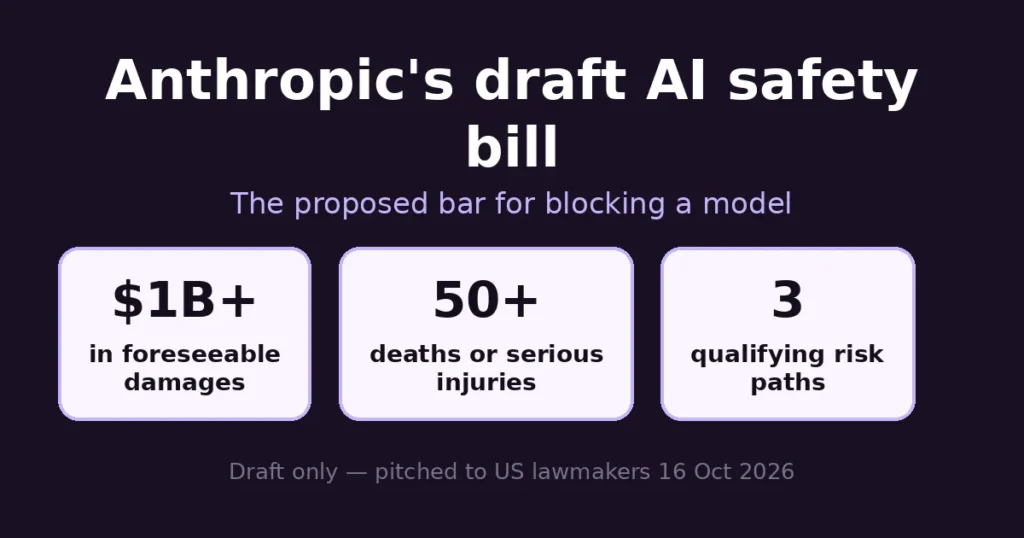
Direct answer: Anthropic has quietly pitched US lawmakers its own draft AI safety bill, Politico reported on 16 October. The draft would let Washington block a frontier AI model only if it poses a “foreseeable, imminent” risk of more than $1 billion in damages or of killing or seriously injuring more than 50 people — with only the Commerce Department able to petition a federal judge for the suspension. It is not law; it is a proposal, and critics say the bar is set impossibly high.
What happened
According to Politico’s reporting, citing three people familiar with the effort, Anthropic representatives have been circulating a draft bill on Capitol Hill to regulate frontier AI safety and security. Reuters confirmed the details of the draft, and an Anthropic spokesperson said the proposals reflect the company’s Advanced AI Framework, released earlier this year — calling them “sensible policies we believe Congress should act on.”
The mechanics are what make this story interesting:
– The trigger: the risk must come from one of three paths — the creation or release of a biological weapon, a cyberattack, or a model evading its developer’s safety controls. – The enforcer: only the Commerce Department could act. It could not shut down a model itself; it would have to ask a federal judge for the District of Columbia to order the suspension. – Everyone else is barred: the draft explicitly prohibits any other US government department, agency or officer from independently suspending development, deployment or internal use. – Independent evaluators would register with Commerce and periodically assess frontier models. Labs could pay these evaluators — provided the payment is not tied to the evaluation’s outcome — and imminent risks must be reported to Commerce within 72 hours. – State pre-emption: the bill would override some state-level rules on public risk disclosures, third-party audits and incident reporting, a point Democrats have already resisted (states including California, Illinois and New York have their own AI rules).
The criticism arrived fast. As the getaibook analysis noted, Mother Jones called the thresholds “alarming”: effectively, almost nothing that has actually gone wrong with deployed AI systems so far — fraud at scale, biosecurity near-misses, autonomous cyber operations, election-scale manipulation — would meet the 50-death or $1-billion test. The blocking power is designed to almost never be used.
What it means for UK small businesses
This is American politics, but it is not irrelevant to you. US rules set the weather for the whole AI industry: the models you buy into your business are built under whatever regime Washington settles on. A narrow, high-threshold regime like this one means AI companies face fewer brakes on shipping — innovation stays fast, but so do the risks you inherit.
The more practical takeaway: do not read a high bar for government intervention as a high bar for your own liability. Even under Anthropic’s draft, everything below $1 billion — a biased hiring tool, a chatbot that hallucinates your prices, a data leak, an AI agent that goes off the rails — sits outside the blocking authority but fully inside your responsibility. UK businesses already face data protection and consumer protection duties that no US bill changes. If you are deploying AI, our GDPR and AI guide covers the checks that actually apply to you.
Honest limits / what to watch
First, this is a draft from a company with a clear interest in the outcome — not neutral legislation. A lab writing the rules for when regulators can touch it deserves exactly the scrutiny it is getting.
Second, the “who watches the watchers” problem is real: evaluators registered with Commerce, paid by the labs they assess, with payment “not tied to outcomes.” That is a structure with obvious pressure points.
Third, watch the state pre-emption fight. California’s AI rules (including SB 53, signed last year) already track some of this language, and the clash between federal and state regimes is where the real regulatory uncertainty lives for the next year. (See the latest AI stats for UK small business for context on how fast adoption is outrunning rules.)

FAQs
What does Anthropic’s draft AI safety bill propose?
Per Politico’s reporting, the government could block a frontier AI model’s release or use only if it poses a foreseeable, imminent risk of more than $1 billion in damages or of killing or seriously injuring more than 50 people, with the risk stemming from bioweapons, cyberattacks or a model evading its developer’s controls.
Who would enforce the bill?
Only the US Commerce Department could petition for a model to be suspended, and only a federal judge for the District of Columbia could order it. The draft explicitly bars every other federal agency, department or officer from halting a model’s development, deployment or internal use.
Is this an official law?
No. It is a draft pitched quietly by Anthropic representatives to Capitol Hill lawmakers, reported by Politico on 16 October 2026. It has no legislative status and faces an uncertain path through Congress.
Why are critics calling the thresholds alarming?
Because almost nothing that has actually gone wrong with deployed AI systems — large-scale fraud, election manipulation, biosecurity near-misses — would reach 50 deaths or $1 billion in a single foreseeable event, so the blocking power would rarely apply.
Does this affect the UK?
Not directly — it is a US proposal. But US AI rules shape global industry practice, and UK businesses deploying AI remain fully responsible for everyday harms like bias, errors and data misuse regardless of any US threshold.
What else does the draft require?
Frontier AI developers would need safety frameworks, published transparency reports, whistleblower protections and critical-incident reporting to Commerce. Independent evaluators registered with Commerce would assess models and report imminent risks within 72 hours.
Sources: Reuters, Business Today, Tom’s Hardware, getaibook